

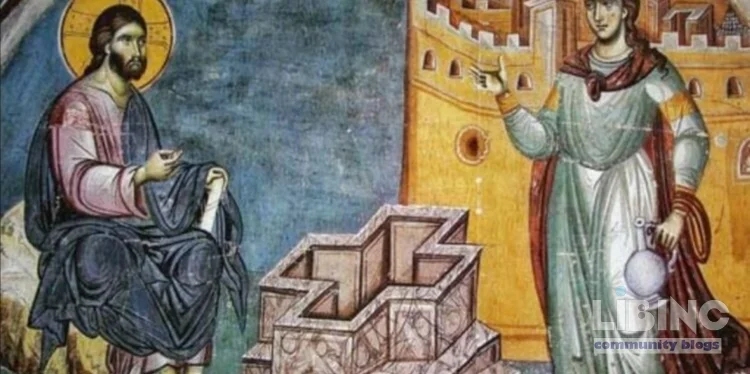
The Samaritan Woman at the Well and the Living Water: A Critical Reading of John 4
Midday heat presses the scene into a moment of exposure, where thirst becomes a theatre for moral glare and hidden longing. The well stands as a threshold, not merely a source of water but a symbol of social economy: a place where gendered suffering seeks relief and a voice, even as the surrounding world polices who may draw near. In the account of the Samaritan woman at the well, Maximos Pafilis refracts a centuries-old exchange through the lens of a modern pastoral gaze, insisting that grace breaks through the rigidities of purity codes and communal judgment. The encounter is not a simple cure of personal guilt but a reorientation of space, power, and knowledge. The living water offered by the Knower of hearts unsettles both the petitioner and the onlookers, revealing that the deepest thirst roams where righteousness fears to tread.
Why is this analysis relevant today? Because the scene crystallizes a perennial conflict: can a community maintain its defined boundaries while a stranger’s presence enacts a transformation that redefines those boundaries as insufficient for truth? The stakes extend beyond a single conversation. If the Samaritan woman at the well becomes a conduit for living water, cities awaken to a reimagined ecology of faith, where open hearts matter more than certificates of virtue. The hidden conflict surfaces in the very act of speaking to one another across lines of gender, ethnicity, and religious affiliation. The article proceeds through four analytic lenses to reveal how the text does more than recount a miracle; it diagnoses a spiritual ecology where failure to see the marginal as bearer of truth becomes a barrier to salvation.
In the pages that follow, we maintain a critical posture. We do not accept the surface narrative as merely a biographical moment but treat it as a methodological invitation: to re-situate canonical action within a structure of relational responsibility. The analysis foregrounds the Samaritan woman at the well as a figure who questions authority, demands theological adequacy, and thus compels a broader ecclesial imagination. The discussion draws on the commentator tradition—Nikephoros Theotokis and John Chrysostom among others—to illuminate how early ministry recast purity as lived truth rather than external polish. The purpose is analytical clarity and a forward-looking hermeneutic that translates ancient insights into contemporary ethical and liturgical sensibilities. [1] [2]
Through Analytics: Reading the encounter as a critique of purity codes and a theology of presence
The analytical frame treats the scene as a compact architecture of meaning where setting, dialogue, and turn of phrase co-create a new anthropological horizon. The midday heat is not merely a backdrop; it performs a rhetorical function by foregrounding vulnerability. The well—historically Jacob’s—appears as a locus where literal needs intersect with spiritual questions. The question that begins as a practical request for water mutates into a probing inquiry about worship, revelation, and the nature of “true” desire. Pafilis’s meditation privileges the dynamics of voice: the Samaritan woman speaks with paradoxical courage; the Knower of hearts responds with invitational precision that unsettles every presumption about sacred space.
- Water as epistemology: The turn from “give me water” to “I will give you living water” reframes thirst as a method of knowing. The dialogue shifts from supply to source, from consumption to revelation, making thirst a hermeneutical instrument rather than a failing to be concealed.
- Mobility of truth over cardinality of place: The author’s emphasis on crossing social borders—ethnic, gendered, and religious—reorients the place of worship from a fixed site to a dynamic, encounter-centered practice. This is not merely inclusive; it is truth-constituting.
- From purity to hospitality: The sea-change rests on moving away from external markers of purity toward a hospitality that accepts woundedness as a locus of divine presence. The “iron rule of the age” yields to a living invitation that requires vulnerability as a precondition for knowledge.
- Witness as praxis, not credential: The woman’s evangelistic response demonstrates that authentic knowledge of God emerges from transformative experience rather than from social qualifications. The infection point is conversion, not confession alone.
The analysis foregrounds a consequential chain: the encounter destabilizes accepted certainties; the freed woman becomes a messenger; cities hear a voice they once suppressed. The theological pivot lies in the radical claim that God seeks open hearts more than marble thresholds. The living water becomes a critique of ritual calculus and a push toward personal and communal repentance. The old borders dissolve because the source of life proves more expansive than the self-assured conscience that guards its own purity. The text thus functionally operates as a case study in hermeneutical humility: when the encounter shows itself to be more than a cure, readers are compelled to reconsider what counts as spiritual authority. [1] [2]
Through Contrast: The Samaritan woman at the well against the white-masked moralists
The narrative uses stark contrasts to reveal how purity codes function as social control and how grace operates as liberating recognition. The Samaritan woman stands in the foreground as a living contradiction to the “pure” who guard their reputation while their interior remains unexamined. The contrast is not merely rhetorical; it exposes how social morality weaponizes judgment to enforce conformity. By turning the gaze from her body to her testimony, the text redirects the viewer toward a truth that requires communal listening rather than policing. The confrontation with Jesus disrupts the simplistic dichotomy between righteous and defiled, revealing the depth of human desire and the inadequacy of ritual purity to satisfy it.
- Public condemnation versus private transformation: The crowd’s initial condemnation is replaced by a public following, revealing that true discernment often emerges from the margins when encountered by the divine presence.
- Religious exclusivity versus global invitation: The scrap of geography—Samaria, Jacob’s well, and the mountain—gives way to a universal claim: worship “in spirit and in truth” transcends location and lineage.
- Law as preserver of status versus gospel as force for liberation: The legalistic impulse to police purity crumbles under the weight of a liberating horizon that invites honest self-scrutiny and communal change.
- Voice as authority: The woman’s voice, once suspected and silenced, becomes the catalyst for collective discernment and mission. Her testimony redefines authority from credential to witness.
The contrast reveals a deeper operative mechanism: the sacred breaks through not by erasing the human past but by reframing it as a site of grace. The lens shifts from the fear of defilement to the recognition of woundedness as a legitimate space for encounter. In this light, the Samaritans’ response—an openness to a new revelation—becomes a social test for the community’s spiritual integrity. The passage thus operates as a critique of a moral economy that prioritizes surface cleanliness over interior truth, a critique that remains alarming and instructive for modern readers who face similar tensions between tradition and reform. [2]
Through Cause and Effect: How personal revelation propagates communal transformation
Cause and effect in this narrative do not track a linear line of salvation but an emergent rippling of conscience that unsettles entire civic structures. The transformation begins with a personal encounter: a woman’s thirst becomes a conduit for the world’s possible salvation. The cause—an initial request for water—leads to an effect: the revelation that the true wellspring is Jesus himself. This shift repositions the town from spectators to participants in a shared discovery. The effect is not limited to the woman; it extends to the social fabric, dissolving barriers that had previously defined and confined the community.
- From personal need to communal mission: The exchange begins with “give me water” and ends with a shared water that waters others. Personal longing catalyzes public proclamation.
- From stigma to invitation: The woman’s past becomes a wounded credential that invites trust, not a chain that shames. The city moves from moral suspicion to experiential curiosity.
- From local to ecumenical horizons: The text dissolves geographical, ethnic, and liturgical boundaries, arguing for a worship that transcends specific sanctuaries and traditions.
- From silence to evangelistic action: She leaves the water-jar and becomes a sign of mission; the act of speaking becomes the act of governance for a new communal秩.
The implication is clear: transformation is a social event as much as a spiritual incidence. When the living water takes root in an individual, it compels a reimagining of communal life—from how people measure holiness to how they measure hospitality. The narrative thus models a causal architecture in which grace functions as agent and instrument of a broader reorganization of social perception. The result is not merely conversion in an individual but a reorientation of public space around a more expansive and inclusive vision of worship. The ancient critique of Pharisaic rigidity serves as a warning against turning doctrinal purity into a social weapon; the living water invites a different economy of belonging. [2]
Through Expert Reconstruction: Re-reading the scene with modern exegetical frameworks
Expert reconstruction treats the Samaritan woman at the well as a node where multiple scholarly currents converge: patristic exegesis, liturgical memory, and contemporary biblical anthropology. The synthesis argues that the text prescribes not only a theological correction but a methodological stance for readers who seek to understand how faith releases power into public life. Pafilis’s meditation, echoing Nikephoros Theotokis and John Chrysostom, frames the encounter as a model for a robust ecclesiology that values mercy and honesty over ceremonial purity. Such a stance aligns with ecumenical aims: a church that acknowledges its wounds, invites conversation with those who sit on the margins, and interprets events as opportunities for communal repentance and evangelistic clarity. The expert reconstruction therefore translates a scriptural moment into a blueprint for living tradition—one that preserves the integrity of faith while expanding its reach.
- Exegetical humility: The text invites readers to recognize the limits of their own categories and to allow paradox to reveal deeper truths about God and neighbor.
- Ethical hermeneutics: The encounter reframes ethics from a grid of purity to a posture of listening, vulnerability, and risk-taking for the sake of the other.
- Ecclesial implications: The church becomes a locus of encounter where marginalized voices carry authority to reveal God, not as a rare exception but as a normative pathway to truth.
- Historical- theological synthesis: The references to Chrysostom and Theotokis anchor the modern reading in a historically grounded tradition that valued pastoral imagination over punitive exclusion.
The reconstruction thus pushes beyond a single-page meditation. It treats the Samaritan woman at the well as a template for how communities interpret revelation: by listening across divides, resisting the impulse to seal purity within the walls of the temple, and allowing the gospel to reframe human experience as the primary measure of truth. This requires a disciplined humility toward wounds—both collective and personal—and a willingness to translate experience into shared action. The result is a form of exegesis that serves life: a church that can endure scrutiny, admit error, and extend the living water to all who thirst. The sources cited—Theotokis and Chrysostom—provide historical ballast for a contemporary hermeneutic that remains urgent and transformative. [1] [2]
In sum, the Samaritan woman at the well becomes more than a subject of a miraculous story; she exemplifies a method of reading the sacred that privileges presence, testimony, and communal discernment over the preservation of boundaries. The living water she encounters and proclaims marks a turning point where spiritual truth no longer hides behind the cloak of purity but shines through the recognition of need, the courage to speak, and the willingness to cross lines for the sake of life. The implications reach beyond the text into the fabric of faith communities today, offering a disciplined pathway from private yearning to public witness. This is the enduring insight of the scene: that the deepest thirst, once satisfied by the stranger who knows the heart, yields a force capable of remaking public life. [1] [2]
Notes
[1] Nikephoros Theotokis, Kyriakodromion [Sunday Sermonary], vol. 1 (Athens: Andreas Koromilas Printing House, 1840), 64.
[2] John Chrysostom, Ta Heuriskomena Panta [The Complete Findings], in Patrologiae Cursus Completus: Series Graeca, ed. Jacques-Paul Migne, vol. 59 (Paris: J.-P. Migne, 1862), 196.
Bibliography: Chrysostom, John. Ta Heuriskomena Panta [The Complete Findings]. In Patrologiae Cursus Completus: Series Graeca. Edited by Jacques-Paul Migne. Vol. 59. Paris: J.-P. Migne, 1862. Theotokis, Nikephoros. Kyriakodromion [Sunday Sermonary]. Vol. 1. Athens: Andreas Koromilas Printing House, 1840.
Practical Pathways for Contemporary Faith Communities
Though the analytic lenses illuminate why purity codes fail, readers benefit from concrete steps to translate the living-water paradigm into daily ministry. Here are practical pathways that can be piloted in local congregations, schools of ministry, and community groups.
| Aspect | Purity Code | Hospitality Approach |
|---|---|---|
| Purpose | Maintain boundaries | Expand belonging |
| Social Effect | Exclusion | Hospitality as mission |
| Source of Authority | Credential and ritual purity | Witness and experience |
| Outcome | Stasis | Transformation and invitation |
Practical action steps
- Hospitality audits: scan who is welcomed, where doors close, and what barriers remain.
- Listening sessions: invite voices from margin to share experiences, with listening guidelines.
- Liturgical reform: embed mercy-focused prayers and sermons that honor vulnerability.
- Leadership pathways: create bridges for testimony to become a legitimate authority.
- Community partnerships: team with local groups to serve shared needs beyond church walls.
Consider a local parish hosting a “Living Water Forum” where a neighbor shares a hardship story; the outcome is a written plan for inclusive practice. In youth contexts, use the water-jar symbol to discuss consent, respect, and inclusion in group dynamics.
Anonymous Reflection
The aim is to anchor the reading in concrete acts, letting the living water flow through real relationships and everyday decisions. The steps above are not quotas but invitations to reimagine belonging as a practice rather than an ideal.
Expanded mercy practice moves boundaries outward
- Audit belonging
- Map welcome spaces
- Identify gaps
- Invite testimony
- Host guest speakers from marginalized groups
- Share personal stories
- Reframe leadership
- Develop pastoral teams that prioritize listening
- Establish accountability
- Regular review of policies and outcomes
The aim is to anchor the reading in concrete acts, letting the living water flow through real relationships and everyday decisions. The steps above are not quotas but invitations to reimagine belonging as a practice rather than an ideal.
How does the Samaritan woman's encounter redefine worship spaces?
The encounter reframes worship spaces as relational domains opened to outsiders rather than sealed sanctuaries guarded by purity codes. It shows that true worship happens when hospitality becomes the defining practice of the community and when the Spirit's presence is recognized beyond the church walls, moving worship from a fixed location to a lived practice of presence that invites strangers to share the living water. This reorientation challenges leaders to measure success by the growth of inclusive belonging rather than the maintenance of inherited boundaries and to craft rituals that center testimony, listening, and shared mission. Practically, this means inviting voices from marginalized groups to preach or testify, revising welcome rituals, and partnering with communities beyond church walls to serve real needs.
What is the role of hospitality in the living water metaphor?
Hospitality is the channel through which living water is shared; it turns personal thirst into communal invitation and replaces judgment with listening. It requires concrete acts such as greeting newcomers, inviting diverse stories, and ensuring resources and leadership are accessible. Churches can implement listening circles, adjust seating arrangements to reduce barriers, and fund initiatives led by people from outside the traditional core. When hospitality leads the conversation, the gospel becomes tangible mercy and belonging grows.
How can modern churches implement worship in spirit and truth across boundaries?
Worship in spirit and truth is enacted by dismantling performance driven expectations and cultivating practices of honest testimony, mutual accountability, and cross cultural dialogue. Start with listening sessions that gather both long time members and newcomers, then co create prayers and songs that reflect shared experiences. Build partnerships with neighbors from different backgrounds, and create accountability mechanisms that ensure leadership remains answerable to the gathered community. The goal is not to erase difference but to let grace shape common worship that honors the Spirit in all voices.
What does the text suggest about leadership and authority?
The text elevates witness over credential, showing that authentic authority arises from transformed encounter and credible testimony rather than inherited status. When someone testifies to transformation, their voice can unlock new questions and invite reform. Leaders should welcome challenging input and be willing to adjust practices in light of new testimony. This approach builds a more resilient church that learns from wounds, protects the vulnerable, and models humility in governance.
How does this reading address marginalized voices?
It centers marginalized voices as vessels of revelation, insisting that divine truth often speaks most clearly through those long silenced or judged. By creating spaces for their stories to be heard and by including their perspectives in decision making, communities cultivate a more accurate and expansive sense of belonging. This practice challenges bias and expands the horizon of what counts as spiritual authority.
What practical steps can communities take today to apply this reading?
Practical steps include hospitality audits, listening circles, liturgical reform, leadership changes, and community partnerships. Start by surveying who is welcomed and who is not, host listening sessions with clear guidelines, revise sermons to emphasize mercy rather than ritual purity, create pathways for new voices to join leadership, and build projects with local organizations to serve shared human needs. Document outcomes and adjust annually to keep the living water flowing in every season.







Add a comment
To comment, you need to register and authorize
Comments