

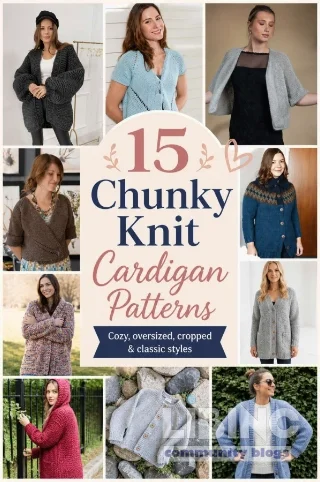
Chunky Cardigan Patterns: An Analytical Guide to Selection, Construction, and Fit
Table of contents
- Analytics: understanding the chunky cardigan landscape
- Contrast: beginner vs. expert patterns, free vs. paid, seamed vs. seamless
- Cause and effect: how gauge, yarn, and ease shape the finished garment
- Expert reconstruction: a practical framework for pattern selection and adaptation
The chunky cardigan offers a tactile knitting experience with fast visual feedback. The large stitches reveal progress quickly, the fabric gains a confident heft, and the wearer gains a versatile layer that works across casual and dressy settings. Yet the appeal is not simply about speed. Yarn weight, gauge, and construction interact with body measurements, climate, and wardrobe goals in ways that determine whether a cardigan becomes a beloved staple or a fleeting novelty. This article treats chunky cardigans as a system: yarn, needles, gauge, ease, and finishing all push and pull on each other. By examining patterns, construction methods, and sizing logic, we develop a framework you can apply to any chunky cardigan choice. This analysis proceeds in four blocks. First, we map the landscape of chunky cardigan patterns and their design logic. Second, we compare patterns by structure, ease, and technique. Third, we trace cause-and-effect relationships among core variables like gauge and fabric weight. Fourth, we offer an expert reconstruction: a decision and substitution guide you can use to tailor a pattern to your body and your style.
Analytics: understanding the chunky cardigan landscape
From a modeling perspective, the chunky cardigan ecosystem clusters around a handful of structural archetypes: oversized wearables, cropped layers, hooded jackets, and wrap-like or wrap-front cardigans. Across this landscape, yarn selection, gauge, and shaping decisions drive both the final silhouette and the wearer’s comfort. The same pattern can read very differently when worked in a dense merino blend versus a loftier alpaca blend. The core variable, however, remains gauge: it governs fabric density, drape, and warmth, and it is the most reliable predictor of finished measurements when you substitute yarns with similar gauge characteristics.
Consider five representative patterns that frequently appear in roundups. These patterns illustrate the spectrum from free to paid, beginner to advanced, and straightforward to surprisingly inventive. Each entry shows how the same design language adapts to different yarns and techniques, reinforcing the principle that gauge and ease, not just name recognition, decide success.
- Moonbow Slouchy Chunky Knit Cardigan — free pattern with a relaxed, oversized shape, generous sleeves, and pockets. Minimal shaping invites beginners to move from scarves and blankets to a wearable garment, while still offering a satisfying project for first-time sweaters.
- Daybreak Chunky Cardigan — free pattern available in a broad size range (XS through 5XL). Thick, softly textured yarn creates warmth with a fluffy surface, and the silhouette remains forgiving for a wide range of body shapes.
- Novice Cardigan: Chunky Edition — PetiteKnit’s top-down approach, designed for easy on-the-fly fitting and a relaxed fit with about 6 inches of positive ease. Uses bulky yarn plus a strand of lace-weight to achieve a soft, cloud-like finish.
- Easy Peasy Chunky Cardigan — Katrine Hannibal’s beginner-friendly piece, worked on large needles with two yarns held together for texture without excessive weight. The simple silhouette pairs well with modern wardrobes.
- Reading Room Cardigan — Lion Brand’s easy pattern, designed for super-bulky yarn and a garter-plus-stockinette blend. Its long, blanket-like silhouette makes it a practical layering option for lounging or casual wear.
These examples emphasize a key takeaway: pattern choice should be measured against gauge expectations and how the garment is intended to be worn. If you know you want a long, enveloping layer, you prioritize yarns that bloom and drape. If you seek a structured, jacket-like piece, you lean toward tighter gauges and more controlled shaping. The main keyword, chunky cardigan, anchors this analysis by focusing attention on fabric weight, construction simplicity, and wearability across occasions.
Contrast: beginner vs. expert patterns, free vs. paid, seamed vs. seamless
The spectrum of chunky cardigan patterns reflects different learning curves and construction philosophies. A practical evaluation considers four axes: complexity, construction method, ease of finishing, and adaptability to yarn substitutions. The flow from beginner to expert is not merely about stitch vocabulary; it is about how patterns scaffold skills, reveal techniques progressively, and enable customization without sacrificing fit.
Beginner-friendly patterns typically emphasize straightforward construction and forgiving shapes. They profit from top-down methods that allow you to try on the garment as you go, and from minimal shaping that reduces the cognitive load during knitting. Conversely, expert-level designs exploit unusual constructions, dramatic collars, or wrap-front closures to create standout pieces that require careful reading of charts and more advanced finishing. The following contrasts illustrate practical implications for choosing a chunky cardigan pattern.
- Top-down vs. bottom-up: Top-down patterns offer real-time fit assessment and quicker gratification. Bottom-up schemes can optimize yarn usage and tailor specific sections with precision, but they demand more planning and final shaping decisions.
- Seamed vs. seamless: Seamed constructions provide structure and easier seam finishing, whereas seamless designs minimize finishing work and yield a smoother drape—ideal for beginners when paired with forgiving yarns.
- Garter-stitch and stockinette blends: Garter offers extra texture and resilience, while stockinette creates a sleeker line. A mixed approach can deliver both warmth and a modern silhouette.
- Pattern availability: Free patterns often prioritize accessibility and straightforward silhouettes, while paid patterns may offer detailed tutorials, video guidance, and extended size ranges that matter to serious knitters.
When evaluating patterns, compare not just the final shape but the learning curve and the tools provided. A well-structured paid pattern can reduce time spent decoding abbreviations, while a free option can offer a quick, low-commitment test run. The aim is to align the pattern’s level with your current skills and with your broader knitting project trajectory, ensuring you advance without frustration.
Cause and effect: how gauge, yarn, and ease shape the finished garment
The interaction between gauge, yarn weight, and finished measurements is the core mechanism that translates pattern instructions into wearable fabric. Gauge swatch accuracy under real washing conditions predicts the finished bust, sleeve length, and overall silhouette with higher reliability than mere yarn naming. A small error—one stitch per 10 cm—can cascade into a substantially altered garment width, which is especially consequential for chunky knits where fabric is dense and changes in gauge are visually and physically noticeable.
The weight and fiber content of the yarn drive warmth, drape, and structural stability. Super-bulky blends deliver rapid progress but can create weight that pulls the garment downward, while wool-rich blends may bloom after washing, increasing size and altering hand-feel. The choice between a more compact weave and a loftier, airier fabric changes how the cardigan sits on the body, how it blocks, and how it layers over other garments.
- Positive ease: For an oversized look, patterns may specify 10–30 cm more bust measurement than the actual bust. The decision to add ease should consider the garment’s intended climate and layering needs.
- Finished weight: A dense super-bulky cardigan can become heavy when worn all day. Lighter blown yarns or wool blends can deliver thickness without excessive mass, balancing warmth with comfort.
- Bloom and relaxation: Yarns that bloom after washing impact final dimensions. Plan for this when substituting yarns or selecting a pattern with a precise silhouette.
- Blocking behavior: The fabric’s behavior during blocking affects drape and fit. A garter-stitch panel may tighten less than a stockinette block, influencing how the garment sits on the torso.
Size selection hinges on the relationship between ease and body measurements. A cardigan designed to be worn as a relaxed layer often benefits from more positive ease than a structured or cropped option. This is not merely a preference; it is a material constraint rooted in how bulky fabric stacks and drapes over the shoulders and torso. The right balance of ease and fabric weight yields a cardigan that feels substantial yet comfortable, a hallmark of well-chosen chunky cardigan patterns.
Expert reconstruction: a practical framework for pattern selection and adaptation
The final stage transforms data into a repeatable workflow. The expert approach combines measurement accuracy, pattern analysis, and controlled substitutions to create a cardigan that fits your body and matches your style goals. The framework below is designed to be portable across projects and adaptable to many pattern sources—from free community patterns to paid, professionally written designs.
Step 1: Define the wearing context and climate. Decide whether the cardigan will be a weekend lounging layer, a dressy outerwear piece, or a transitional garment between seasons. This choice determines the target gauge range, fiber content, and the garment’s overall weight and warmth. The selection of a chunky cardigan should align with your climate and wardrobe needs to avoid over- or under-insulation.
Step 2: Establish a baseline fabric plan. Start with a swatch that uses the same yarn weight category as the pattern, then wash and block to gauge real-world behavior. Compare the swatch’s gauge, drape, and hand with the pattern’s stated gauge. If necessary, adjust needle size to land on a comparable finished fabric density. This is the most reliable way to preserve fit when substituting yarns or altering size ranges.
Step 3: Interpret ease and silhouette. Read the pattern’s finished measurements and compare them to your bust, waist, and hip measurements. Use positive ease as a guide to pick a size that provides the intended silhouette. A cardigan may be designed with 10–30 cm of positive ease; adjust based on whether you want a closer look or a cocoon-like shape.
Step 4: Plan substitutions with discipline. When replacing yarns, prioritize gauge, fiber content, and construction method over yarn name. If you substitute a yarn with similar gauge but different hand, evaluate how it will affect blocking and wear. For unusual constructions—such as wrap fronts or draped panels—check the schematic to ensure stitch counts translate to the new yarn and needle combination.
Step 5: Consider finishing touches for longevity and style. Finishing details—such as edge shaping, button testing, and seam allowances—impact both wearability and durability. In chunky cardigans, neat edging and well-executed hems matter because the fabric’s bulk magnifies any finishing irregularities. The aim is a garment that holds its shape and feels intentional, whether worn over a dress or with jeans and a tee.
Step 6: Build a small library of go-to patterns. Collect patterns that fit your preferred silhouettes and yarns and document what works for you. By developing a catalog of reliable patterns, you streamline future projects, reduce decision fatigue, and increase the likelihood of finishing sweaters that satisfy both form and function.
With this framework, the practitioner can move beyond single-pattern dependencies. The aim is to arrive at a consistent method for choosing chunky cardigan patterns that deliver predictable results in fit, warmth, and wearability. The pattern pool described in the Analytics section serves as a catalog for this approach, while Real-world substitutions and testing fill the gaps between theory and finished garment.
In practical terms, the most successful chunky cardigans blend straightforward construction with reliable gauge behavior and a silhouette that suits the wearer. Beginners can start with higher-ease, looser shapes and gradually tackle more complex constructions as they gain confidence. Experienced knitters, meanwhile, can push into bold colorwork, dramatic collars, or wrap closures, secure in the knowledge that their substitution and fitting strategies support a strong result.
Ultimately, a cardigan is a personal statement as much as a garment. The interplay of yarn, gauge, and pattern philosophy creates a piece that people wear with intention. Whether you choose a cropped style to pair with dresses, an oversized slouchy cardigan for weekends, a hooded jacket for autumn, or a wrap-front design for layering, the selection framework above will help you arrive at a robust, well-fitting chunky cardigan that holds up over years of wear.
How to use this article in practice
- Audit your wardrobe goals: Define the occasions, silhouettes, and climate ranges you want to cover with chunky cardigans.
- Assess yarn resources: Inventory your stash and note which yarns are best suited to bulky or super-bulky weight patterns, considering bloom tendencies and washing care.
- Test small projects: Start with a simple pattern, work a gauge swatch, and block to observe true fabric behavior before committing to a full garment.
- Plan substitutions thoughtfully: When changing yarns or sizes, re-check stitch counts and ease estimates to preserve intended fit.
With a deliberate approach to pattern selection and adaptation, a chunky cardigan becomes more than a quick knit. It becomes a reliable, adaptable layer that, once understood, can be tailored to your exact needs and style preferences. The patterns cited here — Moonbow, Daybreak, Novice Cardigan, Easy Peasy, Reading Room — illustrate the range of options, while the reconstruction framework ensures you can extend those options to your own projects with confidence.
The distinction between chunky and bulky yarn often emerges in discussions of gauge and weight. In practice, the safest comparison is not the yarn name alone but the pattern gauge, recommended needle size, meters per 100 grams, and the final appearance after washing. This approach helps knitters substitute confidently and maintain the intended fabric characteristics. A measured substitution strategy keeps your chunky cardigan from morphing into an ill-fitting garment simply because a name on the label suggested a different thickness.
Choosing a chunky cardigan is as much about process as it is about product. The right pattern, combined with careful swatching and mindful substitution, yields a garment that sits well on the body and withstands the test of time. The patterns and techniques discussed here provide a solid foundation, while the reconstruction framework offers a practical route to personalizing a cardigan that feels like it was made just for you.
In short, a chunky cardigan is not just a knit; it is a careful orchestration of yarn, gauge, ease, and finishing that together produce warmth, texture, and lasting style. Armed with the guidance above, you can choose a pattern that aligns with your skill, your wardrobe, and your climate, and you can adapt that pattern with discipline to achieve a garment you will wear for seasons to come.
Keywords guiding this exploration include chunky cardigan, bulky yarn, gauge swatch, top-down cardigan, and garter stitch. Each term anchors a facet of the design process, enabling a practical, methodical approach to pattern selection and adaptation. The result is a more reliable and satisfying knitting journey, with a completed garment that exemplifies thoughtful construction and personal fit.
Practical yarn and gauge substitution: a concrete example
Substituting yarn while preserving fit relies on matching gauge and accounting for bloom, ease, and finishing. The example below demonstrates a real-world swap that keeps the silhouette true to the pattern’s intent.
| Pattern gauge (st/4") | Original yarn | Substitute yarn | Estimated needle size | Outcome |
|---|---|---|---|---|
| 12 | Bulky A | Bulky B | #9–#11 | Circumference preserved; length may shift |
| 11 | Bulky A | Super Bulky C | #11–#13 | Looser weave; plan length adjustment |
To keep the finished bust near target, compute new stitch counts: old stitches × (g1/g2). If g1 is 12 and g2 is 11, expect about a 9% increase in stitches. Length is tied to row gauge, so adjust row counts to maintain overall length. Always swatch in the substitute yarn, wash, block, and compare against the pattern gauge before committing to a full size.
Impact snapshot
Blocking and careful swatching are the most reliable guards against unexpected fit changes when yarns differ in texture or bloom.
In practice, use a small swatch for the substitute yarn, wash and dry as you will for the garment, and compare to the target gauge. If the substitute remains looser after adjustment, choose a different size or pattern with more positive ease to preserve comfort and layering space.
| Step | Action | Output |
|---|---|---|
| 1 | Identify target gauge | Matched density |
| 2 | Swatch substitute yarn | Realistic fabric behavior |
| 3 | Adjust stitch count | Similar finished circumference |
| 4 | Block and compare | Final fit validation |
With disciplined substitutions, a chunky cardigan remains a reliable wardrobe piece that adapts to yarns while preserving fit, warmth, and texture.
How do I choose the right gauge for a chunky cardigan?
Choosing the right gauge begins with the silhouette you want and the climate where the cardigan will live. Start by matching the pattern gauge exactly and making a swatch in the same weight category, washing and blocking it to see real fabric behavior. If your stash yarn has a looser gauge, the finished circumference will grow and the drape will loosen; if tighter, the fabric becomes denser and stiffer. In practice, use proportional stitch counts to maintain circumference, then recheck length by counting rows and compare the drape to your layering needs. This careful alignment ensures comfort and warmth without bulk or cling.
Analytically, gauge fidelity reduces surprises in fit and pacing during knitting sessions and helps you forecast how the fabric will behave after washing. The approach translates across pattern types—from top-down to wrap-front designs—so you can apply the same test swatch discipline to any chunky cardigan project.
What is positive ease, and how much should I use for a chunky cardigan?
Positive ease is the extra room built into the pattern beyond the body’s actual measurements, and for chunky cardigans it typically ranges from 5 to 30 cm depending on the desired silhouette and climate. The direct goal is to balance layering space with a flattering line. As a practical rule, start with the pattern’s stated ease, then adjust by trying on the knitting as you go if using a top‑down method, or by comparing finished measurements to your body with the plan for wearing layers underneath. This ensures comfort without excessive bulk while preserving mobility and shape across activities.
From a deeper perspective, choosing the right ease affects drape, warmth, and how the garment lands on the torso, particularly with dense gauge and heavy yarns. Small shifts in ease can alter the entire visual proportion, so use swatches and blocked samples to validate decisions before committing to full size and length.
How do I substitute yarn without changing final fit?
Direct yarn substitution hinges on matching gauge first, then validating fiber behavior and finishing. Start with a swatch in the substitute yarn and wash like you will for the final garment. If the gauge matches within 1 stitch per 4 inches, you’re typically safe; if not, adjust stitch counts and possibly needle size to land on the same finished dimensions. Consider bloom, drape, and edge finish, since chunky knits magnify finishing irregularities. Finally, compare the swatch’s measurements and drape to the pattern’s schematic to confirm the fit remains consistent across sizes and silhouettes.
Analytically, this reduces risk when yarns differ in fiber, wash behavior, or loft. The goal is a repeatable method that you can apply to any pattern and stash without compromising silhouette or warmth.
Top-down vs. bottom-up: which works best for beginners in chunky cardigans?
Top-down patterns offer real-time fit checks and immediate gratification, which is invaluable for beginners learning gauge impact and ease. Bottom-up schemes can optimize fabric usage and allow precise control over specific sections, but they demand more planning. Practically, start with a forgiving, top-down project to learn how gauge, stitch texture, and blocking interact, then progress to bottom-up patterns for size refinement and advanced shaping. This progression reduces frustration while building structural confidence and finishing skill over time.
From a practical viewpoint, the choice of construction method influences how you learn. A staged approach aligns with real wardrobe goals and helps you build a reliable library of patterns and substitutions across seasons.
How does blocking affect gauge and final size for chunky cardigans?
Blocking relaxes or tightens stitches depending on yarn and construction, so it’s essential for assessing final size. For most chunky knits, blocking can increase drape and alter width by a small but noticeable amount. Always block swatches and garments with the same care you plan for the finished piece, including water temperature and drying method. The result is a truer gauge reading, which informs fit across sizes and helps you predict how the cardigan will sit on the body after washing.
Technically, blocking harmonizes the fabric’s characteristics, ensuring the stitches open evenly and the garment sits as designed. This step is often the deciding factor between an acceptable fit and a garment you reach for daily.
What finishing touches most impact the durability of a chunky cardigan?
Finishing touches such as edge shaping, seam allowances, button testing, and secure necklines significantly influence wearability. In chunky knits, bulk magnifies any irregularities, so precise edges and neat seams contribute to longevity. Plan for reinforced seams, choose sturdy closures, and test the garment through a few wear cycles to identify potential stress points. A well-finished cardigan not only lasts longer but maintains its intended silhouette through repeated washing and daily use.





Add a comment
To comment, you need to register and authorize
Comments