

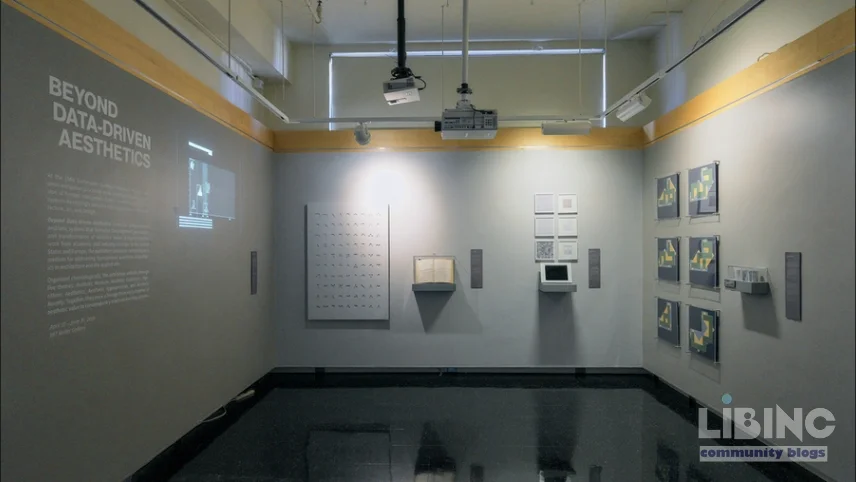
Computational Aesthetics as Interpretative Translation: Beyond Data-Driven Aesthetics at MIT Keller Gallery
Computational aesthetics is not a gadget, but a framework for rethinking design judgment under computation. In Beyond Data-Driven Aesthetics, Alexandros Haridis translates dense algorithms, mathematical theories, and machine-learning models into tangible installations and interactive visuals at the MIT Keller Gallery. The exhibition treats computation as a medium for creative production and aesthetic evaluation in architecture and the applied arts, foregrounding design computation as a method rather than a garnish.
Public discourse frames AI as new inborn taste, yet Haridis locates a longer history spanning the 20th century—from the Dartmouth AI proposal to rule-based design computation and shape grammars. The project asks: how do data-driven systems relate to established theories of beauty, value, and form, and where do human insight and machine methods converge or clash? The work positions computation as a site of interpretative translation rather than a mysterious black box.
The direction is to translate theory into experience, and to test whether design can reveal how computation contributes to spaces and objects people inhabit. Through spatial making, data visualization, and interactive media, the show reframes aesthetics as a design problem with measurable, navigable, and revisable dimensions.
Through Analytics
The opening analytic lens asks what counts as aesthetic value when computation mediates judgment. Haridis treats theory as material that designers can test in space, not merely a set of formulas to be read. By moving from dense publications to tangible artifacts, the exhibition probes the boundary between evaluation and generation, showing how algorithmic reasoning can be read, questioned, and revised through craft. This is not a celebration of machines but a discipline in which design computation makes abstract ideas legible and contestable.
Aesthetic Measure
George Birkhoff’s 1930s attempt to quantify beauty remains a reference point for contemporary computational aesthetics. The exhibit reframes measure as a design-oriented inquiry that asks what counts as balance, proportion, and harmony when an algorithm can adjust criteria in real time. In this sense, the project treats measure as a living protocol rather than a fixed index, inviting critique of what the numbers claim and what they omit. The approach foregrounds how mathematical quantification can illuminate, but also constrain, human perception and meaning.
- Historical lineage from early AI debates to shape grammars and rule-based computation
- Quantifiable metrics reinterpreted through spatial installation and interaction
- Critical examination of what numerical value captures about beauty and usefulness
- Design computation used to reveal the limits of formalist measure
Translation into Space
Where papers articulate theories in symbols and diagrams, the exhibition translates those ideas into physical form and motion. Design reconstruction, material fabrication, and live visualization become a loop: a concept is drafted, embodied, tested with visitors, and then refined. This process demonstrates how algorithmic aesthetics can operate in tandem with human experience, rather than supplant it. The end product is a tangible argument about how computation can shape perception in built environments.
Through Contrast
The contrast between data-driven learning and rule-based computation illuminates where each approach strengthens or distorts aesthetic judgment. Generative models excel at exploring vast design spaces, but risk surfacing unforeseen artifacts without an explicit interpretative framework. Rule-based systems offer transparency and controllability, yet may constrain novelty. The exhibition foregrounds how contrast invites critical scrutiny: a balance of exploration and governance yields spaces that feel both inspired and legible.
Data-Driven vs Rule-Based
In practice, data-driven methods push the envelope of possibility, but their outputs demand interpretive anchoring in human expertise. Conversely, rule-based grammars provide predictability and traceability, yet can reproduce conservative patterns if not challenged by broader design objectives. The synthesis, then, rests on embedding evaluation within generation, letting rules adapt alongside learned tendencies. This stance aligns with a broader architectural argument: computational systems should augment human discernment, not replace it.
- Generative models expand the search space for form and material strategies
- Rule-based grammars enforce consistency and maintenability across projects
- Hybrid approaches combine exploration with constraint to curb artifact drift
- Evaluations must be ongoing, not a one-off lab measure
Case and Theory Intersection
The exhibition juxtaposes theoretical readings with practical manifestations, asking how algorithmic aesthetics translates into perceptible outcomes. Some works foreground the negotiation between familiar forms and machine-produced modifications, revealing where familiarity helps comprehension and where deviation sparks critique. This dialogue with theory anchors computation in lived experience rather than abstract calculation.
Through Cause-and-Effect Relationships
Thinking in terms of cause and effect foregrounds a chain: data inputs and theoretical positions drive processes that shape outputs, which in turn influence human experience. The exhibition maps this chain so criticism can follow the steps: what data sets or rules drive a given outcome, how the visualization reveals intermediate states, and which perceptual cues trigger interpretation or misinterpretation. This causal perspective makes computation a designerly instrument, not a hidden engine.
By tracing effects back to their sources, Haridis invites critique of whether a given system contributes positively to the built environment or merely replicates familiar stylistic patterns. The work therefore becomes a testbed for evaluating how different computational models affect comfort, legibility, and meaning in space. In short, the exhibition treats causation as a design constraint, not a bureaucratic afterthought.
- Inputs rooted in historical theories of aesthetics and value
- Processes that materialize ideas as interaction, form, and visualization
- Outputs that reframe spaces, objects, and user experience
- Assessments that close the loop with redesigned criteria
To illustrate this, consider a workflow where a rule-based constraint system generates form candidates, a neural encoder evaluates stylistic proximity to a canonical corpus, and an audience interaction layer selects adjustments. The loop exposes both the mechanics of judgment and the perils of overfitting to data, highlighting the need for critical scrutiny of algorithmic taste.
Through Expert Reconstruction
The exhibition foregrounds design as an interpretative device. Reconstruction uses software techniques, physical fabrication, and data visualization to translate opaque computational systems into legible artifacts. This methodological stance makes abstract algorithmic ideas accessible as intuitive experiences, inviting critique, adaptation, and extension by designers and scholars alike.
Haridis describes a five-part thematic structure—Aesthetic Measure, Aesthetic Guidelines, Algorithmic Aesthetics, Aesthetic Appropriation, and Aesthetic Novelty—each a selective window into a distinct computational approach. The aim is not to exhaust a theory but to enable tangible dialogue between text, code, craft, and space. In this sense, the exhibition becomes a laboratory for future discourse on how computation can contribute to human well-being in the built environment.
- Software reconstruction of papers into interactives
- Physical fabrication of responsive artifacts
- Data visualization that clarifies opaque models
- Public-facing formats that broaden access to technical ideas
What follows is a broader, ongoing inquiry: how can computational systems participate in aesthetic evaluation beyond mere performance, and how might spatial formats evolve to communicate scholarly insight to a public that expects tangible, legible artifacts?
Operationalizing Computational Aesthetics in Practice
Despite rich theory, a clear workflow remains elusive for designers translating computation into built outcomes. A practical frame embraces objectives, data governance, method selection, prototyping, and evaluation through user experience. This approach foregrounds design computation as a collaborative instrument that couples craft with analysis, enabling teams to test aesthetic hypotheses in real spaces and to learn iteratively. In architectural contexts, it supports real-time feedback, transparency for stakeholders, and measurable impact on comfort, wayfinding, and identity.
| Method | Strength | Constraint | Example | When to Use |
|---|---|---|---|---|
| Rule-based | Transparent outcomes | Can limit novelty | Facade grammars | When governance and explainability matter |
| Data-driven | Broad exploration | Risk of unforeseen outputs | Generative facade variants | When discovery and adaptation are priorities |
| Hybrid | Balance of exploration and control | Increases governance needs | Interactive shading with ML + rules | When novelty and safety both matter |
| Visualization-first | Clear values for stakeholders | May oversimplify | Live metrics dashboards | For persuasive design critiques |
| Simulation-based | Quantified performance | Computational cost | Daylight and energy models | When performance drives design |
| Participatory | Human-centered input | Requires process setup | Public workshops with sketch probes | When user experience is central |
Applied pragmatically, teams align outcomes with aesthetic intent and user comfort. Practical scenarios include parametric shading for galleries that responds to sun and crowd, sensor-led wayfinding palettes in hospitals, and adaptive interiors that invite resident feedback to steer form and materials. These uses demonstrate how computation can translate theory into tangible spaces without sacrificing craft.
To operationalize these ideas, teams define a lightweight workflow: establish design goals, assemble relevant data and constraints, choose a method mix, prototype in a controlled space, collect user feedback, and iterate. This loop encourages ongoing evaluation, not a one-off test, and supports a shared language among designers, engineers, and clients.
In practice, computation becomes a shared instrument, translating abstract theory into spaces that respond to users and context while maintaining architectural integrity.
What is computational aesthetics in architecture?
Computational aesthetics in architecture combines theory with computation to test, generate, and evaluate design ideas within built or simulated spaces. It treats algorithmic tools as partners that help explore form, light, materiality, and user experience in measurable, interpretable ways. This approach keeps human judgment central while enabling scalable exploration across larger design spaces. Practically, it translates dense ideas into accessible artifacts such as interactive visualizations, prototypes, and live demonstrations that stakeholders can read and critique. The aim is to illuminate how calculation contributes to beauty, usefulness, and place attachment.
Analytically, it clarifies how values like balance, proportion, and clarity emerge from both data-driven exploration and rule-based constraints. It also invites scrutiny of what numbers can and cannot capture about perception and experience.
How do rule-based and data-driven approaches complement each other in design computation?
Rule-based systems provide transparency, reproducibility, and clear governance in design decisions. Data-driven approaches expand the design space, revealing unexpected forms and relationships that humans might not imagine. Used together, they offer a robust workflow: rules guide safety and legibility while data-driven methods discover novelty within those boundaries. Practically, a hybrid system can generate a wide range of options, then use rules to filter and rank them, with human feedback closing the loop to ensure alignment with project goals and values.
In practice, this pairing reduces risk, accelerates exploration, and yields designs that are both inventive and comprehensible to clients and users.
How can practitioners measure aesthetic value in computational design?
Measuring aesthetic value requires both qualitative and quantitative signals. Spatial coherence, legibility, and comfort are assessed through simulations, sensor data, and user testing, while dashboards and visualization tools translate complex models into readable indicators. Aesthetics emerge when metrics align with experiential goals such as wayfinding ease, daylight quality, or material tactility. The most effective measures are communicable to clients and adaptable over time, not fixed once for all projects. Practically, teams track a small set of core indicators and evolve them with project feedback.
These measures anchor exploration to human experience, ensuring computational exploration remains purposeful.
What practical steps help implement computational aesthetics in a project?
Start with clear design objectives and a sketch of success criteria that bridge aesthetics and performance. Assemble data sources, constraints, and stakeholder inputs; choose a mix of rule-based and data-driven methods; build quick prototypes in a controlled setting; test with users; and document outcomes for iteration. Maintain a shared vocabulary across disciplines and establish governance for data provenance and bias checks. Over time, refine metrics, adjust parameters, and publish accessible artifacts so future teams can reuse insights.
In short, a disciplined workflow turns computation from a novelty into a steady design partner.
What are risks and ethical considerations when using AI in architectural design?
Risks include overreliance on models, loss of craft nuance, bias in data, and opacity in decision-making. Ethical practice requires transparency about inputs, explicit human oversight, and ongoing evaluation of how designs affect users and communities. Documentation should reveal how values like accessibility, cultural context, and safety shape outcomes. Teams should also plan for data governance, consent where sensors involve people, and contingencies if algorithmic recommendations conflict with site realities. With thoughtful governance, computation supports inclusive and responsible design.





Add a comment
To comment, you need to register and authorize
Comments