

Table of Contents
- Analytical frame: Assur as a constructed deity
- Contrasts and tensions: Assur against the Sumerian-Babylonian pantheon
- Cause and effect: Expansion, unity of worship, and social dimensions
- Expert reconstruction: how scholars read Assur today
Assur stands as a pivotal figure in ancient Mesopotamian religion: a local city deity elevated to the supreme god of the Assyrian pantheon. This ascent did not occur in isolation but through deliberate syncretism with earlier powers from Sumer and Babylon. The result was a god whose persona encompassed war, wisdom, justice, agriculture, and kingship—an amalgam designed to legitimize imperial power across diverse conquered populations.
To harmonize this unity with a sprawling empire, Assur borrowed traits from Sumerian Anu and Enlil and Babylonian Marduk, and even adopted family ties that mirrored their own divine pedigrees. The king served as chief priest, and the god's name traveled with the ruler into many regions, a signature of political theology.
The result was a religious system that could justify military campaigns, codify governance, and bind disparate peoples under a single divine authority. Yet the figure remained elusive, with Jeremy Black noting that Assur often lacks a fully independent character or iconography of his own, even as his authority grew beyond Ashur’s city limits.
As the empire expanded, the demand to worship Assur anywhere grew, cultivating a sense of omnipresence and a monotheistic-leaning unity that eclipsed other gods, while still preserving localized manifestations under a single divine umbrella, a transformation documented by Paul Kriwaczek.
Analytical frame: Assur as a constructed deity
Assur's rise is best understood as a political project as much as a theological development. He starts as the patron god of Ashur, a city that grew from a trading site into the administrative center of a nascent empire. The process mirrors a broader Mesopotamian pattern in which local spirits become city gods, then national symbols, then vehicles for imperial legitimacy.
Indeed, as E. A. Wallis Budge and later scholars noted, the evolution from household spirits to a cosmically sovereign power involved aligning Assur with the major deities Anu, Enlil, and Marduk—an effort to anchor Assyrian kingship in a familiar, cross-cultural divine order.
The practical effect was twofold: it allowed rulers to claim divine sanction for conquest, and it supplied a common religious vocabulary for annexed populations. The Assyrian king, Ashurnasirpal II's era onward, wove the god's presence into public ceremonies by adopting his name into royal titulature and by moving the capital to Kalhu to reflect a broader, empire-wide devotion.
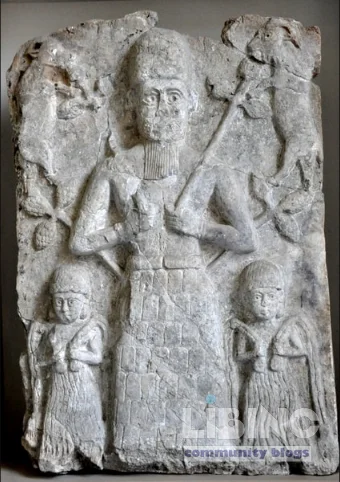
From a religious standpoint, the iconography of Assur—whether a crown-bearing Anu-like crown, a warrior with horned helmet, or a figure standing on a snake-dragon derived from Marduk—reveals competing iconographies rather than a single signature image. This plurality reflects the empire's religious approach: to borrow surface forms while stitching them into a unified political symbol.
Contrasts and tensions: Assur against the Sumerian-Babylonian pantheon
Contrasting Assur with the Babylonian Marduk or the Sumerian Enlil highlights both synergy and tension. While Marduk dominates in Babylon's mytho-political frame and Enlil governs the divine order in older Sumerian tradition, Assur became a composite that absorbed their powers while preserving a distinct voice for the Assyrian state.
The process produced a hybrid theology: a god who can lead armies, oversee law, and sanction kingship, yet whose persona remains blurred because his power is distributed through borrowed attributes rather than an original, self-authored mythos, a point emphasized by Jeremy Black.
Iconographically, Assur's union with the Anu crown, or his depiction with a horned helmet, and occasional winged-disk motifs reveal competing iconographies rather than a single signature image. This plurality reflects the empire's religious approach: to borrow surface forms while stitching them into a unified political symbol.
As the empire absorbed Phoenician, Median, and Hurrian populations, the worship of Assur functioned as a unity device, a shared referent that enabled centralized authority despite regional differences in ritual practice and language.
Cause and effect: Expansion, unity of worship, and social dimensions
The expansion of the Neo-Assyrian Empire altered religious logistics: priests moved across borders, temples were built or repurposed in new provincial cities, and the king's cult tied governance to divine will. The empire's reach required a divine framework that could be invoked across landscapes, not just Ashur.
Paul Kriwaczek describes how this unity of vision transformed religious thought from the immanence of local gods to a transcendental, universal figure; the divine ceased to be tethered to natural cycles alone and was projected onto political space, enabling a national myth to travel with the army.
Within this framework, the Assyrians could present conquests as justified by a singular will, while existing deities of conquered peoples were reinterpreted as manifestations of Assur. This theological realignment smoothed administrative integration but often at the cost of local priesthood authority and female civil rights, which declined under Hammurabi's code and continued under Assyrian rule.
The social consequences extended to gender dynamics: women's participation in religious life diminished as the state cult centralized worship around Assur, reflecting a broader shift toward a male-dominated priesthood and public ritual, a trend that some scholars contrast with earlier Mesopotamian patterns of female deities and priestesses.
Economically and culturally, the absorption of local practices into a single divine framework helped unify tax collection, ritual calendars, and public ceremonies. But it also created tensions among conquered populations who perceived Assur as the god of an imperial machine, not the local guardian of their own cities.
Ultimately, the Neo-Assyrian model of worship fused omnipresence with a centralized political authority, prefiguring later monotheistic interpretations while retaining classical Mesopotamian polytheistic syntax.
Expert reconstruction: how scholars read Assur today
Modern scholarship treats Assur as a dynamic construct rather than a fixed mythic person. Analysts emphasize the deliberate borrowing from Anu, Enlil, and Marduk to frame a sovereign god that could unify an empire rather than a single city's deity.
Paul Kriwaczek notes that the shift to a universal deity changed the devotional landscape, with worship extending beyond the temple in Ashur toward every touched land and language, while E. A. Wallis Budge situates Assur’s evolution within a broader pattern from spirit to state god.
As the empire matured, Assur’s identity became a tool of state policy and ritual politics. The king's title, the capital's relocation, and the installation of military power as a religious sign all served to align divine authority with imperial ambition, echoing the way Anu’s and Marduk's pantheons had consolidated before them.
The later phase of Adad Nirari I to Tiglath-Pileser III reveals how internal reform—such as creating a professional army and centralizing worship—pushed Assur into a role that prefigured monotheistic conceptions in later centuries, even as polytheistic texture remained.
When the Neo-Assyrian Empire fell in 612 BCE, the destruction of Ashur’s temple symbolized a rupture between divine authority and political power. Yet memory persisted; the god survived as a personal and family name, and in Christian-era recollection, the omnipresent deity provided a cultural bridge for monotheistic evangelism in the region.
In contemporary scholarship, the fate of Assur is read not as a tragedy of one god's eclipse but as a case study in how empire and religion co-create each other—a paradigm used to understand other ancient state cults and their legacies in modern religious culture.
Closing note: the figure of Assur shows that religious systems adapt through political necessity, not merely by internal spiritual transformation, and that the most lasting projects are those that offer cohesion across space and time—though often at the cost of local diversity.
To summarize, Assur’s arc—from local deity to imperial symbol, to memory embedded in later religious and cultural identity—illustrates how ancient religions can serve as instruments of statecraft and syncretism, while remaining ambiguous enough to invite ongoing scholarly debate.
Assur’s legacy endures in how empires imagine divine authority: as a unity that travels, a warrant for power that must be earned through ritual legitimacy, and a reminder that religious identities often outlive political custody.
Closing the gap with practical context
The existing account frames Assur as a constructed sovereign deity, yet it often lacks concrete demonstrations of how the imperial cult moved from theory to daily practice across provinces. Here we connect governance and worship by detailing three mechanisms: ritual calendars synchronized with royal campaigns, priestly circuits that carried the god's emblem from city to city, and public ceremonies where the king spoke as the god's earthly agent.
First, the iconography borrowed by Assur is not a single signature image; it is a toolkit used to bind diverse communities under a shared symbol.
| Source deity | Aspect | Representative form |
|---|---|---|
| Anu | Royal authority and sky | Crown-bearing figure; horned helmet |
| Enlil | Law, order, kingship | Authority emblem, staff |
| Marduk | Judicial power, conquest | Dragon motif, winged disk |
A compact timeline shows how worship policy shifted with emperors and frontier realities, then the analysis continues with a glance at the daily rites.
| Period | Event | Location | Impact |
|---|---|---|---|
| c. 873 BCE | Consolidation of Assur as national cult | Northern Mesopotamia | Royal inscriptions frame campaigns as divine will |
| 9th–7th c BCE | Capital relocations and temple networks | Kalhu and Nimrud | Provincial worship aligned with central authority |
| c. 700s BCE | Professionalized cult administration | Empire-wide | Unified ritual calendars, taxation of offerings |
| 612 BCE | Destruction of Ashur temple | Ashur and surrounding cities | Shift from temple-state to memory-based cult |
Finally, a compact glossary highlights core terms used in this imperial framework.
- State cult centralized worship that legitimates imperial power.
- Royal titulature the king's name attached to divine acts and campaigns.
- Temple network a web of shrines that connects provinces to Ashur's god.
- Imperial imagery borrowed symbols used to unify diverse populations under one god.
Together, these mechanisms show how a flexible theology supported expansive governance without erasing regional identities.
Frequently Asked Questions
What evidence supports that Assur served as an imperial cult rather than a local city god?
Assur appears in royal inscriptions and temple dedications across campaigns and provinces, not only within Ashur. Inscriptions from Kalhu and Nimrud name the god alongside the king, showing a nationwide referent rather than a single city patron. This pattern, repeated across multiple sites, signals a national cult whose authority travels with military power and administrative reach. The result is a deity whose public persona aligns with imperial policy and governance.
Analytically, this indicates that worshipfunctioned as political theology, extending divine legitimacy beyond city walls to a broader audience. The evidence suggests a deliberate strategy to bind diverse populations through a shared sacred frame.
How did the king function within the worship of Assur?
The king is presented as both chief priest and principal executor of the god's will. Royal titulature often merges the king’s name with divine attributes, signaling divine sanction for campaigns and reforms. Public ceremonies, oaths, and festivals position the monarch as the god's earthly agent, responsible for maintaining order and justice across the empire.
Scholars emphasize the kinship between political power and ritual authority, with the king guiding temples, distributing offerings, and directing priestly circuits. This embedding of sovereignty in ritual action creates a continuous link between governance and divine consent.
What impact did Assur's worship have on conquered populations?
Centralized worship offered a shared framework that could unite diverse languages and customs under a common divine umbrella. In practice, local deities of conquered regions were reinterpreted as manifestations of Assur, while provincial temples continued to function within the imperial scheme. This political theology simplified tax collection, calendrical systems, and public ritual calendars for administrators and soldiers alike.
However, it often reduced local priesthood authority and distinctive female rites, leading to tensions between central aims and local identities. The result is a blended religious landscape where local variation persisted within a dominant national frame.
What kinds of artifacts illustrate Assur's borrowed attributes?
Artworks and inscriptions frequently show Assur wearing an Anu-style crown or horned helmet, sometimes paired with Marduk's winged-disk or dragon motifs. This iconographic toolkit demonstrates a repertoire rather than a single emblem, reflecting the empire's method of stitching elements together to project unity. Such visuals appear on temple façades, seals, and stelae across major cities, reinforcing the imperial claim to universal authority.
In sum, the material record supports a polity where iconography served a political function as much as devotional, binding diverse peoples under shared symbols.
What is the modern scholarly view on the evolution of Assur?
Scholars view Assur as a dynamic construct shaped by imperial needs. Borrowing from Anu, Enlil, and Marduk allowed a universal frame for a god that could legitimize campaigns and governance. The king's cult and the expansion of a temple network show a shift from local devotion to a mobile, empire-wide worship—an early form of a state religion with polytheistic texture.
Ultimately, this model informs broader questions about how empires mold religion to stabilize power across diverse regions and populations.
What happened to the cult after the empire fell?
After the fall of the Neo-Assyrian Empire, the temple at Ashur was wrecked, and the direct political channel between divine authority and imperial power disappeared. Yet the memory of Assur persisted in later religious and cultural contexts and in regional identity. The deity continued to function as a symbolic presence in religious memory and regional storytelling, illustrating how state religion can outlive political custody through cultural resonance.
Analytically, the episode demonstrates how powerful ideologies can linger beyond political systems, informing later religious and cultural landscapes.





Add a comment
To comment, you need to register and authorize
Comments