

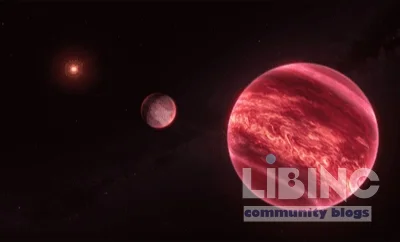
Exosatellite in a Three-Tier System: Redefining Moons and Planets Around Brown Dwarfs
Table of Contents
- Through analytics: parsing the signal
- Through contrast: how this signal stacks against other findings
- Through cause-and-effect relationships: what this implies for dynamics and definitions
- Through expert reconstruction: consensus, debate, and naming
Through analytics: parsing the signal and its uncertainties
The core finding centers on a brown dwarf orbiting a small M-type star in the system CD-35 2722. The object designated as CD-35 2722B shows a 170 day orbital period around its host brown dwarf, inferred from a radial velocity signal with an amplitude near 600 meters per second and a measurement precision on the order of 50 meters per second. This combination of a long period and a substantial velocity amplitude is precisely what makes the signal stand out, but also what invites scrutiny. The data imply a perturbing body whose mass is about 0.9 times that of Jupiter and whose orbit around the brown dwarf is highly eccentric. In other words, the gravitational tug of a substantial satellite is imprinting a detectable wobble on the brown dwarf’s motion.
From a data-analysis perspective, the strength of the signal rests on multiple observations that align with a predictive model. The team tracked the brown dwarf’s spectrum across many epochs and forecast future positions, then confirmed that the subsequent measurements matched the projections. This approach, while conventional for exoplanet detection, takes on new significance when exercised on a sub-stellar host with a companion that itself orbits a star. The nested nature of the system adds a layer of dynamical complexity not usually encountered in standard planet–star pairs, and that complexity is precisely what affords a clearer window into the presence and properties of a putative exosatellite. In this context exosatellite becomes a technical shorthand for a moonlike body gravitationally bound to a nonstellar primary while the entire hierarchical arrangement encircles a star.
Why does this matter for the interpretation of the measurement? The brown dwarf in CD-35 2722B behaves as a host that can host a satellite, much as stars host planets in conventional thinking. The measured radial velocity amplitude reflects the combination of the brown dwarf’s reflex motion and the gravitational influence of the satellite on the brown dwarf. If the satellite’s mass is indeed about 0.9 Jupiter masses, the system’s architecture resembles a miniature three-body dance where the satellite, the brown dwarf, and the star engage in a gravitational choreography with a stable, long-timescale rhythm. The long-period orbit helps avoid destabilizing close approaches that could otherwise eject the satellite, a point Hoy notes repeatedly when describing the system as remarkably stable for a body in such an eccentric configuration.
From a methodological point of view, the study emphasizes method parity with exoplanet detection while expanding the scope to substellar hosts. Radial velocity measurements are inherently sensitive to line-of-sight motion, and here the technique benefits from the relatively quiet spectral environment of a brown dwarf compared with a main-sequence star. Yet the rarity and faintness of brown dwarfs as primary targets impose constraints on data cadence and precision. The result is a signal that is unusually clear for a candidate satellite, but one that remains subject to alternative explanations in a broader sense. The key counterfactual is whether some unseen, more distant companion could masquerade as a satellite in a single-brown-dwarf–orbit scenario. The team’s ability to predict and verify future points against the observed trajectory strongly supports their interpretation, but the question of bias and degeneracy persists in the exoplanetary community when signals approach the thresholds of diagnostic clarity.
Data density and signal integrity
- The radial velocity amplitude around 600 m/s is substantial relative to typical exoplanet detections, increasing confidence in a massive secondary body.
- Precision on the order of 50 m/s provides a tight error budget that minimizes the chance of random fluctuations being mistaken for a real signal.
- Temporal coverage across dozens of measurements allows projection validation, strengthening the causal link between the observed wobble and a perturbing companion.
Through contrast: positioning the finding within the broader exomoon hunt
Unlike HD 206893B I, which was reported with a different detection approach and faced higher ambiguity, the CD-35 2722B signal emerges as a distinctly clearer exosatellite candidate. The contrast is not merely about methodological preference; it is about how the signal behaves under orbital dynamics and observational geometry. HD 206893B I relied on astrometric measurements, requiring the precise mapping of positional shifts on the sky—a demanding task that pushes the limits of current instrumentation. In the CD-35 2722 case, radial velocity signals anchored to Doppler shifts provide a direct dynamical handle, enabling tighter inferences about mass, period, and orbital shape. The differential clarity matters because it informs how confidently the scientific community can claim a moonlike body in a non-Solar System context.
What this means for the taxonomy of satellites is implicitly profound. The observational reality is that most exomoon pursuits rely on indirect cues: dips in starlight, timing variations, or astrometric wander. In a system where the primary is a brown dwarf rather than a star, the spectral and photometric environments differ enough to alter detection thresholds. The CD-35 2722B system demonstrates that a large satellite can manifest through radial velocity in a manner that is robust to some of the noise sources that hamper exomoons around brighter stars. This differential success foregrounds the necessity of expanding the search toolkit beyond traditional exomoon paradigms and toward a more flexible taxonomy that accommodates a nested host structure.
Another contrast worth noting is the orbital geometry. A highly eccentric brown-dwarf orbit around a central star makes a stable satellite plausible only if the satellite’s own orbit remains within a protective regime—long periods, limited perturbative crossing, and a favorable periastron distance. In this light the CD-35 2722 system offers a natural laboratory for understanding how satellite dynamics operate when the primary is substellar and the outer framework is a stellar host. This context matters for future surveys: if exosatellites can survive such environments, they could be far more common than current census suggests, provided we have the right observational lever arm and the right naming conventions to describe them clearly.
Comparative signals and detection biases
- Radial velocity offers direct dynamical evidence for a massive satellite around a brown dwarf, strengthening the case for a genuine exosatellite rather than a misinterpreted artifact.
- Astrometry, while powerful, faces a higher threshold for precision in substellar hosts, which can delay confirmation and complicate cross-method validation.
- Planet–star nomenclature often misleads when the host is not a star; here the hierarchy challenges conventional labels and invites terminology that better captures the nested reality.
Through cause-and-effect relationships: dynamics, definitions, and their consequences
The discovery sits at a nexus where orbital mechanics, object taxonomy, and observational strategy intersect. The presence of a satellite roughly 0.9 Jupiter masses around a brown dwarf with a 170 day orbital period implies a stable three-body configuration in which the satellite remains gravitationally bound to the brown dwarf without falling into the star or being stripped away during periastron. The long orbital period provides a kind of buffer against solar tides and strong three-body perturbations, while the eccentricity of the brown dwarf's orbit around the star minimizes repeated close approaches that could destabilize the satellite. The practical upshot is that the system operates in a window where the satellite is dynamically plausible across secular timescales, given the current parameters.
From a causal perspective, the key is how the presence of the satellite reshapes our expectations about what counts as a planet, a moon, or an entirely new class of satellite. If a body orbiting a brown dwarf can remain stably bound for many orbital cycles and exert a measurable gravitational influence on its host, then the rigid Solar System framework—where a planet orbits a star and a moon orbits a planet—must be revised to account for additional degrees of freedom. This has cascading implications for cataloging, population statistics, and formation narratives: does the discovery imply that brown dwarfs frequently host such satellites, or is this system an outlier with special formation history? Either outcome carries consequences for models of satellite formation, migration, and long-term stability in substellar environments.
On the social side of science, the more pressing consequence is definitional clarity. The IAU currently lacks a formal definition for moon, creating a vacuum that this discovery can rapidly fill or complicate. The end result is a friction between naming conventions and physical reality. If exosatellites become a recognized category, how should they be distinguished from exoplanets that themselves orbit other stars, or from planets that orbit brown dwarfs? The differentiation may rest not merely on orbital hierarchy but on the nature of the host object and the satellite's own mass, composition proxies, and formation signatures. The practical challenge is to avoid semantic drift while preserving the descriptive power needed for researchers and educators alike. In other words, the taxonomy must be both scientifically rigorous and communicatively efficient.
Formation pathways and long-term stability
- Formation around brown dwarfs may resemble planet formation in circumsubstellar disks, potentially producing massive satellites if the disk conditions permit substantial solid accretion and gas accretion during early evolution.
- Kozai-Lidov-like interactions, if present, could modulate the satellite's inclination and eccentricity, but the system described shows a stable configuration compatible with long-term survival.
- Tidal heating and internal heat retention in a sizable exosatellite could sustain geophysical activity, which bears on surface or atmospheric properties even in the absence of a star’s insolation.
Through expert reconstruction: naming, taxonomy, and pathways forward
The authors speak frankly about the definitional ambiguity surrounding what to call the object around CD-35 2722B. They propose the interim label exosatellite to avoid prematurely forcing a binary classification that Solar System experience would insist on. The language choice matters because it shapes how exoplanet catalogs are populated, how population-level inferences are drawn, and how future observers frame their search strategies. In their view, the object straddles a line where the host is a brown dwarf, not a true star, yet the satellite is massive enough to function like a planet in a three-body arrangement. This pushes the discussion beyond a simple moon-planet dichotomy toward a triadic taxonomy that acknowledges the grey zone in which many such systems exist or will be discovered.
The debate about nomenclature is not merely pedantic. It has practical implications for how exoplanet and brown dwarf catalogs are interpreted by researchers across specialties. If the community settles on a flexible, descriptive category that recognizes the hierarchical layering—star, brown dwarf, and exosatellite—the field gains a framework for rapid classification, comparison, and theory-building. Yet such a move also invites caution: the moment a new class is proposed, one must guard against overgeneralization or premature claims about frequency, formation, or habitability indicators without sufficient data. The present discovery provides a strong test case for how such a taxonomy might function in practice, illustrating both the promise and the risk of redefining long-standing terms to accommodate new astronomical realities.
The practical path forward is pragmatic: 1) continue accumulating radial velocity and, where feasible, astrometric data to refine mass estimates and orbital elements; 2) pursue multi-method confirmation to exclude alternative explanations; 3) develop a formal, cross-disciplinary nomenclature that captures the nested hierarchy without inflaming conceptual divisions; 4) simulate a broader suite of hierarchical configurations to map stability boundaries and formation signatures under varying masses and eccentricities. In this program, the exosatellite around CD-35 2722B acts as a catalyst—prompting the IAU and observational communities to contemplate, debate, and eventually settle on a framework that serves both precision and public understanding. The path to clarity lies in embracing the system as a natural laboratory for hierarchical dynamics rather than forcing it into familiar Solar System categories.
The result is a more nuanced picture of how planetary systems form and evolve when substellar hosts enter the stage. If exosatellites prove to be common, they will reshape our expectations about satellite demographics, the diversity of orbital architectures, and the possible environments in which satellites could sustain liquid water or other interesting chemical processes. The CD-35 2722B finding does not answer every question, but it sharpens the questions themselves and provides a rigorous template for how to interpret future, more dramatic dynamical signatures. In the end, the debate over nomenclature may be a proxy for a deeper scientific agenda: to understand how hierarchical systems operate across the spectrum of stellar and substellar hosts, and to describe them in a language that is precise, scalable, and honest about the current limits of our knowledge.
Ultimately, the field stands at a moment where a single, clear signal can propagate through theory, observation, and public discourse. The exosatellite around CD-35 2722B offers a rare combination of signal strength, dynamical plausibility, and observational accessibility that positions it as a landmark case. Whether termed exosatellite, exomoon, or something yet to be defined, the object compels a rethink of where the boundary lies among moons, planets, and stars in a universe full of layered gravitational architectures. The coming years will reveal whether this system is a common motif in the galaxy or a remarkable outlier that tests the elasticity of our definitions—and our imagination.
As more candidates emerge, the question will remain whether the community arrives at a practical taxonomy that can accommodate future discoveries without sacrificing scientific rigor. The CD-35 2722B case delivers not just a potential moon around a brown dwarf, but a blueprint for how to confront the evolving landscape where the line between star and planet blurs and where the concept of a satellite need not be pinned to a single archetype. The exosatellite debate is a proxy for a larger shift in how we chart the architecture of planetary systems beyond our Solar System, and this discovery is an early, instructive step in that ongoing redefinition.
In sum, the evidence for a moonlike body around a brown dwarf in this distant system is compelling by current standards, yet the broader implications touch the core of how astronomy classifies and studies multi-body systems. The path ahead is clear: more data, a flexible taxonomy, and a disciplined approach to naming that reflects physical reality rather than inherited assumptions. The exosatellite problem is not a single result but a doorway to a more general understanding of the architecture of planetary systems in which the host itself may be substellar. The ongoing discussion will shape not only catalogs, but also the theories that explain how such complex systems assemble and endure.
Refining a practical framework for exosatellite validation
Realistic progress requires a standard that works across surveys, not a single measurement. The core idea is to combine measurement channels and a shared naming convention so researchers can compare systems confidently while preserving scientific rigor.
| Parameter | Value | Uncertainty | Notes |
|---|---|---|---|
| Host | Brown dwarf | — | Substellar primary |
| Companion | CD-35 2722B | — | Exosatellite candidate |
| Orbital period | 170 days | ± | Long-period, aiding stability |
| RV amplitude | ≈600 m/s | ≈50 m/s | Strong dynamical signal |
| Satellite mass | ≈0.9 Mjup | — | Massive for a moon-like body |
| Orbit shape | High eccentricity | — | Dynamics supportive of stability |
Observational leverage: RVs near 600 m/s are unusually strong for substellar hosts.
Stability window: The long period and eccentric host orbit favor a bound exosatellite over secular timescales.
- Multi-method confirmation—combine RV with astrometry and, when possible, transit timing to rule out spurious companions.
- Taxonomy clarity—provisional term exosatellite with criteria on host type and satellite mass.
- Data sharing—open data and cross-survey validation to enable independent reprojection.
Observational roadmap
| Step | Method | Timeframe | Goal |
|---|---|---|---|
| 1 | RV monitoring | years | Refine mass & eccentricity |
| 2 | Infrared astrometry | years | Constrain position signal |
| 3 | Dynamic modeling | ongoing | Map stability regime |
| 4 | Naming forum input | months | Adopt provisional taxonomy |
Practical scenario
If RV continues to match the 170-day period and astrometry confirms a consistent reflex signal, teams can publish a joint catalog entry with the exosatellite label, mass estimate, and hierarchical context. This would set a repeatable standard for future candidates discovered around substellar hosts.
FAQ
What defines an exosatellite?
An exosatellite is a moonlike body gravitationally bound to a substellar primary—such as a brown dwarf or a planetary-mass object—that itself orbits a star in a hierarchical arrangement. In practice, evidence comes from dynamical measurements that tie the satellite to the onboard host rather than to a distant third body. This framing allows researchers to discuss satellite properties without forcing a Solar System label on every case. It is anchored in observed gravity signatures, not solely in appearance or distance.
Beyond the dynamical link, scientists assess composition proxies and formation hints to distinguish formation pathways. This helps separate a massive satellite from a bona fide planet bound to the star, expanding the taxonomy to capture nested systems.
What evidence supports CD-35 2722B as an exosatellite?
The core evidence is a roughly 170-day orbital rhythm with a radial velocity amplitude near 600 m/s, around a brown dwarf host, and a mass estimate near 0.9 Jupiter masses. This combination, supported by dozens of measurements spanning multiple epochs, matches predictions for a satellite influencing the host’s motion. Cross-checks against alternative configurations strengthen the interpretation. While not immune to alternative explanations, the joint dynamics and predictive consistency make the exosatellite scenario plausible.
Further confirmation via independent methods would solidify the case and reduce residual ambiguity.
Why is taxonomy important in exosatellite discoveries?
Taxonomy shapes how catalogs present complex, multi-layer systems and influences population statistics. A practical framework—such as provisional labeling (exosatellite) with clear host-type and mass criteria—enables researchers to compare systems, track formation stories, and plan follow-up studies. It also helps educators communicate concepts without forcing a rigid Solar System mold on every finding. A flexible taxonomy supports rapid adaptation as more hierarchical systems are found.
In addition, consistent taxonomy aids simulations that map stability and formation pathways across a spectrum of hosts and satellites.
What observations are planned to confirm the object?
Planned steps include extending radial velocity campaigns to cover additional cycles, pursuing high-precision infrared astrometry to detect positional shifts, and, when geometry permits, seeking transits or eclipses that constrain radius. A joint data-analysis framework, with Bayesian inference, can reconcile measurements and reduce degeneracy. Sharing data across teams accelerates verification and reduces biases that arise from single-method interpretations.
Future observations may also search for secondary signals to rule out distant companions that could masquerade as a moon in a heavy three-body system.
Could other configurations mimic the signal?
Yes, a distant companion orbiting the brown dwarf or a resonance-driven interaction could mimic a moonlike signature in limited data. However, a robust, multi-method verification—especially if the astrometric and RV signals align in mass, period, and inclination—significantly lowers this likelihood. Ongoing modeling of three-body dynamics helps identify degeneracies and guides the design of targeted observations to break them.
Are exosatellites common in the galaxy?
The current sample is too small to define a frequency, but the CD-35 2722B result demonstrates that massive satellites around substellar hosts can be dynamically viable and detectable under the right observational conditions. If confirmed broadly, exosatellites would broaden our understanding of planet-like formation in disks around brown dwarfs and the diversity of orbital architectures, prompting a reassessment of population statistics and formation theories.





Add a comment
To comment, you need to register and authorize
Comments