

Table of contents
- Analytics: The arc from Sophists to the AI era
- Contrast: Philosophers and rhetoricians across ages
- Causes and effects: How fallacies propagate in media ecosystems
- Expert reconstruction: Lessons for today’s information landscape
In this examination, critical thinking emerges as the central instrument for navigating rhetoric and power from ancient Greece to the digital era. The Sophists turned argument into a lucrative craft, while Socrates and later Aristotle built diagnostics for truth that demanded disciplined reasoning. Today, the same tension reappears in the information ecosystem shaped by social media, data analytics, and AI. This article traces the arc of critical thinking across centuries, reveals persistent patterns, and identifies what modern readers must insist on to stay intellectually honest.
Today, the stakes are not merely philosophical; they affect policy, science, and everyday judgment. The strength of a society rests on its ability to separate sound reasoning from persuasive fiction. The challenge is how to recognize and resist fallacies while preserving openness to new ideas. The following analysis proceeds through four lenses — analytics, contrast, causality, and expert reconstruction — to expose how the art and science of thinking have evolved and why they matter in an era of rapid information flow. The main idea is simple: rigorous thinking remains the best defense against deception, provided we cultivate practices that expose faulty logic and demand evidence-based justification.
Analytics: The arc from Sophists to the AI era
The Greek world laid two foundations at once: a marketplace for rhetoric and a demand for intellectual discipline. Sophists mastered the art of persuasion, often trading in persuasive structure rather than universal truth. They showed that an argument can be made to move opponents, even when the underlying premise is contestable. Yet this is not merely a curiosity of ancient talk; it foreshadows a perennial problem in public discourse: the lure of technique without accountability.
To understand the rise of critical thinking, we must track how argument quality shifted from performative success to cognitive reliability. The first major pivot occurs when Socrates carts the conversation toward normative checks: definitions, definitions of definitions, and a relentless demand for justification. Aristotle then codifies a taxonomy of reasoning, distinguishes form from content, and introduces the triad ethos, pathos, and logos as the essential levers of persuasion. This triad anchors the discipline in a framework where evidence, credibility, and emotional resonance must align with a sound argument.
Through the centuries, the discipline grows more precise, but the underlying tension remains. Formal fallacies expose itself as a problem of structure, while informal fallacies reveal vulnerabilities in content and context. In the modern era, the emergence of empirical science, experimental controls, and rigorous epistemology further sharpen the demand for falsifiability and reproducibility. The later Burnt-Oak of science—Popper’s insistence on refutation as the test of science—offers a compact rule: an assertion must survive attempts to disprove it. Without this, a claim remains mere rhetoric, useful for persuasion but not for truth-seeking.
Key transitions through history include a shift from rhetoric as a public theatre to rhetoric as a disciplined craft enriched by empirical standards. The digital revolution intensifies this shift: social platforms compress time, crowd opinions amplify, and algorithmic amplification can masquerade as objective consensus. In this complex environment, critical thinking must operate with both the discipline of logic and the pragmatism of real-world assertions. The result is a robust methodological stance that treats reasoning as an accountable enterprise, not a magical performance capable of making the weaker argument appear stronger.
- Emergence of critical thinking as a discipline: from deliberative dialogue to methodological scrutiny.
- Distinction between form and content: syllogistic validity versus persuasive force.
- Falsifiability and evidence: tests that separate belief from knowledge.
- Digital acceleration: how information technology reshapes the stakes and tools of reasoning.
Contrast: Philosophers and rhetoricians across ages
Across epochs, thinkers diverge on what counts as winning an argument. Protagoras insists that man is the measure of all things, a provocative stance that thrives on relativistic persuasion. Socrates counters with a method that discloses ignorance and demands clarity. Aristotle formalizes a systematic approach to reasoning, while Cicero combines rhetorical elegance with a quasi-ethics of public speech. The Renaissance adds a split between empirical investigation and rational deduction, a split that underwrites modern science and modern skepticism.
Aristotle’s emphasis on logos complements his emphasis on pathos and ethos; the aim is not to crush emotion but to align it with a truth-bearing structure. Cicero’s oratory aims at persuasion through virtue and proof, yet he remains vigilant about the gap between appearance and reality. Francis Bacon pushes for empirical methods that strip away idols and preconceptions, while Descartes insists on methodological doubt as a pathway to certainty. Kant then reorganizes judgment around critical criteria, insisting that reason itself must be free yet governed by universalizable rules. This lineage culminates in modern critical theory, where the aim is not to sanctify a single method but to balance skepticism with constructive reasoning.
In practical terms, the contrast yields four enduring patterns. First, a methodical approach to argument reduces the likelihood of logical slips. Second, persuasive force remains powerful even when a claim lacks rigorous support. Third, the ethics of argument matter: reasoning without respect for truth produces social cost. Fourth, the best thinkers deploy a hybrid toolkit—clear structure, credible evidence, and an awareness of audience susceptibility—to maximize the chances of a sound conclusion.
These contrasts are not merely historical curiosities. They illuminate today’s debates about AI-assisted discourse, algorithmic curation, and the politics of information. The Sophists would recognize the raw power of new media; Socrates would challenge the quality of the discourse behind it. The modern reader must integrate both heritage and new technologies to sustain a reasoned public sphere.
- Former emphasis: rhetoric as primary tool of influence.
- Modern emphasis: evidence and method as guardrails for truth.
- Ethical dimension: truth-centered critique versus power-centered pragmatism.
- Hybrid skill-set: combining logical structure with persuasive clarity.
Causes and effects: How fallacies propagate in media ecosystems
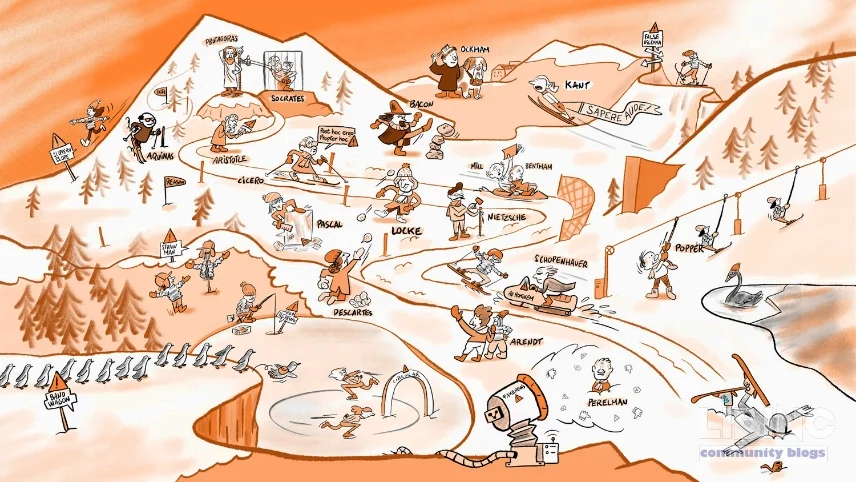
The diagram of fallacies presented in classical and modern texts is not a relic; it lives in contemporary discourse. The eight named fallacies—slippery slope, straw man, bandwagon, circular reasoning, red herring, post hoc ergo propter hoc, ad hominem, and false dilemma—function as a portable toolkit for diagnosing weak arguments in real time. The challenge is subtler than naming them. It lies in recognizing implicit premises, optional assumptions, and the social incentives that reward rhetorical cleverness over epistemic accuracy.
In the age of post-truth, the temptation to shortcut truth through emotional or reputational leverage remains strong. A claim backed by a majority may feel authoritative, yet it can be hollow without robust evidence. A single striking example can create a red herring that diverts attention from the core issue. A present-tense imperative like “this policy must be adopted now” often functions as a false dilemma that narrows the field of viable options. The digital ecosystem intensifies these dynamics: algorithms reward engagement, not truth; micro-targeted messaging exploits cognitive biases; and data visualization can be both enlightening and misleading, depending on the design and intent behind it.
To counteract these forces, we must insist on four practices. First, demand explicit premises and definitions before evaluating conclusions. Second, test claims against falsifiability and reproducibility, not merely plausibility. Third, scrutinize the medium as a channel for argument, not just a conduit for information. Fourth, evaluate the source with a skepticism proportional to the stakes and to potential conflicts of interest. When these practices become routine, the same fallacies lose their ability to distort judgment, and public discourse gains a firmer ground for agreement or legitimate disagreement.
- Slippery slope: a chain of undesirable outcomes presented as inevitable.
- Straw man: misrepresenting an opponent’s position to make it easier to attack.
- Bandwagon: appealing to popularity rather than quality of argument.
- Circular reasoning: using the conclusion as a premise, without justification.
- Red herring: introducing irrelevant material to distract from the main issue.
- Post hoc ergo propter hoc: confusing temporal sequence with causation.
- Ad hominem: attacking the person rather than the argument.
- False dilemma: restricting the spectrum of options unduly.
Expert reconstruction: Lessons for today’s information landscape
Scholars like Chaïm Perelman reframed argument as a social practice aimed at aligning an audience to a thesis without sacrificing critical scrutiny. The New Rhetoric emphasizes proof as a discursive technique that persuades by coherence and relevance, not by power alone. Karl Popper’s standard of falsifiability provides a practical test for scientific claims, including those that arise in economics, psychology, or AI research. Hannah Arendt’s call for broad-based clarity underlines a democratic imperative: thinking aloud in public forums should be a shared discipline, not an elite privilege. Taken together, these perspectives offer a practical blueprint for contemporary critical thinking.
The digital age compounds the urgency of such a blueprint. Generative AI, machine learning, and sophisticated analytics reshape what counts as evidence, how quickly arguments circulate, and who has the authority to speak. The antidote is neither blind skepticism nor naive credulity, but a disciplined practice of evaluating argument structure, traceable evidence, and transparent methodology. In classrooms, newsrooms, policy labs, and online communities, the aim is to cultivate citizens who can dissect claims, test them against reliable data, and adjust beliefs in light of new, credible information. This is not a simple skill set but a dynamic practice that adapts as technology and society evolve.
Developing a robust culture of critical thinking requires four commitments. First, prioritize explicit reasoning over rhetorical flourish. Second, demand openness to challenge and revision, embracing falsifiability as a pathway to truth. Third, treat the medium as part of the argument, not a neutral backdrop. Fourth, foster ethical awareness: the best arguments aim to advance understanding, not merely win a debate. If these commitments take root, modern publics can curb the coercive power of sophistry and recover the integrity of public discourse.
- Explicit reasoning: demand clear premises, definitions, and warrants.
- Openness to revision: welcome falsifiability and new evidence as progress marks.
- Media as argument: scrutinize how format, platform, and design affect persuasion.
- Ethical discipline: align discourse with truth-seeking and public good.
In sum, critical thinking is not a static possession but a living discipline tuned to the pressures of its time. From the Greek agora to the digital agora, the core questions remain: What is the evidence for this claim? How does the reasoning force align with ethical standards? And what are the consequences if we accept or reject the conclusion? Answering these questions requires the kind of disciplined skepticism that Socrates championed, tempered by Aristotle’s insistence on coherent structure and Perelman’s sense of audience. If we cultivate that synthesis, we gain not just sharper arguments but wiser judgment in a world where truth competes with speed, image, and appetite for simplification.
Glossary and methodological notes
The following terms anchor the discussion for readers seeking precision in argumentation. Though not exhaustive, they provide quick references to common concepts that recur throughout the history of critical thinking:
- Sophist: a rhetorician who prioritizes winning arguments over discovering truth.
- Fallacy: a reasoning error that undermines argumentative validity or relevance.
- Ethos, logos, pathos: ethical, logical, and emotional appeals in rhetoric.
- Falsifiability: the possibility that a claim can be disproven by an experiment or observation.
- Post hoc, causation: distinguishing correlative patterns from causal relations.
- Evidence-based reasoning: basing claims on reproducible data and transparent methods.
Conclusion
Critical thinking remains a living, evolving discipline. The ancient quarrels between Sophists and Socrates mature into modern standards of evidence, testability, and ethical debate. The digital era amplifies both the risks and the opportunities: it can spread sound reasoning at scale or scatter it through noise. The choice is ours. By maintaining rigorous argument structures, embracing falsifiability, and treating medium and message as inseparable, we can sustain a public sphere where truth has room to breathe and be tested.
Practical field guide: applying critical thinking to daily digital life
To close the practical gap, readers can adopt a lightweight workflow that mirrors the article’s four lenses: analytics, contrast, causes, reconstruction. This compact routine is designed for real-time use, with five explicit steps that fit into a 60‑second scan or a longer evaluation when the stakes are high.
Field-work cue
Five-step diagnostic: claim, premises, evidence, medium, conclusion. Use it before sharing or reshaping the narrative.
- State the claim: restate the central assertion in a concise form.
- Enumerate premises: list explicit assumptions supporting the claim.
- Review evidence and test falsifiability: identify data sources, methods, and whether a counterexample could disprove it.
- Assess the medium: consider incentives, platform design, and potential biases of the channel.
- Communicate with clarity: summarize the conclusion with explicit warrants and caveats.
Examples anchor the routine in real life:
- Example 1: A viral post claims a miracle diet doubles weight loss in two weeks. Break down the premises, verify the source, check sample size and controls, and compare with independent studies before accepting the claim.
- Example 2: A dashboard shows a 34% improvement in productivity. Inspect data provenance, date range, measurement method, and whether outliers are accounted for.
- Example 3: A policy brief asserts that a new regulation reduced unemployment. Seek independent evaluations, look for confounding factors, and test for reproducibility across regions.
| Question | What to verify |
|---|---|
| Claim | Is it specific and testable? |
| Evidence | Source credibility, sample size, controls |
| Conclusion | Does the reasoning follow from the warrants? |
| Medium | Platform incentives and design effects |
Adopt this routine as a standard habit in reading, watching, and sharing information. It cultivates digital media literacy, strengthens evidence-based reasoning, and reduces susceptibility to cognitive biases in everyday decisions.
How can I apply the four lenses in real life when reading online content?
To apply these four lenses—analytics, contrast, causes, and reconstruction—in real life, begin by isolating the claim, translating it into a concise testable statement, then enumerate the explicit premises and the minimum evidence required to support each premise, followed by a rapid check of source credibility, data quality, and potential incentives that shape the message, next imagine a credible disconfirming case to test falsifiability, compare alternative explanations for the observed effect, and finally summarize your judgment with a precise, citable justification that you could defend in conversation or debate. This habit stabilizes judgment across diverse topics and reduces snap judgments.
What makes a claim falsifiable, and why does that matter for everyday decisions?
Falsifiability means the claim could be shown false under some circumstances; in practice, look for conditions, contexts, or data that would contradict the claim, check whether such tests exist or could be feasibly designed, and assess whether credible researchers or institutions have attempted or could attempt such tests; without the possibility of refutation, the statement remains untestable and thus intellectually weak, so you should require specific predictions, transparent methods, and independent replication to elevate it toward knowledge. This approach guards against marketing spin and strengthens decision quality in daily life.
How should the medium influence our assessment of an argument?
The medium shapes perceived credibility through design and incentives; for example, a post with a sensational headline can trigger confirmation bias even when the underlying data are tenuous, while a peer‑reviewed article requires different scrutiny; thus always examine layout cues, data source labels, uncertainty intervals, and the presence of methods or protocols; awareness of algorithmic curation helps adjust confidence in the claim rather than treating it as unassailable.
How can we recognize and counter common fallacies in fast-moving news cycles?
To recognize and counter fallacies, maintain a habit of listing premises, identifying the fallacy type, and verifying whether a red herring or false dilemma is present; practice with concrete examples from current events and compare against independent sources; use a two‑column check: what is claimed vs what is evidenced; this discipline reduces knee-jerk reactions and fosters more constructive dialogue that advances understanding rather than amplifies noise.
What practical steps can educators take to foster critical thinking?
Educators can promote critical thinking by embedding structured argument analysis, explicit reasoning, and transparent methodology into lessons; provide exercises that require tracing claims to premises, evaluating evidence, and practicing falsifiability; integrate real-world datasets, simulations of media environments, and safe spaces for revision and debate; these methods build digital literacy and public-minded reasoning that learners carry into work, policy, and community life.






Add a comment
To comment, you need to register and authorize
Comments