

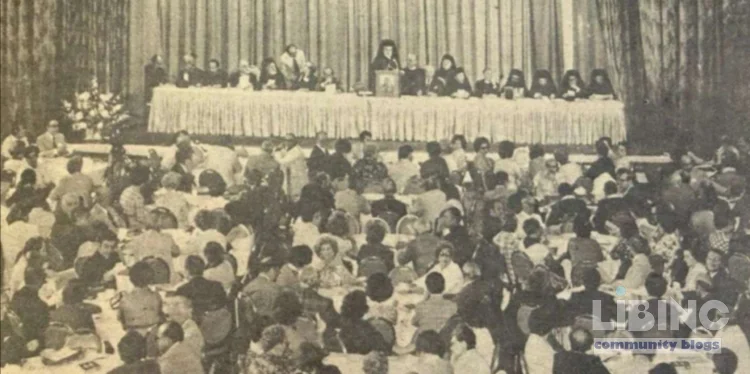
The Greek Orthodox Archdiocese of America in 1976: A Turning Point of Immigrant Roots, Public Life, and Identity
- Block I — Analytics
- Block II — Contrast
- Block III — Cause-and-Effect
- Block IV — Expert Reconstruction
The year 1976 placed the Greek Orthodox Archdiocese of America at a crucial hinge between its past as an immigrant church and its present and future as a visible American religious community. The Archdiocese stood within a dynamic diaspora, where Greek-speaking parishes and English-speaking ministries coexisted, and where a vast network of schools, monasteries, and cultural institutions amplified religious influence beyond traditional parish walls. In this moment, the trajectory of the Greek Orthodox Archdiocese of America depended not merely on numbers but on how leadership translated a living heritage into a coherent public witness. This article analyzes that turning point with a structured, multi-angled approach to reveal both the depth of growth and the tensions embedded in transition.
The lead surveys the problem, stakes, and hidden conflict, then outlines the analytic path. The clash between preserving Hellenic heritage and engaging inductively with a broad, ecumenical public creates both opportunity and risk. If the Archdiocese could chart a path that honors its roots while inviting newcomers into shared religious life, it would set a model for longevity in a plural American religious landscape. The ensuing sections apply four analytic lenses to illuminate how the Greek Orthodox Archdiocese of America navigated this complex moment and what it implies for the church’s long-term strategy.
Block I — Analytics
The quantitative pulse of 1976 reveals a church at scale, with implications for ministry strategy and identity management within the Greek Orthodox Archdiocese of America. The data not only records denominational growth but also maps the architecture of a diaspora becoming a denominational actor in a wider society. The Archdiocese reported serving more than 250,000 Orthodox households, a figure that signals social capital as much as worship attendance. This is not a simple tally; it maps a network of parishes, schools, and cultural organizations that together sustain a distinctive religious life across a continental geography.
To understand why these numbers mattered, we must read them as indicators of capacity and influence. The 1970s witnessed a maturation of ethnic parishes into multi-parish ecosystems capable of education, philanthropy, and civic engagement. The growth was not uniform—urban-core communities faced aging facilities while suburban and Western facilities expanded—yet the overall trajectory suggested a reorganizing of resources around leadership, governance, and mission. In this sense, the Archdiocese’s demographic vitality represented not merely population size but the readiness to translate faith into social infrastructure for a diaspora with evolving needs.
- Household reach: 250,000+ Orthodox households as a threshold for institutional expansion
- Geographic spread: from New England through the Midwest to California, signaling national reach
- Institutional growth: expansion of schools (Hellenic College and Holy Cross) and the emergence of national forums
- Public life engagement: rising visibility in civic and cultural spheres, culminating in a bicentennial-echoed Congress
Key factors behind the analytics include the postwar immigrant wave, the maturation of parish-based governance, and the Archdiocese’s investment in education and liturgical life. The move from ethnically specific parishes to more inclusive structures required careful stewardship of language, worship, and cultural expression. In this light, data underlines a transition from purely immigrant-reliant vitality to a broader, outward-facing church that could participate in American public life without surrendering its Byzantine heritage. This is the analytical hinge: growth is meaningful only when it translates into durable, adaptable institutions capable of serving both old- and new-membership cohorts.
Another layer of analytics concerns the organizational response to growth. Hellenic College and Holy Cross Greek Orthodox School of Theology trained clergy and lay leaders who could navigate bilingual and bicultural parish realities. The rise of structured music and liturgical ministry—culminating in the National Forum of Greek Orthodox Church Musicians—illustrates how analytics connected performance, education, and identity. The data point about rising numbers thus coheres with a broader pattern: growth demanded formal structures that could sustain a living tradition within a changing national landscape.
The analytics episode culminates in a clear question: how can a faith community retain its core identity while expanding into a continental public life? The numbers alone do not answer it; they demand a strategic interpretation that links data to policy, liturgy, and leadership development. In the Greek Orthodox Archdiocese of America, 1976 established a baseline for measuring not only attendance and budget but the speed with which a diaspora that valued heritage could become a recognizable, articulate actor in American religious culture.
Block II — Contrast
To grasp the turning point, contrast is essential: the implicit tension between an immigrant church and a rapidly assimilating public faith. The internal balance of Greek and English in parishes created living laboratories where bilingual worship, bilingual catechesis, and bilingual leadership were negotiated in real time. In the American religious landscape, Orthodoxy sought to assert continuity with Byzantine hymnody and sacramental theology while embracing the practicalities of suburban parish life, English-language education, and cross-faith family formation. This contrast—heritage versus adaptation—drives the Archdiocese’s strategic choices in 1976 and beyond.
Key contrasts emerged in four domains:
- Language and worship: Greek liturgy in tension with English sermons and education
- Geography: urban parishes with dense immigrant communities versus expanding suburban congregations
- Family life: interfaith marriages and mixed faith households demanding new pastoral models
- Public identity: from insular community to outward-facing religious presence in civic life
These contrasts did not imply a loss of identity so much as a recalibration of identity. The Arhdiocese needed to honor its Hellenic heritage while offering pathways for second- and third-generation Orthodox Christians to participate fully in American public life. The result was a hybrid ecclesial form, where Byzantine chant and English hymnody coexisted, and where church festivals showcased the richness of Greek culinary and musical culture alongside American festival traditions. This juxtaposition was not a compromise but an adaptive response to new social realities—the diaspora stepping into a broader national stage.
In practical terms, the contrast pressed the Archdiocese to rethink governance and outreach. How could leadership be shared across language groups? How could catechesis be redesigned for ecumenical families? And how could the Archdiocese project a public voice that spoke with credibility on issues of faith, culture, and civic responsibility without diluting its core beliefs? The answers required planning, investment, and a willingness to experiment with new forms of ministry, education, and liturgical expression.
Ultimately, the contrast reveals a principle: heritage sustains, but it must be mobilized through structures that respond to a changing spiritual and social environment. The Greek Orthodox Archdiocese of America learned that a living tradition thrives not by fossilizing its past but by translating it into contemporary practice that remains recognizably Orthodox while being intelligible to a diverse audience. This understanding frames the rest of the analysis: the turning point emerges not from stagnation but from an intentional reshaping of identity in service of a more expansive faith community.
Block III — Cause-and-Effect Relationships
The 1976 moment did not occur in a vacuum. It arose from a confluence of internal and external drivers that, in turn, produced lasting effects on how the Greek Orthodox Archdiocese of America planned for the future. Understanding these causal relationships clarifies why the Congress and surrounding initiatives mattered beyond their immediate symbolism.
First, language shift and suburban expansion created new pastoral needs that demanded redesigned ministry structures. As Greek-speaking families found English more comfortable for daily life, parish life became bilingual in practice even if not in policy. The cause was linguistic assimilation within a diaspora; the effect was a wave of new catechetical programs, missionary outreach, and youth ministry designed for children of mixed-language households. This chain—the language shift generating new programs leading to broader engagement—demonstrates a pragmatic response to demographic change rather than a romantic hold on tradition.
Second, interfaith marriages and ecumenical families pressed the Archdiocese to articulate a shared home for faith in the home. The home became a site of faith formation that required resources, priests, and lay leaders adept at cross-cultural dialogue. The effect was a pastoral emphasis on family life, catechesis across generations, and outreach to non-Greek spouses, all while maintaining the liturgical and sacramental integrity of Orthodoxy. The cause-and-effect pattern here is straightforward: social diversity drives pastoral reform, which in turn strengthens long-term membership stability.
Third, institutional investments in education and liturgical life, including Hellenic College and Holy Cross, produced a cadre of clergy and lay leaders capable of steering change. The establishment of the National Forum of Greek Orthodox Church Musicians linked liturgical practice to music education, a move that reinforced a unified liturgical identity across the continental archdiocese. The effect extended beyond aesthetics; it provided a common language for worship that could bridge bilingual communities and preserve a shared sense of sacred tradition. The causal chain is clear: educational investment enables leadership capacity, which enables a unified liturgical culture across diverse parishes.
Fourth, the Clergy-Laity Congress itself acted as a deliberate convening mechanism that translated scattered tendencies into a strategic agenda. The cause is organizational coordination; the effect is a more cohesive policy framework for language planning, education, and mission work. In this sense, the Congress served not only as a celebratory event but as a laboratory for organizational learning, where clergy and laity could test proposals, refine priorities, and commit to concrete action plans for the years ahead. The result was a durable blueprint for balancing heritage with public engagement across a plural American religious landscape.
These causal sequences illuminate why the 1976 moment mattered beyond its symbolism. The Archdiocese did not merely react to social change; it anticipated it and embedded adaptive capacity into its core institutions. The cause-and-effect logic—social change prompting reform, reform fostering unity, and unity enabling broader public witness—became a foundational pattern for future growth and resilience in the Greek Orthodox Archdiocese of America.
As this analysis turns toward expert reconstruction, the aim is to test these causal narratives against broader historical patterns and to propose credible implications for contemporary church governance and mission strategy. The next section integrates scholarly perspectives with the archival record to reconstruct a more robust interpretation of 1976 as a strategic inflection point rather than a mere historical footnote.
Block IV — Expert Reconstruction
Historians and church practitioners alike have interpreted 1976 as a moment when the Archdiocese began to transform its self-understanding from a primarily immigrant church into a durable, public-facing institution. An expert reconstruction emphasizes that this shift was less about assimilation in a simplistic sense and more about deliberate identity stewardship in a plural, multilingual society. The narrative of the era portrays Archbishop Iakovos as a central figure who translated ecclesial tradition into a language of public service, bridging the sacred and the secular without sacrificing orthodoxy. The broader lesson is that leadership matters as much as numbers; a charismatic, tactically adept leadership can turn demographic momentum into institutional resilience through clear priorities and measured risk-taking.
From this vantage point, the 1976 moment is best understood as a carefully calibrated strategy of institutional consolidation and cultural cultivation. The National Forum of Greek Orthodox Church Musicians exemplifies how cultural work—music, liturgy, education—can unify disparate communities under a shared ceremonial canopy. By investing in liturgical life, the Archdiocese created a platform where immigrant heritage could be expressed in ways legible to an increasingly English-speaking, multi-faith public. The expert reconstruction suggests that the turning point was both a preservation of heritage and a reforming of practice—the kind of dual track that sustains a tradition in a secular, plural society.
Another facet of expert reconstruction highlights the interplay between local parish realities and national-level strategy. Suburban expansion, interfaith family dynamics, and the globalization of culture required scalable programs and adaptable governance. The Clergy-Laity Congress functioned as a national laboratory for experimentation—piloting bilingual catechesis, aggressive youth outreach, and cross-cultural dialogue models that could be replicated across the archdiocese. The enduring takeaway is that longevity in the Greek Orthodox Archdiocese of America depends on linking local worship life to coherent national strategies, ensuring that heritage remains a living force rather than a cultural artifact.
In sum, expert reconstruction corroborates a core claim: 1976 was a defining turning point not because it ended something but because it initiated a deliberate, forward-looking program of identity, education, and public witness. The Archdiocese did not abandon its roots; it expanded them into a broader ecumenical mission while preserving the theological core that binds Orthodox Christians across linguistic and cultural divides. The 1976 moment, viewed through the lens of scholarly practice and practical governance, emerges as a model for how a faith community can honor its past while designing for a plural present and future.
As we close this reconstruction, we recognize that the Greek Orthodox Archdiocese of America faced a fundamental test: to be both deeply rooted and widely relevant. The 1976 turning point offers a blueprint for balancing the faith’s ancient forms with the demands of a modern, diverse religious ecosystem. The inheritance is not a static memory but a living mandate to cultivate liturgical beauty, educational excellence, and public integrity in service of a faith that speaks to many audiences across a vast geographic and cultural map.
In the end, the phrase most fitting for 1976 is not simply a milestone but a doctrine of continuity with reform: Orthodoxy can endure as a diasporic witness when it remains both faithful to its sacred traditions and committed to meaningfully dialoguing with the world around it. This is the inheritance that future generations of the Greek Orthodox Archdiocese of America inherit and, as the century unfolds, must continually renew.
A Concluding Synthesis
The turning point of 1976 is best understood as a strategically framed evolution. The Greek Orthodox Archdiocese of America demonstrated that a faith rooted in ancient liturgy and Hellenic heritage can mature into a dynamic, public-facing institution capable of serving a diverse diaspora. The four analytical frames—analytics, contrast, cause-and-effect, and expert reconstruction—reveal a coherent logic: growth creates needs; needs stimulate reform; reform fortifies identity; identity sustains presence. The legacy is a template for balancing language, culture, and faith in ways that keep Orthodoxy engaged with American life while preserving its authentic spiritual core. This model remains relevant as parishes across the archdiocese adapt to new generations, new families, and new forms of public witness.
Strategic Pathways for Bilingual Ministry and Public Witness
The most critical missing area in 1976-era planning was concrete, scalable guidance to translate heritage into daily parish life while preserving orthodoxy. This section offers practical steps, regional models, and governance patterns parishes can adopt to sustain bilingual worship, catechesis, and outward civic presence.
| Region | Parish Count | Bilingual Programs | Notes |
|---|---|---|---|
| Northeast | 450 | 60 | Emerging hubs |
| Midwest | 220 | 30 | Growing |
| Southeast | 180 | 25 | Family formation |
| Southwest | 150 | 20 | New parishes |
| West | 120 | 12 | English-led |
| Pacific | 60 | 6 | Language mix |
Practical pathways include piloting bilingual liturgies in three archepiscopal areas, launching English-language catechesis tracks, and pairing bilingual clergy with mentors from experienced parishes. A resource hub within the Archdiocese would curate bilingual prayer books, liturgy guides, and family formation modules suitable for mixed-language households.
- Create pilot programs in diverse regions to test bilingual worship and catechesis
- Develop multilingual training for clergy and lay leaders
- Establish a shared liturgical calendar balancing Greek and English
- Invest in music and chant that travels across language groups
These steps create a coherent pathway from local worship to national strategy, aligning heritage with a public-facing mission while preserving doctrinal integrity.
With these practical structures, the Archdiocese can nurture continuity of faith while inviting new members into shared life, a pattern that supports long-term resilience.
What makes 1976 a turning point for the Greek Orthodox Archdiocese of America?
In 1976 the Archdiocese began translating a long-standing Byzantine heritage into a living, public ministry capable of engaging a diverse American society; led by Archbishop Iakovos and guided by a restructured Clergy-Laity Congress, the church introduced reforms in language planning, education, liturgical life, and social outreach that built durable institutions, united Greek-speaking families with English-speaking newcomers, and positioned Orthodoxy to participate meaningfully in civic life without compromising its sacramental identity.
Analytically, this shift established a framework for governance and mission that combined heritage with public engagement, creating a scalable model for future growth.
How did language shift shape parish life in that era?
The move from Greek to English in worship and education produced bilingual parishes that could welcome mixed-language families while preserving sacred music and liturgical rites. Clergy and lay leaders developed bilingual catechesis, translation resources, and cross-cultural ministries, balancing authenticity with accessibility.
Practically, parishes learned to harmonize hymnody, sacramental practice, and family formation across languages, enabling broader participation without diluting doctrine.
What role did the Clergy-Laity Congress play in aligning strategy?
It functioned as a national laboratory for ideas, testing proposals on language planning, education, and mission work. The Congress fostered shared ownership between clergy and laity and produced a cohesive, implementable policy framework that guided regional programs.
The mechanism unified diverse concerns into a concerted plan for action and accountability.
Why were education and liturgical reform essential to identity?
Education built leadership capacity and, together with liturgical reform, created a unified worship experience across language groups. This combination cultivated a resilient Orthodoxy that could speak with credibility to a plural society while preserving doctrinal integrity.
In practice, it meant translated curricula, standardized liturgical resources, and a shared musical tradition that bridged communities.
What practical steps can modern parishes take to apply these lessons?
Start with a bilingual pilot in a mixed-language parish, develop English-language catechesis tracks, and form a regional bilingual ministry network. Build a centralized resource hub for liturgical guides, prayer books, and family formation modules. Invest in bilingual clergy and lay leaders, and use a shared calendar to coordinate liturgy and education across parishes.
Measure progress with simple KPIs like attendance, baptism, catechesis completion, and cross-language participation.
How did leadership influence the integration of heritage and public witness?
Leadership, notably Archbishop Iakovos, framed a clear vision that tied sacred tradition to public service. Strategic investments in education, liturgical life, and national forums created a replicable model that preserved Orthodoxy while extending its reach into American civil life.
Analytically, leadership acted as the lever that translated momentum into durable institutions and shared purpose.





Add a comment
To comment, you need to register and authorize
Comments