

AI Retrofit for Industrial Robots: A Pragmatic Path to Near-Term Productivity
- Analytics view: Economics of AI retrofit on installed FANUC robots
- Contrast: Retrofit versus humanoid bets on the factory floor
- Cause and effect: How this retrofit path changes adoption dynamics
- Expert reconstruction: What operators should do now
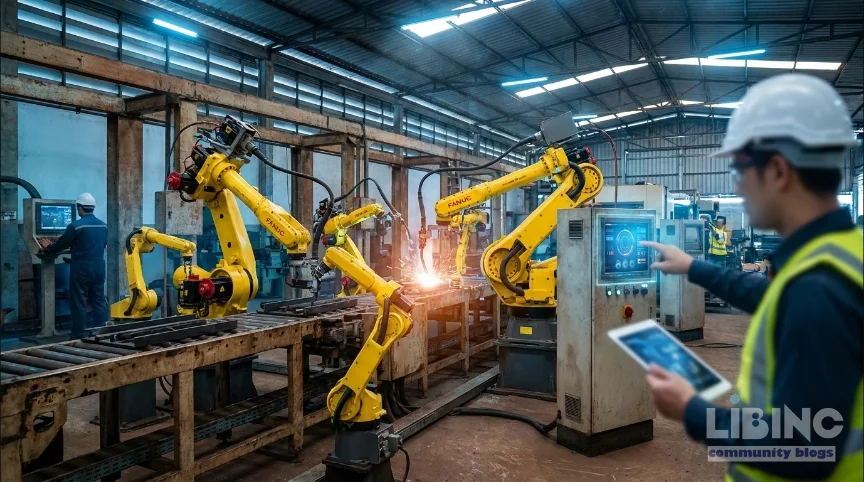
Problem is clear on the factory floor: labor gaps and skilled-wittering turnover threaten throughput and consistency. The most consequential move this year is not a new robot but a software and intelligence upgrade to the machines already on the line. The FANUC and Google collaboration reframes automation from a hardware chase to a cognitive upgrade of the installed base, aiming for a faster, lower-risk path to relief. The hidden tension is that media attention focuses on humanoid ambitions, while the market quietly leans into a brownfield solution that leverages proven assets. This article traces the logic, compares paths, and asks what operators should buy with capex in the near term: more thinking, not more parts on the line.
Analytics view: The economics of AI retrofit on installed FANUC robots
The retrofit strategy builds on FANUC's large installed base and Google Cloud's Gemini Enterprise, Intrinsic, and ROS stack to deliver an agent layer that can interpret instructions, recognize objects, and orchestrate task execution on existing arms. The move is not a marketing stunt; it is a software-and-integration upgrade capable of running across FANUC's entire arm catalog, from light cobots to heavy 2.3-ton payloads. In economic terms, the value proposition shifts from purchasing new hardware to monetizing a preexisting asset with software that enhances perception, decision-making, and control on a live line. This is a fundamental reframing of automation capital, nudging the calculation toward software-enabled throughput gains and reduced downtime rather than outright capex for new machines. LSI: brownfield automation.
The cost of ownership dynamics change when you retrofit. A FANUC arm has already cleared the most onerous gates: safety interlocks, cell integration, and proven throughput in production. The retrofit path avoids the safety-validation grind and the large, multi-month reliability tests required for new machine classes. Operators can treat the upgrade as a software-and-services package that preserves existing ROI cadences while expanding capability. The economic argument hinges on utilization: if the upgraded line can adapt to variation without re-teaching, the incremental benefit is compoundable across multiple shifts and product mixes. The formal payback hinges on reliability, predictability, and the expanded skill set of the operator, not just the marginal cycle time of a single task. LSI: throughput validation.
The engine behind the analytics is that an installed base of roughly 1.1 million FANUC arms constitutes a vast pool for retrofit opportunity, rather than a market needing a new class of machines. The practical reach of the upgrade depends on whether the right generation, controllers, and sensors exist on the line to enable a seamless integration with Gemini Enterprise, Intrinsic, and ROS drivers. If a significant portion of these arms are already in productive use and meet the retrofit prerequisites, the addressable market becomes a software-and-integration play with expected faster payback than any new robot program. The argument rests on retrofit feasibility and operating discipline as much as on the size of the installed base. LSI: brownfield automation.
Traction is real: FANUC reports shipment of more than 1,000 robots for physical-AI applications since the December 2025 debut, signaling demand that moves beyond demonstrations. The 1,000+ units are not a marketing statistic; they are evidence that operators trust the upgrade path enough to commit real capital and changeover planning. The success hinges on how many of these units can be migrated onto production lines without disrupting safety interlocks or throughput. If the retrofit proves scalable, the base-case ROI improves as the deployment footprint expands and maintenance demands stay within familiar operational envelopes. LSI: throughput optimization.
Contrast: Retrofit versus humanoid bets on the factory floor
Humanoid and advanced-bot programs attract headline attention, but their near-term impact on high-volume assembly lines remains uncertain. Hyundai and Boston Dynamics unveiled Atlas production concepts for 2028, with a stated capacity goal of 30,000 units per year as a horizon target. That pace is compelling, yet it rests on unproven integration into live manufacturing and a longer safety-validation cycle. The short horizon for retrofit is clearer: operators can realize meaningful benefits within 12–24 months, using the assets they already know and trust. This is not a minor timing difference; it is a difference in risk posture and capital discipline. LSI: humanoid automation.
Schaeffler's approach illustrates the same trend: deploying Digit humanoid on 8-hour shifts at scale and partnering with Agility for a fast deployment path. The pattern across both cases is a staged, multi-year rollout with safety, validation, and uptime guarantees still in progress. In contrast, the FANUC-Google path emphasizes leveraging the robust performance envelope of existing machinery, backed by a cloud AI stack and a familiar control architecture. The contrast is not only about speed to deploy but also about where risk is concentrated: hardware novelty versus software-assisted reliability. LSI: staged rollouts.
Other hardware-focused bets, like the 2028 timetables for humanoids, imply a longer period before scalable line performance is demonstrated. The brownfield proposition offers a different risk calculus: you preserve the factory's line safety, train the operator on the upgraded intelligence, and reduce the capital risk of introducing a new machine class that must prove itself in a live line before you trust it with high-volume output. This is particularly salient for industries with high mix and frequent product changes, where re-teaching a line to a humanoid can dwarf the short-term savings from faster cycles. LSI: safety validation.
Cause and effect: How this retrofit path changes adoption dynamics
The retrofit path reshapes the adoption curve in three core ways. First, it lowers the barrier to entry by turning capex into a software-and-integration commitment with clear milestones and faster ramp. Second, it aligns with the operating realities of brownfield plants where lines already exist, safety systems are validated, and changeovers must be carefully managed to avoid throughput losses. Third, it creates a lever for ongoing capability expansion rather than a single-point improvement: once the cognitive layer sits on a stable hardware axis, operators can progressively widen the skill set embedded in the line. The result is a gradual, observable improvement in OEE and line stability as more arms become AI-enabled on the same floor plan. LSI: safety validation.
Yet there are critical caveats. The stack used in the FANUC-Google collaboration—Gemini Enterprise as the cognitive front end, Intrinsic for development and orchestration, and ROS as the control backbone—does not claim universal autonomy. It offers sophisticated task execution under instruction, not a universal cognitive agent capable of any factory task. The plan is to enable reliable, repeatable actions on industrial hardware, not to replace human oversight entirely. The result will hinge on the robustness of the integration, the ability to test across line variations, and the quality of the safety and validation workflows that govern production in harsh, real-world environments. LSI: industrial robotics stack.
Another subtle effect is the impact on supplier ecosystems. If retrofit becomes a standard path, equipment suppliers may accelerate investments in compatible sensors, controllers, and safety features that ease integration with AI stacks. This could catalyze a broader ecosystem shift toward software-first automation on legacy hardware, compressing the time-to-value for many plants and sharpening competition among vendors. In that sense, the retrofit play acts as a catalyst for a market-wide realignment around software-enabled durability of installed assets. LSI: ecosystem acceleration.
Expert reconstruction: What operators should do now
Manufacturers weighing automation spend in the next 24 months should adopt a disciplined, risk-aware approach to AI retrofit. Here is a practical reconstruction of steps, informed by the FANUC-Google model and the lessons from humanoid bets.
- Audit the installed base for retrofit suitability
- Identify robots with compatible controllers, sensors, and safety interfaces
- Assess line criticality, changeover frequency, and downtime windows
- Define a staged upgrade plan
- Start with pilot cells that have the highest defect rates or variability
- Set measurable targets for uptime, cycle-time, and defect rate before expanding
- Establish a governance model for safety and validation
- Map safety cases, approvals, and validation checkpoints with the plant's safety team
- Plan revalidation after major line changes or product launches
- Invest in operator upskilling and change management
- Train floor teams on AI-driven decision making and monitoring
- Develop dashboards that translate AI outputs into actionable line decisions
- Pipe governance, performance measurement, and feedback loops
- Track total improvement in OEE, scrap reduction, and throughput stability
- Iterate the cognitive layer with real-world learnings from production
For operators, the core decision is not whether to buy AI, but which form of AI to adopt on the installed base, and how to accelerate adoption without destabilizing the line. The FANUC-Google approach offers a controlled, scalable path that leverages existing assets and safety infrastructure while delivering autonomous task execution where it matters most: on the factory floor. Embracing this path requires discipline in scoping, validation, and change management, but it promises faster relief for labor gaps and a smoother transition toward more adaptable manufacturing. LSI: brownfield automation.
In the end, the fastest route to meaningful productivity may be quieter than the loud promises of humanoids: retrofit intelligence onto what you already run. The installed FANUC base provides a durable platform, and a software-driven upgrade can unlock substantial improvements in resilience and efficiency without the risk of introducing an unproven machine class. The modern plant manager will need to balance immediate labor relief with long-term capability growth, choosing a path that earns the right to scale. The evidence from early deployments suggests this is a credible, near-term strategy for factories that need to tighten a gap between demand and available labor. LSI: safety validation.
Ultimately, the choice comes down to what a plant can control today. Retrofit offers a faster, lower-risk payoff on a line you already depend on, while humanoids promise long-run upside with more transformative potential. The prudent path blends both: maximize the value of your existing assets with intelligent upgrades, while watching the humanoid programs for pragmatic milestones that justify larger bets in the future. This balanced view respects the realities of production, where reliability and uptime trump speculative capability. LSI: ecosystem acceleration.
As operators move forward, the question becomes a practical one: how do you translate this AI retrofit into a reliable, repeatable improvement on the line in the next 12 to 24 months? The answer rests in disciplined pilots, robust validation, and a governance framework that ties AI decisions to concrete operational outcomes. If executed well, the installed FANUC base can become a more intelligent, more resilient backbone of modern manufacturing—without the disruption of rip-and-replace programs. LSI: throughput validation.
Closing thought: the industry is watching a shift from chasing the latest robot to upgrading what already exists with smarter software. The potential payoff is not merely incremental; it is transformative for the economics of automation, especially in brownfield environments where the line is king and downtime is costly. AI retrofit for industrial robots is not a novelty; it is the near-term pragmatism manufacturing needs to stay competitive. The pace will hinge on execution, validation, and the ability to turn cognitive perception into practical action on the factory floor. LSI: industrial robotics stack.
A pragmatic ROI blueprint for AI retrofit
Implementing AI retrofit requires a concrete, staged plan that translates potential improvements into measurable results. This section closes a key gap by outlining a realistic pilot framework, with example targets, governance, and risk controls that align with brownfield realities.
Table: Pilot ROI Snapshot
| Criterion | Retrofit Outcome | Humanoid Outcome | Time to Value | Key Risks |
|---|---|---|---|---|
| Upfront capex | Low (software/integration) | High (new hardware + integration) | 3–6 months | Procurement delays, safety validation gaps |
| Uptime improvement | +3–5 percentage points | Varies by line | 6–12 months | Control changes, sensor compatibility |
| Cycle-time impact | -8% to -15% | -15% to -25% | 12–18 months | Line variation, task specificity |
| Changeover time | -40% to -60% | -30% to -50% | 12–36 months | Product mix complexity, tooling changes |
| Payback | 12–24 months | 3–5+ years | 12–24 months | Longer ramp, hardware risk |
Infographic: ROI levers and targets
- OEE uplift: 3–7 percentage points
- Downtime reduction: 20–40%
- Scrap reduction: 5–15%
Process flow: Pilot to scale
- Audit the installed base to identify compatible controllers, sensors, and safety interfaces
- Define a staged upgrade: start with high-variability cells and set measurable targets
- Establish governance for safety validation and revalidation after line changes
- Upskill operators with AI decision-making training and monitoring dashboards
- Track improvements in OEE, scrap, and throughput; iterate the cognitive layer with live data
What is the AI retrofit approach and why does it matter now?
In practical terms, the retrofit layers perception, decision, and orchestration software on top of an existing FANUC base, leveraging cloud cognitive services to interpret instructions and coordinate actions. This matters now because it reduces the risk and lead time of new hardware while maximizing the value of assets already on the line. It enables faster relief from labor gaps and supports gradual capability expansion without a full capital retooling cycle. In real deployments, the work focuses on safe integration, predictable validation, and measurable line improvements rather than speculative autonomy.
Analytically, operators gain a near-term path to higher uptime, more stable changeovers, and better defect handling. The approach also shifts supplier dynamics toward software-enabled durability of installed assets, creating a stepwise, auditable improvement curve rather than a single dramatic leap.
What ROI ranges can be expected from AI retrofit?
The ROI depends on baseline performance and product mix, but a typical brownfield case targets a payback of 12–24 months with modest to meaningful throughput gains. Retrofit tends to deliver lower upfront capex and faster risk-adjusted gains than a complete hardware replacement, while humanoid-based programs often demand longer validation cycles and higher upfront risk. Real-world benefits grow with disciplined pilots, validated safety, and scalable governance.
Analytically, the value accrues from reduced downtime, improved cycle-time consistency, and better defect control across shifts and products. The ROI is compound when the cognitiv e layer reliably handles variability and re-teach is minimized across product changes.
What does a pilot deployment look like?
A pilot builds around a high-variance cell with existing safety interlocks. Baselines are established for uptime, cycle time, and defect rate, followed by a controlled config of Gemini Enterprise and ROS orchestration. If targets are met, the upgrade scopes expand to adjacent cells with ongoing governance and validation. The result is a staged path to scale with clear milestones and repeatable methods.
From an analytics perspective, pilots should track learning curves, stability of outputs, and the rate at which new tasks are integrated without re-teaching. This creates a reliable basis for broader rollout and capital planning.
What safety and validation steps are essential?
Critical steps include mapping safety cases, defining approvals, and establishing validation checkpoints with the plant safety team. Revalidation is planned after major line changes or product launches to preserve throughput and maintain regulatory compliance. The approach minimizes risk by keeping the safety envelope consistent with what the line already certifies today.
What data and metrics are needed to monitor impact?
Key data include uptime, availability, cycle-time, changeover duration, scrap rate, and overall equipment effectiveness (OEE). A dashboard should translate AI decisions into line actions, with alerts for anomalies and a formal change-control cadence to protect production stability. Analysts should compare before/after baselines and track multi-shift variance to demonstrate durable gains.
How does this affect the supplier ecosystem and future upgrades?
The retrofit path tends to accelerate demand for compatible sensors, safer interfaces, and robust data pipelines. It can catalyze a shift toward software-first automation on legacy hardware, accelerating time-to-value across plants while keeping the door open for larger, humanoid-scale investments in the future. The ecosystem evolves toward durable, software-enabled automation that amplifies existing assets.





Add a comment
To comment, you need to register and authorize
Comments