

Industrializing the Z4: JetZero's bold bet on scaling a blended-wing-body airliner
In Greensboro, JetZero is betting on a factory-scale push to make the Z4 blended-wing body a commercial reality. The 8-million-square-foot final-assembly plant at Piedmont Triad International Airport, backed by a $4.7 billion incentive package and a job announcement of about 14,564 over the next decade, signals more than a single aircraft program. It is an industrialization wager on a non-traditional airframe—one that requires a manufacturing system capable of turning a novel aerostructure into steady, repeatable output. The core question is not whether the Z4 can fly; it is whether the enterprise can build the system that builds it. This analysis dissects the industrialization challenge, separating aerodynamics from the factory physics that will determine whether JetZero delivers at scale.
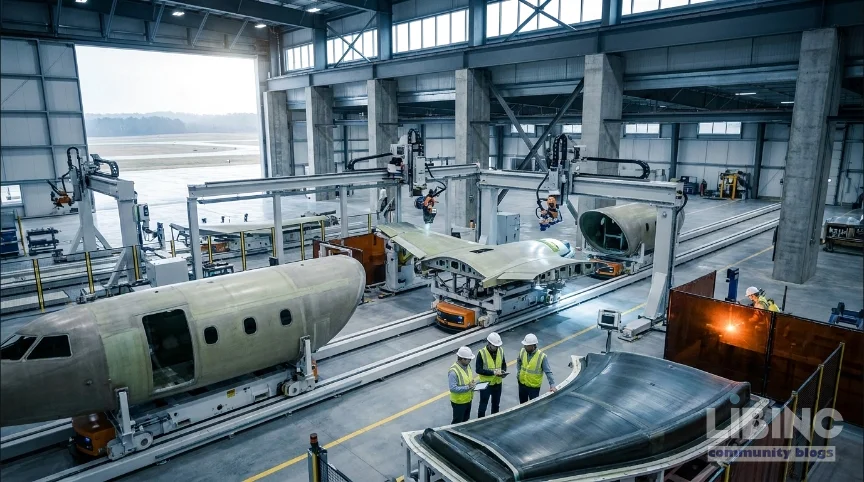
At the center of the discussion sits a 250-seat jet with a range of roughly 5,000 nautical miles, designed around a blended-wing body that fuses fuselage and wing into a single lifting surface. JetZero’s claim of up to 20 aircraft per month at full rate by the late 2030s rests on two pivots: an airframe built from stitched, resin-infused composites rather than conventional metal skins, and a factory modeled as a comprehensive digital twin before concrete ever goes into the ground. The plant is being designed with Siemens and Deloitte as part of an AI-driven, end-to-end production simulation meant to identify bottlenecks before they appear on the line. This is a manufacturing-industrialization program as much as an aircraft program, and the odds hinge on how well the two halves—structure and shop floor—are stitched together.
To frame the discussion, this article follows four lenses. First, analytics: what the Z4’s non-cylindrical pressure vessel implies for materials, tooling, and process control. Second, contrast: how JetZero’s plan compares to decades of widebody build programs and to prior flying-wing concepts that failed on economics and reliability rather than pure aerodynamics. Third, cause-and-effect: how the 8-million-square-foot footprint, the supply chain ramp, and the workforce plan interact with certification and demand, and what that means for program risk. Fourth, expert reconstruction: what a practical path to risk reduction could look like, given the realities of a pre-revenue startup trying to industrialize a non-traditional airframe at scale.
Analytics of the Z4 industrialization: turning a non-cylindrical pressure vessel into a manufacturable reality
The Z4’s geometry disrupts a fundamental aerospace truth: airframes rely on cylindrical pressure vessels to manage hoop stresses under pressurization. A blended-wing body, with a non-round cross-section, concentrates stresses in bending rather than uniform hoop loading. That structural reality has a cascading effect on weight, stiffness, and the ability to pressurize without compromising crashworthiness and serviceability. In practical terms, the airframe demands a different class of materials, a different kind of tooling, and a manufacturing rhythm that avoids brittle failure modes that a traditional tube-and-wing fuselage simply does not encounter.
JetZero’s approach centers on stitched, resin-infused composites rather than metal skins or laminate skins. The idea is that a non-cylindrical pressure vessel benefits from a continuous, continuous-fiber architecture that can distribute loads more efficiently than segmented shells. Yet composites of this scale introduce new variables: long cure cycles, large-area inspection challenges, and the risk of delamination or misalignment across a surface that is as much a wing as a fuselage. The choice of materials and the architecture of joints between panels become a critical determinant of repeatability and yield on the line. In depth, the analysis points to four industrial levers that will shape outcomes: material science maturity, tooling and process control, inspection and non-destructive testing (NDT), and the integration of these elements into a stable, certifiable production system.
Material science maturity matters because stitched composites for an aircraft of this scale must deliver consistent out-of-plane properties at aerospace-grade tolerances. The program leans on established off-the-shelf engines and systems to stay within today’s certification envelope, reducing regulatory risk that would come from unproven propulsion interfaces or novel subsystems. The trade-offs here are non-trivial: reliance on existing components constrains performance uplift but provides a clearer path to track record and airworthiness. For the factory, the implication is that the plant must accommodate a different set of manufacturing steps—curing cycles, ply stacking accuracy, and automated inspection—compared to a conventional widebody assembly line.
Rate tooling and repeatability are the two questions JetZero must answer to bridge from a demonstrator to 20 aircraft per month. The digital twin that currently underpins factory design aims to flush out bottlenecks before steel and concrete are poured. The caveat is that a simulation cannot capture every stochastic event on an active line, but it can reveal where variability in material supply, human factors, and machine performance accumulates. The practical takeaway is that the learning curve for a non-cylindrical, composite airframe is steeper than for a conventional metal airframe, especially at the production rate target. The analytics therefore suggest a two-layer risk posture: treat the airframe as a physics problem you solve with proven tools, and treat the factory as a reliability problem you solve with digital thread, real-time data, and modular, scalable workflows.
LSI: composite manufacturability; non-cylindrical pressure vessel; hoop stress; cure cycles; automated inspection; digital twin; rate tooling; certification basis.
Contrast: why the Z4 pursuit sits apart from classic widebody programs and past flying-wing concepts
Historically, commercial widebodies gained scale through decades of learning curves, capital intensity, and risk sharing that gradually cemented reliable supply chains and global certifications. Boeing, Airbus, and their suppliers built dead-ended, incremental improvements over multiple generations of products. The Z4, by contrast, attempts to leap to a 20-per-month assembly cadence with a non-traditional airframe and a pre-revenue financial profile. The question then becomes not merely whether a flying-wing geometry can meet performance metrics, but whether an industrial system can absorb the risks of a brand-new geometry and deploy rate tooling that matches a mature, slow-moving industry’s expectations in a relatively compressed runway.
In aerodynamics terms, the Z4’s blended-wing body promises up to 50% fuel burn reduction relative to a tube-and-wing airliner of similar mission. The catch is that the aero performance has to be realized within a manufacturable, certifiable platform. This is where the contrast matters: the physics may be favorable, but the manufacturability must be equally robust. The historical reluctance toward flying-wing concepts often centered on structure, pressurization, and certification, not only aerodynamics. JetZero’s emphasis on composites, hooked into a digital-twin factory, attempts to shift those barriers: if the manufacturing process is robust and repeatable, if the supply chain can be qualified for a non-standard airframe, and if the workforce can scale, then the late-2030s target becomes plausible. If not, the project risks becoming a high-profile demonstration with limited industrial payoff.
LSI: historical widebody programs; manufacturing scale; certification pathways; flying-wing skepticism; fuel-burn performance; non-traditional airframe economics.
Cause-and-effect: how the plant, workforce, and supply chain interlock with certification and demand
The 8-million-square-foot footprint is a deliberately large signal about how JetZero intends to scale. The manufacturing system must ingest raw composites, cure large structures, and assemble a complete airframe before a single flight test. Each link in the chain—materials, tooling, automation, human labor, supplier qualifications, and the digital-twin loop—affects the others. If any one link underperforms, the entire ramp can slip, undermining the cost curve that underpins the business case for a 20-per-month rate. This is the essential cause-effect wedge: the plant is not just a factory; it is the backbone of a new propulsion and airframe ecosystem that must synchronize with a fresh supply chain and a new set of regulatory considerations.
The United Airlines equity stake and a $175 million funding round provide demand-side credibility and capital that help de-risk financing. But equity and money do not accelerate learning curves in manufacturing physics, nor do they bypass the inescapable constraints of a non-cylindrical, composite pressure vessel. The practical effect is a staged risk profile: lower financial risk in the near term due to airline backing and incentives, but higher technical and operational risk in the mid to late 2020s as the team moves from demonstrator to full-rate production. The schedule anchors this tension—demonstrator flight targeted for 2027, certification as early as 2029, service entry in the early 2030s—while the harder challenge remains the development of a supply chain that can stay tied to a 8-million-square-foot factory and deliver consistent throughput at scale.
LSI: supplier qualifications; digital twin; rate tooling; non-cylindrical pressure vessel; certification timeline; capital and demand signals.
Expert reconstruction: practical paths to de-risk and accelerate industrialization
To move from a demonstrator to serial production, JetZero likely needs to codify a set of best-practice patterns in four domains: industrial architecture, structural engineering, supply-chain integration, and workforce development. In industrial architecture, the key is modularity: a series of repeatable subassemblies that can be produced in parallel and integrated with a stable, auditable digital thread. For the airframe, the emphasis is on validated, repeatable composite processes—tight control of cure cycles, laminates, and fastener integration that can support large, near-net-shape panels without compromising quality. This reduces the risk of late-stage rework that could jeopardize a 20-per-month cadence.
Structural engineering must converge on a robust design-for-manufacture approach. That includes validated finite element models that account for bending-dominated loads and the distribution of stress across a non-cylindrical hull, as well as an integrated damage-tolerance and inspection regime to ensure that delamination and microcracking do not erode airworthiness. A well-governed certification plan needs to be in lockstep with the manufacturing readiness level, rather than treated as a downstream hurdle. The external suppliers—engines, avionics, and interior systems—must align with a stable, known interface to minimize change orders and certification risk. The result is a smoother, end-to-end program that reduces the probability of a certifiable but unaffordable airframe.
On the supply chain front, the path to scale includes securing a diverse supplier base capable of delivering large, composite components with consistent quality, while maintaining traceability in a digital ledger. The plan must also address talent: a regional pipeline in the Piedmont Triad that can supply composites technicians and aerospace assemblers at volume. The Hub in Greensboro offers a nucleus for the local ecosystem, but the broader question remains: can a regional labor market absorb tens of thousands of skilled workers over a decade without causing wage inflation that erodes the business case?
LSI: design-for-manufacture; damage-tolerance; certification integration; supply-chain resilience; workforce development; digital thread.
Conclusion: JetZero’s industrialization bet rests on turning a novel airframe into a reproducible manufacturing system. The Z4’s aero advantages are compelling, but the project’s fate will hinge on the factory’s ability to repeat complex composite manufacturing at scale, maintain a stable supply chain, and secure timely certification without compromising safety or cost. If the digital twin reduces the first-order mistakes and if the workforce scales with predictable productivity, the 8-million-square-foot plant could become the backbone of a credible commercial pathway for a blended-wing body airliner. The upside is transformative, but the path from groundbreaking to mass production is where the real test lies.
LSI: manufacturing-scale realism; production discipline; airworthiness; regional labor dynamics; digital maturity.
Table of contents
- Analytics of the Z4 industrialization
- Contrast with traditional widebodies and past flying-wing concepts
- Cause-and-effect: plant-to-certification chain
- Expert reconstruction: de-risk and accelerate industrialization
Notes on scope and assumptions
This analysis relies on publicly stated program details and industry-standard considerations for large-scale composite aircraft production. It does not assume undisclosed capabilities or proprietary strategies beyond what is publicly documented. The purpose is to illuminate the industrialization dynamics that determine whether JetZero can graduate from demonstrator to industry-scale manufacturing.
Closing the missing link: actionable de-risking plan
To move beyond conceptual benefits, the integration of design-for-manufacture, tooling readiness, supplier qualification, and a formal certification timeline must be tightly linked. The most critical missing link is a fully integrated, phase-gated program that couples the airframe design with a stable, repeatable factory rhythm. A practical path rests on four pillars: modular subassemblies with stable interfaces, validated composite processes, a digital-thread lifecycle, and a staged supplier ecosystem. The four steps below translate those pillars into concrete actions and measurable milestones that reduce late-stage rework and accelerate the ramp.
Manufacturing-readiness snapshot
| Stage | Key Capability | KPI | Status |
|---|---|---|---|
| Material maturity | Composite out-of-plane properties | ± tolerance, coupon tests | On plan |
| Tooling readiness | Parallel subassembly tooling | Tool availability 95% | In progress |
| Cure cycles | Large-area cure control | Average cycle < 24 h | Critical path |
| NDT coverage | Automated inspection | 100% surface inspection | Prototype phase |
| Digital twin integration | Real-time plant data | Latency < 1 s | Validated |
| Workforce readiness | Composite technicians | Certification rate 90% | Ramp stage |
The snapshot aligns with readiness bands and focuses on reducing late-stage rework, a primary driver of cost and schedule risk in a non-traditional airframe program. It also highlights the need for a robust digital thread, so data flows from shop floor to design teams without delay.
Contrast: why the Z4 pursuit sits apart from classic widebody programs
Historically, widebodies evolved through decades of incremental learning, capital intensity, and shared risk. The Z4 aims for a 20-per-month cadence with a non-traditional airframe, relying on a digital-twin factory and composite-centric manufacturing. The challenge is not only aerodynamic performance but the ability to manufacture at scale with high repeatability. If the factory remains brittle under real-world variability, the economics collapse even if the airframe performs well in wind tunnel tests.
LSI: manufacturing-scale readiness; design-for-manufacture; digital twin maturity; supply-chain resilience.
Cause-and-effect: plant-to-certification chain
The 8-million-square-foot footprint signals a demand for a tightly coupled ecosystem where materials, tooling, automation, and human capital align with certification needs. If one link weakens, the ramp can stall. The plan must ensure that supplier qualifications, interface standards, and production documentation are synchronized with the evolving airworthiness basis. Airline backing and incentives help de-risk financing, but cannot substitute for a proven, repeatable production rhythm and a transparent regulatory path.
LSI: supply-chain resilience; digital thread; certification integration; production throughput.
Expert reconstruction: practical paths to de-risk and accelerate industrialization
To move from demonstrator to serial production, JetZero should codify best practices across four domains: industrial architecture, structural engineering, supply-chain integration, and workforce development. In industrial architecture, the emphasis is modularity and a stable digital thread that can trace every panel from raw laminate to final assembly. For the airframe, validated composite processes—precise cure cycles, ply stacking accuracy, and robust fastener integration—limit late-stage rework and support the target cadence. Structural engineering must converge on a design-for-manufacture approach with damage-tolerance considerations and an integrated inspection regime that preserves airworthiness throughout the ramp. External suppliers must align with stable interfaces to minimize change orders and certification risk. Finally, the workforce strategy must build a regional pipeline capable of supplying thousands of skilled technicians, with accelerated certifications tied to production milestones.
8M sq ft plant and aim for 20 aircraft/month by late 2030s
Four practical steps to de-risk the ramp: modular subassemblies with defined interfaces; validated, repeatable composite processes; a fully linked design-to-manufacture data chain; and a diversified supplier ecosystem with regional training capabilities. Together, these form a disciplined road map that reduces unexpected rework and accelerates the path to service entry.
LSI: modular architecture; design-for-manufacture; digital thread maturity; workforce scaling.
Conclusion: The airframe physics are compelling, but the factory physics will decide the outcome. A disciplined, data-driven ramp that tightens interfaces, speeds up inspection, and aligns with certification milestones is essential for turning a groundbreaking concept into a credible commercial program.
What is the JetZero Z4 blended-wing body, and why does it matter?
The Z4 is a 250-seat aircraft that blends the fuselage and wing into a single lifting surface, aiming to dramatically reduce fuel burn. Its significance lies in marrying a novel airframe with a scalable, data-driven factory approach intended to enable a 20-aircraft-per-month cadence. This combination could redefine efficiency and industry risk profiles if the production system proves repeatable at scale. The question is not only aerodynamics but the manufacturing system that can sustain the rate and meet certification hurdles.
Analytically, the key is to align material science with tooling and process control while keeping a clear path to airworthiness. Digital-twin workflows and modular subassemblies are central to that alignment.
How does the manufacturing strategy differ from traditional widebodies?
The strategy emphasizes composites, non-traditional geometry, and digital-thread validation rather than incremental metal-airframe evolution. The main payoff would be significant fuel savings if the ramp can be achieved without sacrificing reliability or increasing unit cost. The primary risk is achieving the targeted rate while maintaining consistent quality across a vast, novel production system. The plan targets early sensor data and predictive maintenance to prevent bottlenecks before they appear on the line.
What role does the digital twin play in industrialization?
The digital twin functions as a virtual replica of the factory, validating process flows, cure cycles, and automation logic before real-world production begins. It helps identify bottlenecks, quantify risk, and guide the design-for-manufacture decisions. In practice, real-time data from the shop floor feeds the twin, triggering adjustments that improve throughput and reduce scrap. The outcome is a more predictable ramp and fewer learned-through-fire-drill failures on the line.
What are the critical milestones for certification and service entry?
The milestones include demonstrator flight, formal certification timelines, and service-entry windows aligned with the factory ramp. Success depends on maintaining traceability for materials, interfaces, and inspections, and on demonstrating that large composite structures meet safety and reliability standards under pressurization and fatigue loads. A rigorous, staged plan reduces the risk of certification slippage and helps secure regulatory acceptance with a proven production-readiness narrative.
How will the plant and workforce shape the regional economy and supply chain?
The 8-million-square-foot facility signals a substantial regional impact through construction, regional training pipelines, and new aerospace jobs. A diversified supplier base and transparent digital ledger support global sourcing while preserving local employment. The long-run success hinges on stable wage evolution, continual upskilling, and the ability to scale talent pipelines in the Piedmont Triad without destabilizing regional costs. This approach aims to seed a resilient, export-oriented aerospace cluster.
What are the main risk-mitigation strategies for the program?
The core strategies are modularization, phased supplier qualification, and a strong alignment between certification milestones and factory-readiness levels. Early stable interfaces reduce changes downstream, while digital-data governance minimizes miscommunication between design, manufacturing, and regulation. A proactive risk register, with regular reviews and independent audits, helps keep the program on track and the economics viable.







Add a comment
To comment, you need to register and authorize
Comments