

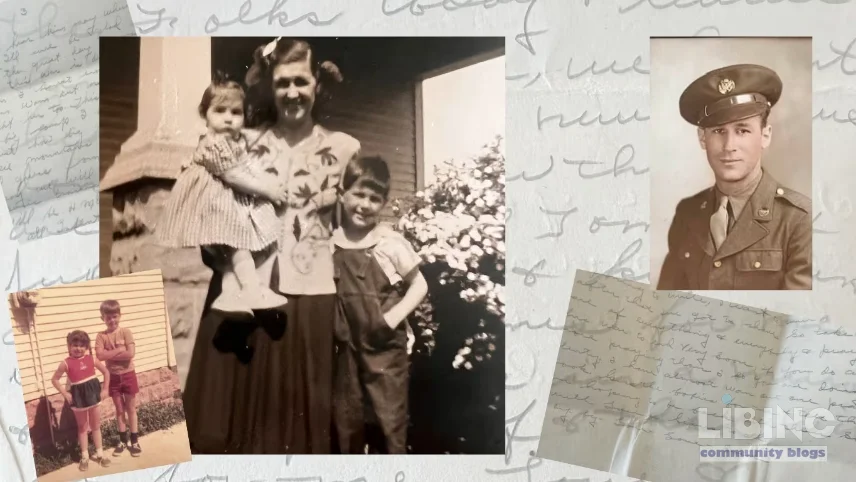
Memory as Duty and Bridge: Reconstructing Family and World War II Sacrifice Through a Grandfather's Letters
Memory is not a passive archive of what happened; it is a living process that translates absence into significance. The narrator of this piece grew up among the walls her great-grandparents built, and those walls held both laughter and the long shadow of loss. Her grandfather, Otis Bryant, left behind letters from the European theater that shaped a private world of devotion, fear, and faith—a world that time never fully dissolved. By choosing to read those letters in chronological order, she did more than learn about a war; she learned how memory is assembled, piece by piece, inside a family and inside a nation. The questions driving this analysis are simple but stubborn: What does memory do when it travels across generations? How does it stretch, bend, and finally connect private sorrow to collective remembrance? And what happens when memory becomes a bridge rather than a barrier between worlds?
In the end, the decision to seek out the burial place of a grandfather who never came home becomes the narrative hinge of this inquiry. The journey to Lorraine American Cemetery in France and the pilgrimage organized by the Thanks GIs Association reframed memory as a form of ethical witnessing. It is not merely a search for a tomb; it is a pursuit of accountability, gratitude, and a more precise accounting of sacrifice. The stakes are not merely personal grief or family pride; they are about how societies remember the costs of war and how those costs are transmitted to future generations. This article thus uses four analytical modes—memory as method, memory vs public memory, memory-driven causality, and expert reconstruction—to illuminate how a single thread of letters can illuminate a web of global consequences.
What follows is a structured investigation into how private letters become public memory, how memory can heal divisions rather than inflame them, and how the act of visiting a sacred burial site can polarize into a shared sense of duty. The four sections translate the intimate experience into an analytic framework, revealing memory as both a personal compass and a social instrument. The ultimate argument is straightforward, but the path to it is not: memory is the engine that converts loss into responsibility, and responsibility into action that honors both the dead and the living.
Memory as method: analyzing the archive of war letters
Letters from the war front function as both testimony and technology. They carry the emotional physics of longing—homesickness, fear, and a stubborn faith in return—and the factual scaffolding of daily life in a theater of operations. Reading them in chronological order creates a temporal architecture: the early letters puncture the barrier between home and front, while later ones reveal the erosion of certainty and the stubborn, almost liturgical, commitment to family. The letters are not just narratives of events; they are artifacts that organize memory by rhythm, cadence, and tone. They invite the reader to reconstruct a battlefield not as a map of terrain but as a map of feelings, loyalties, and moral commitments.
These letters are also data for a disciplined kind of memory work. The writer notes small rituals—prayers said, the keeping of a worn prayer book, the flattened flower tucked into a letter on an anniversary. Such details are not mere sentimental gloss; they reveal the everyday language of devotion that sustained soldiers under pressure. In the archive of the 80th Division and the 317th Infantry, these micro-events become macro-signals of character and morale. When memory is treated as a method rather than a mood, it becomes a tool for testing hypotheses about how soldiers and families negotiated fear, faith, and the fear of losing one another. The result is a more robust picture of how individual choices ripple outward into collective memory.
LSI: oral histories, veteran correspondence, battlefield diaries, commemorative geography. These terms map the methodological terrain of memory work and show how private letters intersect with public narratives to form a coherent, verifiable record. The integration of oral histories with written correspondence invites a multi-voice reconstruction of events, offering a fuller sense of what those in uniform believed they were fighting for and what their families believed their sacrifices entailed. The archiving process is not neutral; it actively shapes how future generations interpret the meaning of duty and loss.
The specific archival path—consulting the 80th Division Veterans Association website, examining unit histories and morning-after action reports—retains a rigorous sense of historical method while preserving the emotional resonance of the letters. This dual lens prevents memory from becoming speculative sentiment and ensures that it remains tethered to verifiable context: unit movements, combat engagements, medical and logistical constraints, and the social fabric of home life. The method is not simply about what happened; it is about why memory chooses to hold onto certain moments and why others fade, a question that becomes central when memory travels across generations.
In this sense, memory as method acts like a sieve that differentiates between memory as feeling and memory as evidence. It acknowledges the personal voice of the letters while insisting on the necessity of corroborating details from field reports and historical records. The risk here is sentimentalism—reading emotion as truth without weighing corroborating data. The antidote is a disciplined cross-checking of dates, places, and battles with the surrounding documentary record, which helps transform a family treasure into a credible node in the larger network of World War II memory.
Illustrated storytelling can extend this analytic frame without sacrificing rigor. The letters’ romantic cadence, their explicit references to home, and the insistence on steadfast faith lend themselves to a narrative of moral character under pressure. Yet the same letters expose complexity: the soldier’s loneliness, the writer’s sense of duty to a wife and child, the tension between hope for reunion and the reality of a protracted conflict. The memory-work must hold these tensions in balance, not gloss over them, to avoid reducing the past to a single emotional trajectory.
Memory vs public memory: a contrast between personal recollection, familial grief, and communal gratitude in France
The private world of Otis Bryant’s letters speaks in a language shaped by hearth and faith; public memory speaks in ceremonial language—memorials, anniversaries, and the language of gratitude from strangers. The encounter in France, where villagers greet a granddaughter’s pilgrimage as a collective act of acknowledgment, highlights this tension. Personal memory tends to be particular and recursive: it centers on a family’s rituals, the anecdotes that sustain a life, and the emotional truth that one must keep telling the story to avoid forgetting. Public memory, by contrast, seeks universality: it constructs a shared narrative about valor, sacrifice, and the costs of freedom that can be taught and defended across communities and generations.
Here the contrast reveals a crucial dynamic: memory as a bridge requires translation. The granddaughter’s private longing—to visit the burial place of a grandfather whom she never met—translates into a public ceremony of remembrance when villagers publicly express their gratitude. The emotional currency flows in both directions: the living honor the dead; the dead, through memory, sustain the living. This translation is not automatic; it requires institutions, rituals, and ordinary acts of hospitality that convert private sorrow into a public duty to remember. The Thanks GIs pilgrimage becomes a conduit for this translation, turning a personal pilgrimage into a shared act of reconciliation and moral education.
LSI: collective memory, memory culture, memorialization, postwar reconciliation. These terms help explain how a local experience of gratitude interacts with global narratives of World War II. The memory culture surrounding Lorraine—its cemeteries, its villages, its commemorative rituals—functions as a stage where private memory is performed for a wider audience. The private memory of a wife and child becomes a public beacon that can illuminate the sacrifices of strangers just as much as the sacrifices of kin. This is not sentimental theater; it is the friction point where memory becomes social capital that can teach future generations how to honor the past without letting it stagnate in grief.
Contrasts also reveal what memory leaves behind. Family letters emphasize intimate continuity—the everyday prayers, the wish to hold a child close, the certainty of perseverance. Public memory emphasizes universal duty—the obligation to remember, teach, and support those who continue to bear consequences of war long after the battles end. The transfer from private to public memory is delicate: if done well, it sustains a shared moral vocabulary; if done poorly, it becomes a hollow ritual that erases individual silences and the nuance of personal grief.
In this dynamic, memory gains depth when it resists reduction. The handwritten lines about a family’s life and the stone-fire clarity of battlefield reports must coexist in the same memory ecosystem. The Lorraine pilgrimage embodies this coexistence: it validates the private history while making it legible to a wider audience. The villagers’ expressions of gratitude are not a courtesy—they are a social acknowledgment of a shared past that transcends borders. This is the paradox of memory as a political force: it binds people through sorrow while enabling a future oriented toward responsibility and empathy.
The material culture of memory matters here as well. The letter’s flattened flower, the small keepsakes tucked into envelopes, and the photograph of a family that never grew old in the eyes of those who survived—all of these objects anchor memory in sensory experience. They remind us that memory is not a purely cognitive act but a tactile one that requires ritual, repetition, and care. When this material dimension enters the public sphere, it becomes a potent reminder that memory is a form of moral presence—the living insistence that the dead are not merely archived but actively remembered and honored.
From memory to healing: cause-and-effect of memorial journeys
Memory travels best when it becomes action. The granddaughter’s decision to read the entire set of letters, to trace the 80th Division’s routes, and to participate in the pilgrimage is not a passive recounting of the past; it is a causal sequence that transforms memory into personal and communal healing. The immediate effect is emotional: a sense of closeness to a grandfather who was never seen, a reorientation of grief into a form of stewardship. The longer effect is civic: memory becomes a prompt to engage with the ongoing costs of war—how societies care for veterans, how communities remember their local histories, and how future generations learn to resist the romanticization of conflict.
LSI: memorial pilgrimage, combat history, war remembrance, public memory. These concepts illuminate how personal memory activates public responsibilities. When memory translates into tangible acts—choosing to visit a cemetery, attending a memorial procession, sharing the story with the next generation—the past becomes a teacher rather than a relic. The act of walking village streets where battles occurred is a form of embodied memory, a way of letting history speak through space and place. The cause is clear: memory prompts responsibility, which then yields ethical behavior in the present. The effect is a shift from solitary sorrow to shared obligation, a reweaving of social ties fractured by war.
The journey also reveals limits. Memory can overcorrect: an all-consuming nostalgia may obscure the messy reality of combat, the moral ambiguities faced by soldiers, and the fallibility of history. The expert reader must balance reverence with critical inquiry—recognizing the soldier’s human fragility and the civilian gratitude that arises in places far from the trenches. The healing process is not a denial of pain; it is an integration of pain into a framework of learning, accountability, and mutual respect. When memory anchors itself in accuracy and empathy, it becomes a catalyst for reconciliation rather than a source of renewed division.
Practical consequences emerge in multiple domains: in family storytelling that honors the fallen while acknowledging the living, in veteran and civilian dialogue that seeks common ground, and in the education of younger generations who must understand how sacrifice shapes political and moral commitments. The memory-into-action sequence demonstrates that remembrance is a civic technology, a set of practices that enable communities to endure without becoming numb to the moral costs of war. This is the true power of memory: its capacity to convert sorrow into sustained responsibility for a shared future.
Expert reconstruction: weaving a family history into the broader memory of World War II
Historical reconstruction requires careful alignment of intimate testimony with established facts. The granddaughter’s experience—her personal encounter with the places where her grandfather served, the archives she consulted, the villagers she met—constitutes a microcase study in how memory can be responsibly expanded beyond the family circle. The first step is corroboration: aligning the letters’ dates with unit histories, morning-after action reports, and the known movements of the 80th Division and the 317th Infantry. This cross-checking turns private words into a credible thread within the larger weave of World War II memory. It also prevents memory from becoming a romanticized simplification of a violent past.
LSI: memorialization, history of World War II, unit histories, battlefield diaries, oral history methods. These terms anchor personal testimony in scholarly practice and demonstrate how a single family narrative can contribute to a broader, evidence-based understanding of the war. The reconstruction process clarifies what is known, what remains uncertain, and how to interpret gaps without erasing the lived experience embedded in letters. It also highlights the ethical dimension of witness—how a private history can bear public responsibility, ensuring that the memory of sacrifice informs policy, education, and international empathy.
In reconstructing the story, the narrator intersects multiple strands: the soldier’s religious devotion, the warmth of a wife’s correspondence, the aching of a mother who feared losing her son, and the French villagers’ gratitude decades later. Each strand carries its own weight and its own memory of loss and resilience. The expert reconstruction does not flatten these into a single narrative voice; it synthesizes them into a calibrated mosaic that respects nuance and conflicts. The result is a more expansive memory—one that acknowledges the private, the public, and the transnational dimensions of sacrifice.
To illustrate this synthesis, the piece culminates in a visual moment: a simple memorial scene rendered in a compact SVG illustration embedded here. The image is not decorative; it is an explicit reminder that memory has material presence—engraved names, stone markers, the quiet figure of a cemetery. The scene anchors the argument that memory, when responsibly reconstructed, serves as a durable bridge between generations, between nations, and between the living and the dead.
What emerges from expert reconstruction is not a definitive, final narrative but a robust framework for ongoing exploration. The granddaughter’s journey—rooted in intimate letters and anchored by careful archival work—demonstrates how memory can be expanded responsibly. It shows how a personal history can contribute to a shared public memory that is accurate, inclusive, and ethically attentive to the costs of war. The final takeaway is clear: memory, when disciplined by evidence and enriched by empathy, becomes a durable mechanism for teaching future generations to honor sacrifice without romanticizing it or ignoring its consequences.
In this way, memory ceases to be a private ritual or a ceremonial gesture and becomes a continuous obligation. The grandparents’ letters, the soldiers’ hardships, the villagers’ gratitude, and the historian’s careful cross-checking together produce a memory that is more than recollection—it is a practiced form of civic memory. It invites readers to translate feeling into responsibility, to let memory guide action, and to recognize that the cost of freedom is not merely paid by those who fought but endured by those who remember and continue to act in their name.
Final reflection: memory is a living system that binds a single family to a wider human project. The act of reading, traveling, and documenting becomes a project of moral continuity—an insistence that sacrifice remains meaningful when it informs care for the living and humility before the dead. The granddaughter’s letters, once sealed and stored, now travel outward as a conduit for understanding, reconciliation, and a shared commitment to remember with accuracy, with gratitude, and with an eye toward future generations.
Keywords and themes recur across the four sections: memory as method, memory vs public memory, memory-driven healing, and expert reconstruction. Taken together, they reveal a path from intimate letters to a public, transnational memory that honors sacrifice while shaping the responsibilities of the living. The legacy is not only in the past; it is in the ongoing work of remembering well so that the lessons endure and the debts owed are steadily repaid through empathy, education, and action.
Concluding thought: memory, rightly cultivated, becomes a form of ethical citizenship. It asks not only what happened, but what we owe those who made it possible to live in a world where people can disagree without surrendering their humanity. In that sense, memory is not a relic but a tool—one that transforms grief into guidance and loss into a promise kept across generations.
Practical workflow: turning memory into action
Memory work gains depth when it follows a repeatable, ethical process. The concise workflow below translates a private archive into a disciplined, public-ready narrative that can inform scholars, educators, and families alike.
| Step | What to do | Typical outputs |
|---|---|---|
| 1. Inventory | List letters, photos, diaries, and notes; capture dates, names, places | Source catalog |
| 2. Timeline | Create a chronological frame linking events and moves | Timeline document |
| 3. Corroboration | Cross-check dates with unit histories and action reports | Cross-referenced notes |
| 4. Contextualization | Record home front rituals and daily life to anchor memory | Context notes |
| 5. Ethical review | Assess gaps; note uncertainties; avoid sentimental simplification | Ethics log |
| 6. Public frame | Choose storytelling form and prepare citations | Draft public piece |
Tip: integrate concrete scenes across places and times, verify with public records, and invite feedback from veterans, librarians, or historians to strengthen credibility and empathy.
Converting memory into action requires discipline, not nostalgia. This workflow provides a shared language for readers to build credible, humane narratives that honor complexity and avoid oversimplification.
Frequently Asked Questions
How does memory drawn from war letters become a usable resource for research and teaching?
Memory resources derived from private letters transform emotion into a usable resource by applying a disciplined workflow, cross-referencing dates with unit logs, and translating the collected details into a public narrative. This approach creates a credible, teachable memory rather than a static sentiment. It also invites external review from archivists and historians to ensure accuracy and balance. By keeping the focus on verifiable context as well as personal voice, readers can guide discussions about duty, loss, and resilience with empathy and clarity.
This method yields a narrative that is both compelling and responsible, forming a bridge between intimate experience and public understanding. It supports classroom lessons, museum captions, and family storytelling that resist simplistic heroism while preserving human worth and memory.
What role does corroboration play in reconstructing a family history?
Corroboration tests private memories against external records such as unit histories, action reports, and archival materials. The first sentence of the answer emphasizes that corroboration locks memory to verifiable context, preventing romanticized or inaccurate portrayals. The longer view shows how corroboration clarifies timelines, places, and personnel, while preserving personal perspectives. When done respectfully, this balance strengthens trust in both the lived experience and the larger historical record.
How can private memory be translated into public memory without losing nuance?
The translation relies on explicit acknowledgment of uncertainties, careful storytelling that juxtaposes intimate scenes with broad contexts, and the inclusion of ethical reflections. The first sentence of the answer states that nuance emerges when personal details are anchored in evidence and when multiple voices—family, veterans, locals—contribute to the narrative. Public memory then becomes an invitation to learn, not a proclamation of certainty.
What practical steps can a reader take to visit memorial sites or cemeteries related to a family history?
The practical steps include planning a route that follows the chronology of events, contacting local archives for contextual materials, coordinating with veterans groups or foundation tours, and preparing respectful questions for guides or residents. The first sentence highlights that preparation strengthens meaning, while subsequent steps emphasize respectful engagement, documentation, and reflection to deepen understanding for future generations.
How does expert reconstruction balance sentiment and evidence in a public narrative?
The balance comes from integrating intimate emotions with corroborated facts, clearly marking uncertainties, and inviting external review. The first sentence communicates that sentiment enriches memory but must be checked by dates, places, and records. The ongoing dialogue with archives ensures the story remains a living, revisit-able account rather than a fixed myth, encouraging learning over nostalgia.
What are common pitfalls in memory-driven history and how can they be avoided?
The pitfalls include romanticizing conflict, neglecting countervailing evidence, and treating a single family voice as universal truth. The first sentence notes that critical scrutiny and diverse sources are necessary to prevent misrepresentation. Avoiding these traps requires transparency about gaps, presenting multiple perspectives, and inviting constructive critique from scholars and communities touched by the history.





Add a comment
To comment, you need to register and authorize
Comments
Beyond method, the piece foregrounds material culture as a kind of tactile memory. A letter with a blossom tucked inside becomes a data point about devotion and daily life, but it also becomes a symbol that can travel publicly, mobilizing empathy and accountability. The question for discussion is how to balance intimacy and accessibility: when private artifacts enter public circulation, how do communities retain the permission to grieve without turning sacrifice into spectacle? Finally, the piece hints at a future where memory work might be shared across generations and cultures through multidisciplinary methods, from philology to data visualization. If we accept memory as an active process, what implications does that have for teaching history in schools, designing museums, or curating family archives in ways that honor both particularity and universality? How might digital tools help or hinder that balancing act?