

Sand Dredging in Lagos Lagoon: An Analytical Examination of Ecological and Socioeconomic Impacts
Table of Contents
Lead
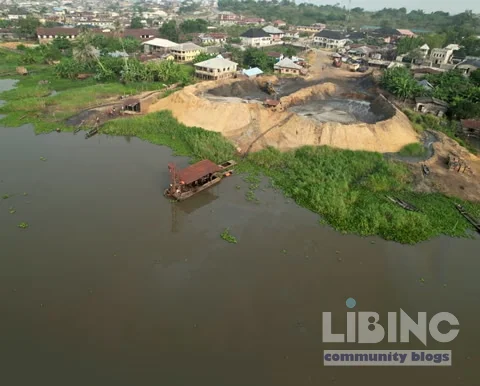
Before dawn, Lagos wakes to the metallic sigh of danfo buses and the rumble of generators, while the lagoon below remains unsettled. The sound is not a splash of fish or the dip of canoes, but the roar of long suction pipes feeding dredging machines that pry up the lagoon bed and spit out wet sand for construction. Lagos, with more than 20 million residents, has an insatiable demand for sharp sand, and regulation struggles to keep pace. The NIOMR study reports erosion of nearly six metres between Banana Island and the Third Mainland Bridge, along a five-kilometre stretch of central Lagos's lagoon channel.
That extraction quietly reconfigures the lagoon's ecology and the livelihoods built on it. The real question is not only how much sand shifts state borders, but how the turbidity plumes, altered fish stocks, and degraded habitats exert pressure on fishing communities and urban planners alike, revealing deep governance gaps and conflicting priorities in Lagos's development push.
Through analytics
The analytical lens foregrounds regulatory architecture, data gaps, and ecological thresholds. The government framework exists, but enforcement remains uneven, especially for mechanised dredging that operates at night or in shifting locations. Data on turbidity, sediment plumes, and habitat loss trail behind the pace of extraction, making catch statistics a lagging indicator of decline. The central question becomes not simply how much sand Lagos gains, but how far ecological thresholds can be breached before fisheries, birds, and sea turtles abandon the coast.
From a data-driven vantage, we must connect sediment dynamics to fisheries resilience and coastal protection. The NIOMR figure of nearly six metres of seabed loss marks a boundary where mud turbidity rises, sunlight penetration falls, and benthic communities collapse. Without robust EIAs, ongoing habitat restoration plans, and transparent environmental governance, the dredging regime metabolizes into a slow erosion of coastal livelihoods. The consequence is not only ecological but socio-economic, driving price volatility and food insecurity in a city that relies on a steady supply of fish and shellfish.
Two policy tensions shape Lagos's dredging landscape: formal regulation that exists on paper and informal practice that dominates nights and backwaters. This dissonance creates a situation where monitoring lags, permits stall, and operators pivot location to avoid detection. The gaps are not merely procedural; they reflect a political economy in which sand dredging is highly lucrative and where local interests clash with broader environmental aims. Weak enforcement capacity, night-time operations, and shifting accountability produce a governance trap that benefits a few at the expense of many.
On the other side, successful case studies from other regions demonstrate that targeted, data-driven monitoring paired with rapid response can curb ecological damage. Lagos, however, lacks consistent environmental monitoring across the lagoon, and the absence of real-time data about turbidity levels, fish recruitment, and seabed changes compounds uncertainty for fishers. If the state cannot observe and respond, the ecosystem becomes a black box whose outputs become livelihoods' cliff edges.
That analytic gap persists at the local scale, where coastal dynamics interact with urban expansion. Dredging changes water flow, deepens channels, and creates sediment plumes that travel with tides, altering nursery habitats and deterring juvenile fish from returning. The result is a cascade: reduced catch per trip, higher fuel costs, longer travel for fishers, and a thinning of the fishmongering base that depends on predictable landings. In short, the mathematics of extraction becomes the arithmetic of hardship for communities along the Lagos-Badagry axis.
Through contrast
Contrast reveals a split between development aspirations and ecological limits. In Lagos, the demand for sand rides on a wave of urban renewal — flyovers, estates, and waterfront redevelopment — while the lagoon bears the externalities in fish stocks and shoreline stability. In other regions with stricter governance, the same construction needs are met through regulated dredging linked to baseline environmental data and active community monitoring. The difference is not simply enforcement but the alignment of incentives and information flows that keep ecological damage within predictable bounds.
Ajoke Orebiyi, a fishmonger in the Oto-Awori jetty, notes that the cost of sand-driven development falls on those who can least bear it. Her earnings have halved in five years as catches dwindle and prices rise, even as new estates rise along the shoreline. By contrast, communities in better-regulated settings report constructive engagement with dredging firms, negotiated mitigation, and some compensation for temporarily displaced fishers. The social contract in Lagos remains unsettled, with promises of jobs and housing rarely translating into stable livelihoods for the most exposed families.
Regulated dredging typically features independent oversight, measurable biodiversity baselines, and adaptive management that responds to early-warning signals. Lagos has regulatory instruments with potential, but the practical reality is a patchwork of permits, nocturnal operations, and informal arrangements with community leaders. When regulatory compliance exists only on paper, the system cannot absorb shocks from climatic events or market swings, leaving communities exposed and governance credibility eroded.
Economic incentives shape behavior at the dock and on the water. Dredging is highly lucrative for operators who can secure contracts and move material to multiple buyers; for canoe-based artisanal miners, it remains a desperate lifeline in a volatile market. The result is a landscape where legal outcomes depend less on environmental science and more on political economy, complicating both enforcement and reform. In Lagos, the tension between growth and stewardship is the defining contrast of the modern coast.
Through cause-and-effect relationships
The causal chain begins with dredging that lowers seabed elevations and intensifies turbidity. The resulting sediment plumes alter light penetration, disrupt spawning grounds, and reduce habitat complexity that juvenile fish rely on. Nets snag on unveiled irregularities in the bed, forcing fishers to cast farther and spend more on fuel. The immediate effect is fewer catches and rising costs, which translate into higher prices at the jetty and at market stalls, squeezing a population already stretched by urban living costs.
The effects reverberate through ancillary sectors: fishmongers like Ajoke absorb price shocks; boat owners adjust routes; and fuel suppliers see demand swings. Dredging also reshapes shoreline dynamics, accelerating erosion in some pockets while depositing sediments elsewhere, creating new sandbanks that alter boat traffic and safety conditions. The habitat losses intersect with climate pressures, including sea-level rise and more intense storm events, compounding the vulnerability of coastal communities.
From an ecological angle, predator-prey relationships shift as benthic communities hinge on sediment stability. The loss of critical nursery habitats reduces recruitment for commercially important species, a trend that can persist for years even after dredging slows. The net effect is a weakening of fish stocks, a slower replacement rate, and increasingly unstable livelihoods for families who depend on daily catches. In short, extraction initiates a chain reaction whose end points are livelihoods, food security, and cultural memory along Lagos's littoral communities.
Climate signals intersect with local practices. Periodic flooding and storm surges move sediment along the coast, while muddi fication from dredging compounds the risk of coastal inundation in eras of heavy rainfall. The combination of climate stressors and human disturbance creates nonlinear responses: small policy changes or enforcement spikes can yield outsized ecological and social effects, or conversely, allow damage to accrue with little public notice until consequences become visible in market prices and community well-being.
Through expert reconstruction
Experts converge on a set of interlocking steps to repair the damage and prevent future harm. First, a moratorium in the most sensitive zones, paired with a comprehensive mapping of critical habitats and breeding grounds, would create a floor for sustainable activity. Second, independent monitoring and transparent EIAs must accompany every dredging permit, with real-time data on turbidity, seabed changes, and biodiversity outcomes feeding adaptive management decisions.
Third, habitat restoration should accompany development, including the creation of mangrove buffers, shallow-water refugia for juvenile fish, and reef-like structures that accelerate sediment deposition where needed. Fourth, community governance must be strengthened so that local fishers and fishmongers have meaningful input into where dredging occurs, how much is extracted, and how benefits are shared. These measures aim to realign incentives, improve accountability, and anchor development in ecological reality rather than political convenience.
Fasasi Adekunle’s story illustrates the stakes: a life spent reading tides and wind now competes with a regime that can ruin the day’s work in minutes if sand extraction shifts the current. Onoja argues that the government must be held responsible for failing to sustain monitoring and enforcement. The moral is clear: development cannot outrun science, and science cannot prosper without credible institutions that act on it with urgency.
Operationally, the path forward requires a combination of technological monitoring, community-based reporting, and a revised incentive structure for dredging firms. Satellite-based shoreline change detection, underwater mapping, and regular independent audits can illuminate missteps before they become irreversible. The new equilibrium must balance the need for infrastructure with the imperative to preserve fisheries, biodiversity, and coastal resilience for future generations.
Final reflections
The Lagos coast is at a crossroads where sand is both a commodity and a lever that can tilt local ecosystems and livelihoods toward stability or fragility. The NIOMR findings expose a boundary line in the lagoon’s bed and life that regulators, communities, and developers must negotiate together. If governance fails to adapt, the very platform on which Lagos seeks progress — a thriving, resilient coast — risks becoming a casualty of rapid construction and short-term gains.
Yet there is room for reform that preserves both development potential and ecological integrity. A synchronized framework of monitoring, transparent EIAs, community participation, and adaptive management can reduce uncertainty and restore fisheries resilience. The choice is not merely about sand; it is about rewriting the city’s relationship with its littoral edge so that growth and shoreline stewardship advance in tandem.
Data-Driven Oversight to Stabilize Lagos Dredging
To close the most critical gap—real-time, independent oversight that blends data with community governance—the following compact framework presents a practical path for action that can be implemented with existing institutions.
| Scenario | Night/Day | Turbidity | Habitat |
|---|---|---|---|
| Current practice | Night | 120–180 NTU | High |
| Enhanced monitoring | Day | 60–90 NTU | Moderate |
| Nocturnal ban | Night | 40–60 NTU | Low |
| Rotating dredge | Mixed | 70–110 NTU | Moderate |
Key indicators to watch extend beyond permits; turbidity, sediment deposition, and nursery habitat health must be tracked in real time to trigger risk-based interventions.
Quick read Turbidity rise: 40–60% | Seabed loss: 2–4 m | Nursery decline: 20–30%
Operational steps translate this data into decisions on site selection, permit timing, and compensation for affected fishers and vendors.
- Data infrastructure
- Real-time turbidity sensors
- Open dashboards
- Governance
- Community councils
- Transparent permit rules
- Habitat restoration
- Mangrove buffers
- Shallow refugia
Adopting this approach supports sustainable growth by aligning development with coastal resilience and fisheries futures.
What is the central ecological risk of dredging in Lagos Lagoon?
The central ecological risk is the rapid expansion of turbidity and sediment plumes that smother nursery habitats, reduce light, disrupt benthic communities, and trigger declines in fish recruitment and biodiversity, a cascade intensified when monitoring is weak or night operations bypass oversight. The consequence is fewer juvenile fish, higher fuel costs for fishers, and longer-term losses for coastal livelihoods. Analytical note: effective monitoring can limit plume duration and protect nurseries.
How can real-time monitoring improve dredging governance?
Real-time monitoring provides timely signals that trigger management interventions such as temporary halts, revised dredging plans, and targeted habitat restoration; it reduces information gaps between operators and regulators and supports adaptive management. Analytical note: dashboards enable proactive enforcement and transparency.
What role can communities play in shaping dredging practices?
Communities can participate through local councils, independent observers, and benefit-sharing agreements that ensure transparency and fair compensation, while their on-the-ground knowledge helps identify sensitive habitats and track social impacts. Analytical note: community oversight builds trust and reduces permit drift.
What restoration strategies help balance development and ecology?
Restoration can combine mangrove buffers, shellfish reefs, and shallow-water refugia to restore habitat complexity while scheduling dredging to minimize sediment spread and support species recruitment. Analytical note: restoration accelerates resilience and sustains fisheries.
What data should regulators prioritize to detect early warning signs?
Key indicators include turbidity, light penetration, seabed change, and juvenile recruitment; setting explicit thresholds and conducting independent audits ensures timely responses to coastal change. Analytical note: clear thresholds enable decisive action.
How does governance affect coastal resilience and livelihoods?
Strong governance aligns development with ecological limits by linking monitoring results to decisions, improving accountability, and distributing benefits fairly to stabilize prices, protect food security, and sustain local culture along the lagoon. Analytical note: accountable systems reduce volatility for fishers and vendors.




Add a comment
To comment, you need to register and authorize
Comments