

Henry Nowak, memory, and the Southampton riot: analyzing the rise of white nationalism and the politics of grievance
Table of Contents
Recent events in Southampton provided more than a local flashpoint; they exposed how memory, grievance, and political theater converge around a single tragic death. Henry Nowak’s murder has become a focal point for competing stories about crime, immigration, and national identity. The spectacle of street chants, online virality, and political opportunism reveals a deeper strain in public discourse: the commodification of grief and the instrumentalization of tragedy for ideological ends. This piece interrogates how Nowak’s death is being narrativized, who gains from those narratives, and what the broader implications are for political legitimacy and social cohesion.
What follows is a structured examination in four parts. First, an analytical reading of the discourses, data, and memory work surrounding the Southampton events. Second, a contrastive look at the divergent narratives offered by media, politicians, and online communities. Third, a causal map linking triggers, incentives, and consequences within a broader landscape of identity politics and online mobilization. Fourth, an expert reconstruction that situates these dynamics within longer-term trends in nationalism, populism, and the politics of memory. The aim is not to celebrate or condemn but to understand how a local tragedy becomes a national turning point.
Henry Nowak figures prominently in every thread of this analysis. His life and death are not just biographical data points; they are prisms through which we can examine the charisma of grievance and the architecture of political storytelling. As the narrative shifts from street chants to editorial debates, the question remains: who controls the meaning of the death, and at what cost to democratic deliberation and human life?
Analytics: data, discourse, and memory
Two impulses drive the Southampton moment: the impulse to mourn and the impulse to mobilize. When analyzing Nowak’s death, we must separate sentiment from structural influence, because sentiment alone rarely changes policy. The data points—crowd sizes, social-media engagement, and frequency of Nowak mentions across outlets—signal not just grief but the velocity of ideological contagion. The key question is why certain discourses travel, while others are sidelined, and how power brokers calibrate that travel to achieve political ends.
Discourse analysis shows a persistent pattern: memory is rarely neutral. In the same breath that Nowak’s story is invoked as a warning, it is reframed as evidence of an existential threat—most often framed as a civilizational risk or as confirmation of a supposed demographic shift. This is not merely rhetoric; it is a mechanism that legitimizes exclusionary policy proposals and reconfigures public sympathy. The consequence, in short, is a refracted memory that serves political operators and marginalizes competing voices, especially those who call for restraint and due process in counting harms.
To understand the dynamics, we need to trace the media ecology surrounding Nowak’s death. Traditional outlets offer ritualized coverage: a chronology of events, updated casualty figures, and expert commentary. But online ecosystems, with their rapid amplification loops, often repurpose tragedy into shareable narratives. The result is a bifurcated information environment where a single incident becomes a mosaic of micro-narratives, each competing for validation and audience attention. The effect is a public sphere where context is overwhelmed by velocity and sensational framing.
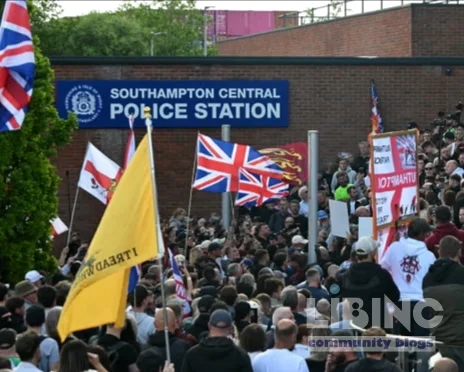
The social-media dimension matters because it creates a forced proximity between ordinary spectators and political actors. The Southampton footage is not just evidence of a street crowd; it becomes a template for identity performance, risk calculation, and peer approval. In these environments, Nowak’s death becomes a canvas for performative acts—chanting, banter, and banal defiance—that blur the boundary between remembrance and theatrics. This is not a marginal phenomenon: the most virulent strands of nationalism leverage these performances to normalize exclusionary attitudes and to signal in-group loyalty.
Analytically, the Southampton moment exposes a recurrent pattern in contemporary politics: the use of tragedy as political capital. Why does this work? Because it converts sorrow into legitimacy, grievance into policy pressure, and memory into a credential for belonging. The phenomenon is not new, but its speed and reach are unprecedented in the modern information environment. Henry Nowak becomes not solely a victim but a node in a larger network of grievance, risk, and collective action.
From the perspective of memory studies, Nowak’s death catalyzes a process of symbol formation that outpaces sober analysis. The memory-work shifts from who he was to what he represents: a proving ground for fears about crime, immigration, and social change. This is why the rhetoric around Nowak feels both personal and political, intimate and structural, grief-laden and strategic. The policy debate, when it comes, is often a mediated byproduct of emotional bookkeeping rather than a considered response to observed harms.
In aggregate, the analytics point to a chilling conclusion: memory manipulation, not legitimate accountability, is the primary driver of public discourse in this episode. The question becomes how to disrupt the reflex of instrumental grief without diminishing compassion for Nowak’s family and friends. We need to re-center memory around human impact and away from the spectacle that invites moral licensing for hostility and exclusion. The stakes are not merely rhetorical; they involve the integrity of public institutions and the safety of minorities and dissidents who become targets of this mobilization.
Key drivers identified by the data include economic anxiety, identity politics, and media amplification. These drivers interact to produce a potent mix: fear, belonging, and a simplified moral universe. The result is a political ecosystem in which Henry Nowak is invoked as a symbol that justifies increasingly punitive policies, often at the expense of evidence-based governance and civil liberties. The implication for policymakers is clear: any response that treats Nowak’s death as a lone violation rather than a symptom of a broader discourse will be insufficient, if not counterproductive, in reducing future harms.
Finally, the analytics reveal a pattern of selective empathy that tracks with political goals. Some voices receive amplified attention precisely because they offer a story aligned with a preferred national identity narrative. Others, whose experiences challenge the dominant frame, struggle to be heard. That imbalance is not just unfortunate; it undermines the legitimacy of democratic debate and inflames social distrust. The memory of Henry Nowak thus becomes a contested resource, with winners and losers shaped by who controls the narrative and who benefits from its persistence.
Contrast: competing narratives and the politics of memory
The Southampton moment is best understood as a battleground of two dominant narratives. One frame treats Nowak as a symbol of victimhood and a call to uphold universal rights, rule of law, and social solidarity. The other frame recasts the event as evidence of civilizational threat, a justification for harsher controls on borders, and a validation of exclusionary social norms. The contrast is not subtle: it maps onto the oldest dichotomy in modern politics—universalist liberalism versus ethnonationalist pragmatism—and it is weaponized through media and social-media amplification.
From a media-structure standpoint, the contrast arises from who gets air time and what kind of air time is considered legitimate. Mainstream outlets tend to embed Nowak within process-focused narratives: a discussion of policing practices, criminal justice responses, and community resilience. In parallel, right-leaning platforms are more likely to recenter the event within a broader grievance framework, where the murder becomes a probe into immigration, social breakdown, and the perceived failure of elites to protect the in-group. These divergent frames are not incidental; they shape what counts as acceptable political conversation and what counts as illegitimate dissent.
Public commentary illustrates how the same tragedy can generate opposing epistemologies. Some analysts focus on procedural justice, calling for transparent investigations, proportional policing, and accountability for violent actors regardless of ideology. Others foreground identity claims, using Nowak’s case to argue for a retuned national polity that prioritizes security over pluralism. The clash between these approaches is not merely academic; it determines which policy trajectories appear credible to voters and which rhetorical moves appear morally permissible to media audiences.
Another axis of contrast concerns the moral vocabulary employed. The discourse about Nowak’s death vacillates between compassion and grievance, but in the latter, language often slides toward essentialist tropes. The risk is a normalization of in-group hostility as a legitimate civic response. In contrast, advocates of universal rights emphasize the shared humanity of all residents and the risks of state overreach. The tension between these vocabularies explains why policy proposals remain contested long after initial outrage subsides.
The online ecosystem intensifies the contrast. Memetic content converts grief into brand-like signals of allegiance. The same content that builds solidarity within a community can simultaneously alienate others who interpret the symbols as exclusionary or violent. The now-familiar dynamic—content circulation, performative acts, and moral licensing—undercuts nuanced policy discussions and makes pragmatic compromise more difficult. In short, the contrast is not only about values; it is about the social infrastructure that sustains political commitment in a highly networked public square.
In sum, two narratives contend for legitimacy around Henry Nowak’s death. The outcome of this struggle will shape public memory and influence future responses to violence, crime, and immigration. The larger question is whether political leadership will cultivate a space for empathetic, evidence-informed debate or capitulate to narratives that reward division and simplification. The stakes extend beyond Southampton to the health of democratic deliberation and the resilience of minority communities under pressure from a hostile media landscape.
To understand what is at stake, we need to examine the causal links between narrative frames and real-world outcomes. When a community sees itself reflected in a story, it is more likely to mobilize in search of belonging or vengeance. When authorities present a measured, rights-respecting response, public trust can be preserved or restored. The Southampton moment tests this balance and asks whether memory can be stewarded in a way that honors human life while safeguarding the institutions that protect it.
Causes and consequences: triggers, incentives, and social dynamics
Any effort to account for the Southampton moment must map three interacting layers: the immediate trigger (Nowak’s death), the incentive structure surrounding public discourse (attention, sympathy, and political capital), and the long-run social dynamics (nationalist sentiment, media ecosystems, and the evolving politics of memory). The trigger is traumatic and indisputable; the incentives, shaped by platforms and personalities, determine how the trigger is interpreted and amplified. The consequence is a politics of memory that can either deepen social fracture or provoke a more inclusive, evidence-driven response.
At the surface, the immediate reaction in Southampton combined grief with a readiness to broadcast. This combination creates an environment where provocative statements, symbolic acts, and visible solidarity become currency in the public sphere. The mechanism is simple: the more visible the action, the more likely it is to attract support, distract from facts, and fuel further polarization. In this sense, the event functions as a catalyst for a broader set of grievances that preexisted Nowak’s death and will intensify if not addressed directly.
Yet the causal web is deeper. Economic anxiety, perceived cultural displacement, and distrust of institutions interact with online echo chambers to produce a self-reinforcing loop. When media narratives converge on a single frame, they create pressure on policymakers to respond in ways that may not reflect ground realities. The danger is policy misalignment: measures aimed at crime control may overlook underlying social vulnerabilities, while aggressive immigration rhetoric may harden boundaries and foster distrust among communities that share the same civic grid.
A second-order effect concerns youth culture and the normalization of violence as a form of political speech. In the Southampton footage, the presence of bricks, bins, and taunting banter indicates a culture that treats physical risk as entertainment and social media as a performance stage. This dynamic undermines risk assessment in policing and complicates the moral calculus of bystander intervention and first-responder safety. It also raises questions about how to separate legitimate protest from violent incitement, and who bears responsibility for distinguishing the two in a rapid, highly mediated environment.
There is also a feedback loop between elite commentary and popular sentiment. When prominent figures decline to condemn violence or equivocate on the role of the in-group, their rhetoric becomes a blueprint for adherents. The effect is a normalization of exclusionary language and a readiness to justify harsh measures in the name of national security or cultural protection. In this sense, Nowak’s death becomes not a singular tragedy but a prop in a longer-running argument about who belongs and what borders should look like in a liberal democracy.
Another facet concerns the legal and ethical implications of memory manipulation. If memory is weaponized, the line between commemoration and grievance politics blurs, undermining the legitimacy of public memorial practices and the integrity of investigative processes. The risk is a memory economy where personal loss is converted into political capital, often at the expense of empathy for all victims and the due process rights of any accused individual. The Southampton moment thus tests the integrity of democratic norms in the face of emotionally charged political theater.
Finally, there is the political economy of the right-wing movement that Nowak’s death has energized. The synergy between a charismatic leader, online followers, and media attention can magnify a sense of momentum that is not necessarily grounded in policy viability. In such a climate, even well-intentioned advocates fracture under the weight of competing demands from the base, media, and civil society. The outcome is a politics of grievance that operates independently of measurable progress toward national well-being, thereby hollowing out the space for constructive policy reform.
Expert reconstruction: synthesis from scholars and commentators
Scholars of memory and nationalism tend to describe the Southampton moment as a case study in how modern democracies cope with trauma while policing the boundaries of belonging. The central insight is that memory is not a passive repository but an active instrument that can be leveraged to justify exclusion or to reinforce universalist commitments. The way Nowak’s death is framed—whether as a crime against an individual or as evidence of a civilizational threat—has real consequences for policy, civil liberties, and social cohesion.
However, experts also warn against simplistic causal explanations. The Southampton moment is not simply a result of a single demographic threat or a single media frame. It emerges from a confluence of economic, cultural, and technological factors that create a fertile ground for both empathy and hostility. A nuanced reconstruction must acknowledge the pain of loss while resisting the temptation to translate grievance into blanket policy prescriptions that stigmatize whole groups of people. The aim is to preserve human dignity and the rule of law even as the public debates intensify around fraught topics like immigration, policing, and identity.
From a political-theory angle, the episode illustrates the enduring problem of how modern democracies manage symbolic politics. Leaders can attempt to domesticate narratives by offering substantive reforms and inclusive messaging, or they can feed the cycle of grievance by courting base emotions and sensationalism. The latter path risks irreversibly widening social fissures and delegitimizing the institutions that are supposed to protect minority rights and civil liberties. The expert reconstruction thus points toward holistic strategies: data-informed policing, trauma-informed public communication, and institutional safeguards that resist being captured by short-term media wins.
Practically, the reconstruction calls for four measures that could recalibrate the conversation around Nowak’s death and similar episodes. First, independent fact-finding that preserves due process and avoids pre-judgement of entire communities. Second, transparent accountability for violent actors while protecting peaceful protesters and bystanders. Third, a deliberate, inclusive memory-work program that centers victims and marginalized voices rather than partisan advantage. Fourth, a policy framework that aligns crime-prevention with social equity, rather than treating them as competing priorities. These steps do not erase pain, but they can reduce the risk that tragedy is weaponized for harm rather than healing.
The ultimate test is whether Nowak’s memory becomes a catalyst for civic renewal or a lever for division. A renewal would involve a public commitment to universal rights, evidence-based policy, and a politics of empathy that does not erase the structural drivers of vulnerability. It would require leaders who can translate memory into policy that protects the vulnerable without curtailing civil liberties. In that sense, the Southampton moment has the potential to yield a more resilient and inclusive national conversation, if guided by principled, data-driven leadership and a disciplined refusal to instrumentalize tragedy.
In closing, the Henry Nowak episode should be treated as a warning and a prompt for better practice. It warns against the seductive ease with which grief can be braided into a totalizing political narrative. It prompts better practice by demanding a careful, rights-respecting response that foregrounds empirical analysis and human dignity. The goal is not to sanitize the pain of Nowak’s family, but to ensure that memory strengthens democratic norms rather than corroding them. If policymakers and commentators heed this call, Nowak’s death might become a hinge point toward greater civic integrity rather than a pretext for division.
To those who share in Nowak’s memory and to those who would defend a plural, open society, the challenge is clear: resist the temptation to reduce tragedy to a political asset. Uphold due process, protect minorities, and insist on accountable, transparent governance. Only then can the memory of Henry Nowak contribute to a healthier political culture and a more resilient social fabric.
What remains is a collective responsibility: to honor the person at the center of this tragedy while scrutinizing the public discourse that follows. If the memory of Henry Nowak can guide us toward a more principled, evidence-based policy framework, then the Southampton moment will have fulfilled a higher purpose than spectacle. It will have reinforced the idea that democracy survives not by avoiding pain, but by confronting it with integrity, care, and rigorous analysis.
Readers are invited to consider how memory, media, and policy can align in ways that respect human life and protect democratic norms. The conversation is ongoing, and it must be conducted with discipline, empathy, and a commitment to truth over triumphalism. Henry Nowak’s legacy deserves nothing less.
Closing the missing piece: practical, rights-respecting memory work
To prevent tragedy from becoming a political lever, memory work must be concrete, inclusive, and grounded in due process. This means designing memorial practices and public communications that center victims, protect civil liberties, and invite plural voices into the conversation. A trauma-informed approach to policing, for example, prioritizes de-escalation, clear timelines, and independent review rather than punitive postures that scapegoat entire groups. It also means equipping journalists and social platforms with guidelines that discourage sensationalism and structural scapegoating while encouraging verification and context. In practice, local authorities can implement three pillars: independent fact-finding with public accountability, inclusive memorial programming, and evidence-informed policing that couples risk assessment with community trust-building.
First, independent fact-finding should be designed with due process safeguards and transparent timelines, ensuring that communities understand how conclusions are reached without pre-judging identities. Second, memory-work programs should provide space for marginalized voices—families, faith leaders, and minority representatives—to shape the narrative and demand accountability without eroding civil rights. Third, policing strategies must follow trauma-informed principles: recognize triggers, avoid aggressive symbolism, and ensure first responders have training to protect bystanders. These steps align with memory politics that honor life while upholding universal rights, and they offer a practical blueprint for policymakers and media alike to resist the lure of grievance-driven storytelling.
| Signal | Interpretation | Source | Public Impact | Policy Response | Risks |
|---|---|---|---|---|---|
| Social-media surge | Amplifies grievance framing | Online communities | Heightened urgency, polarisation | Rapid, transparent communications; measured counter-narratives | Misinterpretation risk |
| Policy-manicure rhetoric | Framing as threat or remedy | Leaders, pundits | Public confusion about aims | Clear policy goals; independent review | Policy overreach |
| Commemoration events | Memory as capital or critique | Communities, civil-society groups | Engagement, empathy building | Structured, inclusive programs | Coercive narratives |
| Independent investigations | Due process safeguards | Judiciary, watchdogs | Increased trust in outcomes | Public reports, transparency | Delayed action |
- Tragedy can be repurposed to signal in-group loyalty or to demand tough reforms without robust evidence.
- Trauma-informed, rights-respecting approaches model restraint and accountability instead of polarization.
- Clear, verifiable data and inclusive voices reduce the risk of scapegoating and erode the fuel for extremism.
- Adopt trauma-informed public communication that avoids sensational framing and respects privacy of victims.
- Establish a local memory-coordination body including survivors, minority representatives, scholars, and police, to guide memorial actions and narratives.
- Publish a transparent, independent report protocol with fixed timelines and public briefings to counter misinformation.
These components provide a concrete playbook for aligning memory with universal rights, public safety, and credible governance, ensuring that remembrance reinforces human dignity rather than grievance politics.
Frequently asked questions
What is the Southampton moment described in this article?
In this context, the Southampton moment refers to how the death of Henry Nowak became a focal point for competing public narratives about crime, immigration, and national identity, illustrating how tragedy can be weaponized in political discourse. It shows the tension between universal rights and in-group security, and highlights the need for memory to be stewarded with transparency, due process, and empathy for all involved. This framing clarifies the dynamics of memory, media, and policy in a time of rapid information flow.
Analytically, the episode demonstrates how emotional events can be reframed by different actors to advance divergent policy agendas, underscoring the importance of verifiable data and inclusive dialogue in democratic governance.
How does memory politics influence public policy in such events?
Memory politics shapes which facts are emphasized and which voices are heard, guiding policy proposals toward symbolic gestures or substantive reforms. The first sentence of the answer highlights that memory can privilege certain narratives, sometimes at the expense of due process or civil liberties. The analytical follow-through shows why policymakers must anchor responses in evidence, include marginalized communities, and resist exploiting grief for short-term political gain.
In practice, this means independent investigations, trauma-informed policing, and inclusive memorial practices that build trust rather than fear.
What practical steps can authorities take to prevent instrumentalization of tragedy?
The recommended steps include establishing independent fact-finding with clear timelines, creating inclusive memory programs that invite marginalized voices, and implementing trauma-informed policing that prioritizes de-escalation and accountability. These actions reduce scapegoating, preserve civil liberties, and foster resilient communities.
Analytically, such steps create a governance environment where memory informs policy without becoming a substitute for evidence.
How should media cover tragedies to avoid fueling xenophobia?
Media should verify facts, provide context, and avoid framing that attributes blame to entire groups. Responsible coverage emphasizes human impact, respects victims, and presents balanced perspectives from diverse voices. This approach reduces the risk that sensationalism shapes policy disproportionately and helps maintain social cohesion.
Analytically, media accountability acts as a counterbalance to rapid amplification that can distort public perception.
What role do online communities play in shaping nationalist narratives?
Online communities can nurture solidarity among in-group members but also accelerate misperceptions when they reinforce fear and exclusion. Recognizing these dynamics allows for targeted counter-messaging, digital literacy, and platform design that privileges credible information without silencing legitimate dissent.
Analytically, understanding network effects helps design interventions that curb harmful escalation while preserving free expression.
What policy framework promotes both public safety and civil liberties?
A balanced framework combines evidence-based policing, independent oversight, transparent communication, and inclusive memory-work. It centers victims, protects minorities, and guards against the instrumentalization of tragedy through clear rules, independent checks, and ongoing community dialogue.
Analytically, this alignment reduces volatility in public discourse and strengthens democratic legitimacy.





Add a comment
To comment, you need to register and authorize
Comments
If we are to foster a healthier public sphere, we need to ask what norms, institutions, and practices can decouple sorrow from policy leverage. Independent fact-finding that preserves due process, trauma-informed communication that acknowledges victims without simplifying their stories into slogans, and memory-work that foreground plural voices rather than partisan victors seem essential. Yet each of these safeguards raises questions about feasibility, legitimacy, and political will. How do we maintain empathy for Nowak’s family while ensuring that public discourse does not morph tragedy into a blanket license for exclusion or heavy-handed policy? What roles should journalists, policymakers, educators, and civil-society groups play in rewriting the memory script so that it respects human dignity and sustains inclusive citizenship? These inquiries invite not only critique but practical experimentation in governance, media ethics, and community healing.