

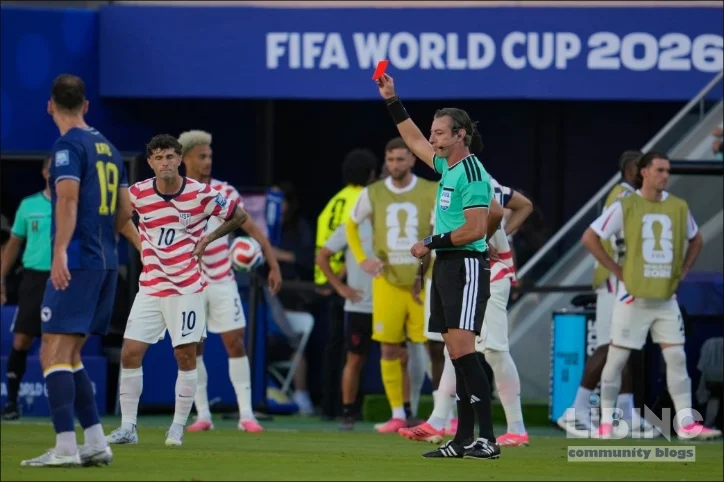
The 2026 World Cup in North America delivered a rare distraction-free stretch for much of the group stage, a period where the sport’s global spectacle appeared to outpace domestic political noise. Yet a single, highly charged episode stretched that calm: the reversal of Folarin Balogun’s red card suspension after an intervention from political leadership. The decision, announced after an appeal process, reframed a match narrative and raised questions about the balance between strict rule enforcement and the broader political context in which global sports operate. This piece examines Balogun suspension reversal through four analytical lenses: governance, contrasts with historical norms, causal dynamics, and expert reconstruction of how such events shape the future integrity of the World Cup.
The central issue is not merely whether Balogun deserved to play; it is whether the process that allowed a high-profile call to bend procedural gravity erodes confidence in the sport’s rulebook. The stakes extend beyond Seattle’s stadium lights. They touch the credibility of FIFA’s disciplinary apparatus, the perceived independence of refereeing, and the World Cup’s ability to project a neutral, rule-bound competition to a worldwide audience. If rules can be suspended in one instance due to external pressure, what stops a similar standard from being invoked in other contexts, against other teams under the same code and the same obligation to fairness?
Hidden beneath the initial outrage or relief is a deeper conflict: the collision between a host nation’s performance incentives, a global media spotlight, and a governance framework that depends on consistency to maintain legitimacy. The Balogun case did not simply test a single red card; it tested the credibility of a system designed to adjudicate on-pitch actions with due process, transparency, and uniform application. The question is not only what happened, but why the decision was deemed acceptable by some and controversial by others, and what this implies for sport’s governance model in an era of heightened political salience.
Direction of analysis: we start with the analytics of the ruling and its implications for enforcement credibility, then move to contrasts with prior incidents to gauge norms, map the causal chain from decision to perception, and finally reconstruct expert recommendations that could insulate future actions from political influence while preserving the spirit of competitive fairness.
Table of Contents
Analytics: Balogun suspension reversal under a governance lens
The core analytic question revolves around rule-of-law versus rule-by-influence. FIFA’s disciplinary code, including Article 27, sets a standard for calibrating sanctions over a probationary period. The reversal appears to hinge on a probationary mechanism, not an outright annulment, which preserves a formal record yet relaxes its impact. From a governance standpoint, the nuance matters: does a probationary pathway create a safety valve that can be activated by national or political pressure, potentially weakening the deterrent function of cautions and suspensions?
FIFA’s decision to invoke Article 27 was framed as a targeted adjustment within a clearly delineated framework. In analytics terms, this is a calibrated intervention that preserves the discipline instrument’s existence while signaling flexibility in exceptional cases. The governing logic must balance predictable enforcement with the avoidance of perceived arbitrariness. When the world watches, theoretical debates about discretion collide with empirical expectations of uniform application in international football governance. The balancing act is to prevent a drift toward inconsistent rulings while allowing context-sensitive corrections when the public record shows a misalignment between the sanction and the offense.
From the perspective of procedural integrity, the Balogun case invites a closer look at how the VAR ecosystem interacts with discipline. Video review frequently shifts perceptions of intent and severity. Although Balogun’s action appeared innocuous at full speed, slowed replays indicated a dangerous ankle twist that merited red-card consideration under FIFA standards. This is a classic example of how interpretive challenges emerge in modern sports: the line between accidental contact and actionable foul play becomes a negotiation between speed of play, technology-assisted review, and the static letter of the law. The tension highlights why transparent rationale matters for legitimacy as much as the ruling itself.
Another analytic throughline concerns the reputational currency of the decision. A reversal, even if procedurally defensible, sends a signal about how much the rules can bend when a high-profile entity leans on the process. The reputational calculus weighs not only the fairness to Balogun’s team but the broader impression of fairness across participants—an impression that is heavily mediated by the global media cycle and the governance narratives crafted around it. In other words, the analytics point to a governance signal: rules exist to constrain, but leadership signals may redefine the constraint in practice, and the market reads that as a governance outcome with real consequences for perceived integrity.
- The decision used a formal mechanism within the disciplinary framework to permit a reprieve without erasing the underlying red card.
- The choice implicates the deterrent function of suspensions if leveraged inconsistently across cases.
- Transparency of the rationale remains critical to prevent the perception of favoritism toward a host-nation narrative.
Crucially, the Balogun case also tests the firmness of procedural promises made by FIFA and its affiliates to uphold fair play across national borders. If the mechanism is rarely used, it can be a credible safety valve; if it is used frequently or without robust justification, it becomes a source of cynicism about rule compliance and the overall integrity of the tournament. The balancing act, therefore, is a test of whether the governance architecture can maintain both predictability and fairness in the face of extraordinary political attention.
LSI note: the case sits at the intersection of FIFA disciplinary procedures, VAR transparency, and international football governance norms. The balance between rigorous enforcement and discretionary relief will define how future decisions are perceived by leagues, federations, and fans around the world.
Contrast: historical precedents and public perceptions
Great sporting moments often drift into historical memory precisely because they crystallize a clash between on-field action and off-field context. The Balogun episode sits among a lineage of controversial calls—moments where the sport’s purity as a meritocracy met the messy realities of global politics and media pressure. The Hand of God and Zidane’s headbutt are the most cited, but the deeper resonance lies in how institutions respond when a consequential decision opens a window for external voices to shape outcomes. The contrast is not simply about one red card; it is about whether the sport’s governance can resist the gravitational pull of power and publicity.
From a governance perspective, these moments reveal a pattern: when a high-stakes match is at stake, the probability of political or public pressure acting on rules increases. This is not a banal observation; it implies that the codified norms of fair play are tested by the visibility of the stage and the charisma of the actors involved. The question for FIFA and other bodies is whether such visibility should ever translate into policy deviations, or whether the system must be robust enough to withstand pressure without compromising the universality of the rules.
The contrast also reveals a perception gap: fans outside the US might read the Balogun reversal as a pragmatic correction; domestic audiences may see it as a political act, a lens through which the fairness of the competition is interpreted. The divergence matters because World Cup narratives are built on shared, global premises of fairness and impartiality. If those premises are seen as negotiable under pressure, the event risks becoming a narrative of selective enforcement rather than a universal standard.
Another important contrast lies in when and how transparency is offered. The Balogun reversal came with limited justification from the disciplinary committee, which invites speculation about whether the decision was strictly rule-based or heavily influenced by extraneous factors. The historical record shows that when explanations are sparse, suspicion grows; where explanations are thorough and tied to explicit criteria, trust can be preserved. The contrast, then, informs a core lesson for governance: the quality of justification matters as much as the decision itself when legitimacy relies on public confidence in the rulebook.
Cause-and-effect: The decision, political pressure, and PR risks
To understand the causal chain, start with the instant of the red card and its immediate consequences: a sanctions regime met with a video-reviewed assessment that resulted in a send-off. The subsequent elevation of the case by political actors created an external leverage point—an avenue to question the decision outside the referee’s and disciplinary bodies. The causal arc then moves to FIFA’s invocation of Article 27, a choice interpreted as both a compliance with the rulebook and a response to external signaling. The effect is a nuanced outcome: the obligation to maintain discipline without triggering a broader perception of rigidity that could invite further challenges to the system.
From a PR perspective, the causal sequence emphasizes another link: the public narrative about legitimacy. When the president of a country publicly criticizes a decision and a global governing body acts in response, the cause-and-effect dynamic reframes the incident as a test of political willpower rather than a pure sporting decision. The effect is to elevate the story from a tactical on-field moment to a strategic commentary on governance norms, which then influences how future decisions will be processed in high-profile contexts. In short, what started as a football decision now operates as a case study in governance legitimacy and political-risk management in international sport.
There is also a legal-technical cascade to consider. Article 27’s probationary mechanism preserves the original sanction but suspends its effect, implying an implicit conditionality: future misconduct triggers reinstatement of the ban. This conditionality creates a complexity layer for clubs, players, and national federations: they must monitor not only current behavior but anticipate how a future misstep could interact with a contingent suspension. The upshot is a more dynamic, potentially more brittle enforcement environment where credibility hinges on both the clarity of rules and the perceived honesty of their application.
Finally, the rational expectations of other teams and referees must be addressed. If Balogun’s case sets a precedent that political or diplomatic pressure can influence sport outcomes, teams may begin to anticipate or even attempt to game the system. The cause-and-effect logic demands that FIFA and related bodies strengthen the indicators and communications that tie decisions to explicit criteria, leaving as little room as possible for misinterpretation. This reduces the risk that future rulings become instruments in a broader political drama rather than principled applications of the code.
- Immediate cause: red card and video review establish a disciplinary baseline.
- Trigger: political attention and public statements create pressure on the governing body.
- Intervention: Article 27 used to provide a probationary pathway rather than a full reversal.
- Effect: potential shifts in perceived fairness and future enforcement dynamics.
In this causal map, the central variable is governance legitimacy: if legitimacy is eroded, the match’s outcome becomes inseparable from the politics surrounding it, diminishing the tournament’s core appeal as a competition governed by universal rules rather than negotiation with power centers.
Expert reconstruction: Reforms to safeguard future contests
Experts converge on a core set of reforms designed to insulate decisions from political signaling while preserving due process. First, publish a clearly delineated rationale for any discretionary adjustment, anchored in objective criteria, with explicit references to the applicable clauses in the disciplinary code. The public justification should be formal, precise, and readily auditable by independent observers. The aim is to reduce interpretive ambiguity and deter accusations of partiality, even in high-stakes contexts. This is fundamental to maintaining international football governance credibility and a robust standard of fair play.
Second, strengthen the transparency of the decision pipeline. From immediate review results to final determinations, stakeholders should access a step-by-step account of the evaluative criteria, the evidence considered, and the threshold for each action. The transparency principle supports stronger trust among clubs, federations, and fans and curbs the temptation to frame outcomes as mere political victories or losses. In practice, this means standardized briefing materials and publicizing the reasoning behind time-bound decisions, subject to privacy and safety constraints when necessary.
Third, implement operational safeguards that reduce susceptibility to outside influence without undermining legitimate diplomacy. Potential measures include independent review panels for exceptional cases, clearly defined boundaries for executive interventions, and a rotating chair with term limits to minimize collusive or biased dynamics. These steps reinforce a culture of procedural integrity, ensuring decisions reflect the sport’s rules first, while leaving space for proportional responses that respect the game’s prestige and host-nation responsibilities.
Fourth, codify a phased, transparent remediation path for controversial rulings. If a decision is subsequently reopened or revised, the process should include public dashboards showing the timelines, rationales, and outcomes for each phase. The goal is to avoid ad hoc reversals and to provide fans with a coherent narrative about why and when rules adapt to unique circumstances. This approach anchors the World Cup’s governance in predictability and accountability, strengthening its global legitimacy.
Fifth, embed governance literacy into the sport’s education agenda. Officials, coaches, players, and media professionals should receive ongoing training on the disciplinary framework, the role of VAR, and the ethics of public communications around contentious calls. A well-informed ecosystem reduces misinterpretations, aligns expectations, and supports a healthier discourse around the game’s rules and their application in the world’s most watched tournament.
- Publish a formal, criteria-based rationale for discretionary adjustments.
- Enhance the transparency of the decision-making pipeline and provide public briefings.
- Establish independent review panels and rotation to mitigate bias.
- Create a remediation pathway with public dashboards for controversial rulings.
- Invest in governance literacy for all stakeholders.
Ultimately, the Balogun episode should catalyze a longer-term reform agenda: build a governance architecture in which exceptional moves are possible but are not subject to the suspicion of arbitrage. If the World Cup is to sustain its status as the planet’s premier global competition, its rules must be inviolable in principle and explicit in practice, with processes that can withstand the most intense scrutiny without compromising on fairness or transparency.
Safeguards in Practice: Turning Reforms into Reliability
Concrete, auditable steps are essential to shield future decisions from external signals while preserving due process. A practical blueprint blends independent review, explicit criteria, and public dashboards. For example, if a future case involves a host-nation scenario, an independent panel would evaluate only standardized evidence, with a fixed deadline for ruling and a public, clause-based justification.
| Stage | Criterion | Documentation | Accountability |
|---|---|---|---|
| Independent Review | Evidence-based assessment | Case file, video references | Public ruling, rotating chair |
| Criteria Alignment | Rule-based justification | Clause mapping | Independent audit |
| Transparency | Public dashboards | Quarterly reports | Oversight body |
| Remediation | Reopen rules only with criteria | Remediation log | Independent review |
Beyond a single ruling, the mechanism should monitor three core KPIs. The sample targets below illustrate how reform becomes measurable:
- Decision latency: 5-7 days from ruling to public posting
- Justification clarity score: 90/100 on a standardized rubric
- Transparency index: high, with weekly dashboards
The middle layer of practice requires a formal remediation path. A quarterly review would test whether the discipline system remains aligned with its criteria and identify drift toward ad hoc actions. For host events, a rotating chair and independent secretariat reduce bias and increase public confidence.
| Phase | Activities | Responsible | Timeframe |
|---|---|---|---|
| Phase 1 | Publish criteria and rationale | Disciplinary body | 0-30 days |
| Phase 2 | Implement dashboards | Secretariat | 1-2 quarters |
| Phase 3 | Independent review | Panel | Ongoing |
| Phase 4 | Annual audit | External auditor | Yearly |
In short, these measures translate reforms into everyday reliability, reinforcing the fairness that fans expect and the governance integrity that sponsors demand. This is how the balance between enforceable rules and prudent flexibility becomes a durable advantage, not a political footnote.
Was Balogun's suspension reversal a signal that governance can be swayed by politics?
External political pressure can sway disciplinary outcomes, risking trust in impartial rules. In practice, this case shows how public statements and diplomatic signals can prompt discretionary relief, underscoring the need for auditable criteria and formal justification to prevent drift. Absent constant, credible criteria, spectators may view rulings as political bargains rather than principled enforcement.
How can governing bodies reduce political influence in decision-making?
A robust approach combines independent review panels, clear, mapped criteria, fixed decision timelines, and public rationale. In practice, these safeguards create a predictable process so results reflect the rules rather than power dynamics. Ongoing training and external audits further strengthen credibility.
What is Article 27 in FIFA disciplinary code and how does it function?
Article 27 provides a probationary mechanism that suspends the effect of a sanction pending future behavior. In practice, it creates conditional discipline that must be monitored over time, while maintaining a formal record of the original sanction. Critics say it can be misread as flexible enforcement unless criteria are transparent.
What are independent review panels and how would they work in practice?
Independent review panels are bodies drawn from neutral experts who re-evaluate exceptional calls using standardized evidence with transparent procedures. In practice, panel members rotate, publish criteria, and deliver timely judgments, with outcomes publicly documented to deter bias.
What KPIs could measure governance transparency in sports?
Key performance indicators include decision latency, justification clarity, and public dashboard accessibility. In practice, these metrics enable ongoing assessment, enabling stakeholders to track whether reforms deliver observable improvements in fairness and trust.
What reforms are suggested to ensure fair play?
Proposed reforms include formal, criteria-based rationale for discretionary moves; a transparent decision pipeline with public briefings; independent review panels; remediation dashboards; and governance literacy programs. In practice, these steps reduce ambiguity and strengthen accountability across the governance ecosystem.





Add a comment
To comment, you need to register and authorize
Comments