

Rethinking the RV Dream: How Off-road RVs Powered by Repurposed Military Vehicles Redefine Wilderness Living
Table of Contents
- Lead
- Analytical perspective on Off-road RVs
- Contrasting fantasy and reality in the RV dream
- Causes and effects of design choices
- Expert reconstruction for the next frontier
- Where this leads
Lead
Recreational vehicles promise freedom, but the romance of the open road often collides with the constraints of crowded resorts and neighborly close-quarters. The dream tends to offer a Grand Canyon out back, yet many RV parks turn that vision into a parking-lot puzzle. Keith Storey, founder of Hunter RMV, did not accept the mismatch. His company, rooted in the name Repurposed Military Vehicles, aims to relocate the RV experience from the assigned-parking doldrums to wild, reservation-free nights beneath desert plateaus or near remote beaches. This article uses Hunter RMV as a case study to examine how off-road RVs reframe the core idea of living on wheels, what technical choices enable that shift, and what costs and compromises come with chasing real wilderness access.
In this exploration, the main keyword Off-road RVs anchors the analysis: how these machines move beyond pavement toward true self-contained exploration, and how design constraints—from chassis choice to energy storage—shape the lived experience. We will dissect the Predator XLE build, reveal why military hardware is attractive for extreme terrain, and weigh the practical trade-offs against mainstream four-wheel-drive campers. The goal is a rigorous assessment that moves beyond hype toward a functional understanding of long-range, off-grid mobility on wheels.
Analytical perspective on Off-road RVs
At the core of Off-road RVs lies a recalibration of what counts as ‘home’ on wheels. Hunter RMV’s approach leverages heavy-duty, purpose-built platforms to deliver sustained wilderness living, not a weekend retreat. The central question becomes how much off-road capability is necessary to unlock remote destinations without surrendering comfort, and how a repurposed-military philosophy can meet that demand without breaking the bank or the user’s sanity.
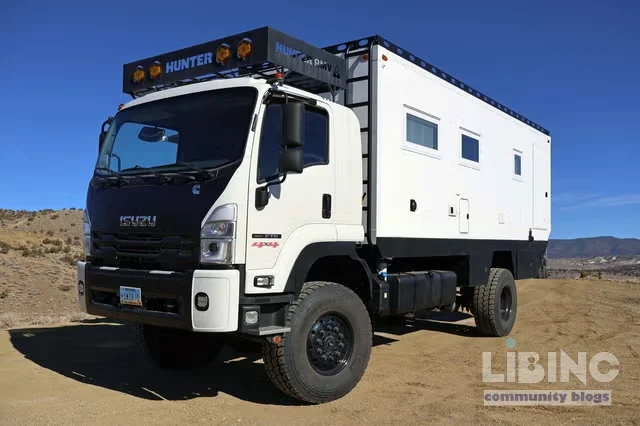
The Predator XLE illustrates the logic: the Isuzu FTR MT3 medium-duty chassis underpins a 22-foot habitat that dedicates 18 feet to living space and 4 feet to a garage. The choice of a chassis originally engineered for extreme service signals that off-road reliability begins with traction and structural integrity. The Meritor front-drive axle with locking differential and an air-shifted two-speed transfer case, added at Tulsa Truck Manufacturing, transform a cargo-hauler into a terrain-taming platform. The point is not merely speed or acceleration; it is the predictable, controlled movement through challenging terrain with a living space that does not collapse under load or compromise safety.
That engineering stance bleeds into the cab dynamics as well. The Isuzu sits high, the driver’s seat several feet above the front axle, and access requires a sequence of grabs and steps. The ride is balanced between a capable highway cruise and an on-trail posture that invites slow, deliberate handling. The result in practice is not a luxury car with a big pantry, but a mobile fortress designed to survive a cross-desert misadventure while offering real creature comforts when you finally stop to rest. Off-road RVs thus map a new continuum between expedition and habitation, where the vehicle’s core mission is to keep the crew alive and comfortable in extreme environments, not merely to shuttle them from campsite to campsite.
The energy architecture reinforces this shift. The Predator’s roof hosts more than 1000 watts of solar generation, feeding a 10-kilowatt-hour battery bank that fuels essential systems. A 100-gallon auxiliary fuel tank stretches range toward 1000 miles of potential travel, a statistic that matters as soon as you consider the distances between viable water sources or the absence of a nearby service station. The living space is optimized for extended off-grid living, featuring two refrigerators and freezers for food storage, a combo washer-dryer, and a Nature’s Head composting toilet that minimizes black-water management. In short, the architecture of Off-road RVs is about resilience, redundancy, and independence as performance multipliers, not merely about horsepower or luxury finishes.
Pricing underlines the strategic trade-offs: the Predator XLE sits at about $545,000, with Acela-based rigs around $275,000 (in this case spoken for) and the Sherpa lineup starting near $225,000. The Apex 6x6, if you want six wheels with six figures of capability, begins around $495,000. Those figures are not mere sticker prices; they reflect a catalog of engineering bets—on materials, on energy storage, on the logistics of keeping thousands of pounds of systems running in remote terrain, and on the financing frictions that come with ultra-heavy, purpose-built machines. The economic calculus matters as much as the engineering one, because the audience for these rigs is both highly capable and highly pragmatic about return on investment, maintenance, and the risk of becoming stranded far from civilization.
In this section, the core insight is simple: Off-road RVs redefine the RV experience by elevating terrain capability to a primary design constraint. They are not just larger campers; they are specialized platforms built to offset isolation with redundancy, and to turn a wilderness night into a controllable living environment. The implications extend beyond the showroom floor—into maintenance regimes, service networks, and the lifestyle choices of those who can now imagine a home that truly travels with them rather than a home that travels to a campground.
Contrasting fantasy and reality in the RV dream
The romantic image of RV travel promises scenic horizons and a backyard that spans the entire continent. In practice, many journeys begin in a crowded resort where your door faces someone else’s sidewall, a situation that dulls the sense of freedom that first drew people to the idea. Hunter RMV’s customers pursue something different: a home that can vanish into a moonscape when the mood or weather demands it, a home that refuses to be tethered to a reservation, a home that is as comfortable as the wilderness allows. The contradiction between the fantasy and the daily friction of conventional RV life is precisely what drives demand for a platform like the Predator XLE, which seeks to eliminate the compromise between living space and mobility by moving the entire living envelope off the beaten path.
The Predator XLE demonstrates how this contrast can be resolved, at least for a subset of adventurers. The rig’s skybox living quarters, accessed by a motorized ladder and ground-bridging stairs, offer a perched vantage that feels remote even when it isn’t. The interior design leans toward a high-end, Scandinavian-inspired aesthetic, differentiating itself from mass-market interiors that often rely on particle-board cabinetry and lightweight veneers. Yet this emphasis on refinement does not come at the expense of practical off-grid features: solar energy, a dual-fridge system, a washer-dryer combo, and a dedicated workshop-like garage space that can accommodate a moto or gear. The result is a lifestyle product that supports remote exploration while preserving a recognizable standard of living inside the cabin, thereby bridging the aspirational with the realizable for those who pursue long-range outings rather than weekend getaways.
Where does this leave the average camper? The benefits are clear: greater range, more independence, and a more authentic wilderness encounter. The costs, however, are real and non-trivial. The Predator’s towering height and mass demand a skilled driver, careful logistics, and a maintenance ecosystem that understands military-grade components and heavy-duty truck culture. Accessibility to specialized service networks becomes a lived constraint rather than a theoretical one. In other words, the fantasy of “go anywhere, stay anywhere” becomes a calculable proposition that requires planning, capital, and a tolerance for complexity that traditional RV ownership rarely tests to the same degree. The contrast is not merely about size; it is about whether the ambition justifies the logistical and financial overhead that accompanies it.
To assess the reality against the dream, consider two axes: space and survivability. On space, Off-road RVs deliver a home-like footprint with abundant storage, climate control, and durable surfaces. On survivability, they push into the unknown with extended fuel autonomy, water capacity, and off-grid electricity, backed by rugged chassis and suspension. The result is a product that trades easy access to a campground for predictable access to remote terrain, a shift that appeals to explorers who view the world as a continuous horizon rather than a series of discrete, mapped stops. The question becomes not whether this approach is superior to standard RVs, but which use cases justify the higher investment and greater operational demands.
Causes and effects of design choices
The decision to base a high-end off-road RV on repurposed military hardware is more than a branding trick; it is a deliberate engineering strategy aimed at reliability under harsh conditions. Military vehicles are designed for durability, wide-range performance, and the ability to function in environments that would degrade consumer-grade machinery. The Isuzu FTR MT3 chassis used for the Predator XLE arrives with a powertrain that includes a Cummins 6.7-liter inline-six diesel delivering about 260 horsepower and 660 pound-feet of torque. In the U.S., four-wheel drive is not standard on the FTR, so Hunter RMV routes the chassis through Tulsa Truck Manufacturing to add a Meritor front-drive axle with locking differential and a transfer case that can split power between axles as terrain dictates. The effect is a platform that can absorb rough trails without sacrificing the reliability expected of a commercial truck engine, a crucial factor for vehicles intended to spend long periods away from conventional service centers.
The choice of a 22-foot habitat with a heavy, multi-use garage is a direct consequence of the core mission: to extend living space without expanding the footprint at a campground. The living area’s interior finishes—high-end cabinetry, an aesthetic reminiscent of Scandinavian design, and a modular bed system that can transform between a queen-position and bunk layout—speak to a practical blend of comfort and flexibility. The trade-off is weight and complexity. A 20,000-pound platform imposing a six-foot floor height tests the limits of highway acceleration, required braking capacity, and the structural integrity of both chassis and habitation frame. The typical on-road experience remains a highway cruise at around 70 mph, but the true test lies in off-road performance where tire size, unsprung mass, and chassis articulation determine whether the vehicle clings to rock or slips into a softer, less navigable surface.
Operationally, the design leans into off-grid resilience. A dedicated solar array—more than 1,000 watts—feeds a 10-kWh battery bank. The dual refrigeration units, the presence of a Traeger smoker and a flat-top stove for outdoor cooking, and the Nature’s Head composting toilet collectively reduce dependence on external infrastructure. The 100-gallon auxiliary fuel and 110-gallon potable-water capacities are not mere conveniences; they are explicit attempts to decouple wilderness living from the nearest gas station or water source. The effect of these choices is a vehicle that promises a longer, more self-reliant stay in remote environments, but it also introduces a chain of maintenance tasks that only a specialized shop with heavy-truck expertise can reliably support. This is a direct causal link between design ambition and the need for calibrated ownership expectations.
Finally, financing and ownership structure arise as a consequence of the scale and specificity of the product. The Predator is priced in a way that factors in military-grade components, bespoke interiors, and the logistical support required to keep such a rig operational far from urban centers. The Acela and Sherpa variants present a different calculus—lower sticker prices and different heritage, but with their own constraints, such as licensing tied to the vehicle’s in-service date and limited availability for traditional bank financing. The causal chain is clear: heavier, more capable machines necessitate specialized procurement routes, which in turn shape who can access these off-road RVs and how they manage ownership risk.
Expert reconstruction for the next frontier
The path forward for Off-road RVs likely rests on three axes: weight optimization, energy and water resilience, and service ecosystems. First, weight reduction without sacrificing durability would enlarge the payload margin for gear and people, improve highway performance, and reduce wear on driveline components. Aluminum or advanced composites could replace some steel framing in non-structural areas, while modular interior elements might shift between configurations without adding mass. Second, expanding energy capability beyond a 10-kWh battery while maintaining reliability could empower longer stays away from power sources. Options include higher-capacity lithium packs, optimized solar layouts with hybrid charging, and smarter energy management that prioritizes essential systems when solar input wanes. A third axis involves the downstream service network: a scalable, nationwide or regional shop footprint for heavy trucks, plus remote diagnostics and over-the-air updates for critical systems to minimize downtime in the field.
From a product-design perspective, these rigs could benefit from increased modularity. A modular habitat that can be swapped for a lighter, compact base for certain trips and heavier, fully equipped configurations for longer expeditions would give owners a more versatile toolset. The interior could also feature more adaptive sleeping arrangements, where bunk configurations deploy automatically from ceiling panels or wall recesses, reducing the number of steps needed to transform spaces and improving ergonomics on rough terrain. The overall market should also explore more flexible financing models that reflect a broader spectrum of use cases—from occasional expedition weekends to extended-season deployments—so more adventurous buyers can access these capabilities without compromising liquidity. Finally, a refined telematics framework could monitor chassis health, fuel usage, solar input, and water reserves, delivering proactive maintenance alerts before a breakdown disrupts an off-grid foray.
Where this leads
Off-road RVs rooted in repurposed military platforms present a coherent answer to the paradox of wilderness access and habitation quality. They deliver real capability and meaningful autonomy, while demanding a disciplined approach to ownership, maintenance, and budgeting. The Predator XLE demonstrates that it is possible to live well while moving through remote terrain, provided one accepts the complexity and cost that come with high-end mobility in extreme environments. The trajectory points toward a market that values not just the thrill of the trail, but the reliability, serviceability, and energy independence that make extended wilderness stays practical. As technology matures and sourcing broadens, the line between expedition caravan and luxury motorhome may blur further, inviting a broader audience to rethink what it means to call the road your home.
Practical adoption: maintenance, service networks, and ownership models
To turn the Predator XLE from a showroom showcase into a reliable wilderness companion, the invisible groundwork must be built around maintenance, spare parts access, and flexible ownership. In remote operations the difference between planned reliability and unexpected downtime is not cosmetic—it's the difference between a successful expedition and a stranded itinerary.
Service ecosystem by region
| Region | Network Coverage | Avg Response | Key Support Features |
|---|---|---|---|
| North America | Strong | 24-48 h | Heavy-truck shops; mobile units |
| Europe | Moderate | 24-72 h | Specialist fleets; spares |
| Remote Regions | Limited | 72+ h | Field diagnostics; spares by request |
Remote diagnostics and mobile units supplement fixed shops, but the real value comes from a flexible, region-aware support map that owners can rely on during long expeditions.
Flexible ownership models
- Modular configurations
- Lightweight weekend setup for quick trips
- Advanced expedition layout for long stays
- Finance options
- Lease-to-own with maintenance packages
- Usage-based insurance and warranties
- Service packages
- Mobile service fleets
- Remote diagnostics and OTA updates
These elements together provide a practical path from dream to durable, field-ready wilderness living.
How do off-road RVs differ from standard RVs in maintenance and upkeep?
Off-road RVs built on heavy-duty platforms demand maintenance that mirrors commercial trucks more than consumer motorhomes. Drivetrain health, suspension articulation, chassis integrity, and field diagnostics take precedence, and access to spare parts or mobile technicians is essential because these rigs operate far from traditional dealer networks. A proactive maintenance plan, stocked parts kit, and remote-support capabilities help keep long expeditions on track. In practice, owners combine scheduled checks with on-the-trail checks, carrying key wear items to avoid field failures.
In short, owners build robust, forward-looking maintenance routines that suit long, rugged trips rather than quick, low-mile weekend runs.
What does the Predator XLE's service network look like in practice?
The service ecosystem blends fixed regional shops with mobile units and remote diagnostics. In practice, owners rely on a regional map of heavy-truck service centers, a schedule for routine checks, and a network of technicians trained to service high-weight, all-terrain platforms. Availability varies by region, so a proactive plan with pre-arranged service windows minimizes downtime on remote trips. The goal is to translate a luxury interior into a dependable field workstation with predictable support.
Ultimately, the service network supports reliability rather than mere capability.
How long can an Off-road RV operate off-grid on a single charge and fuel fill?
In the Predator XLE, a 10 kWh battery and roughly 1 kW of solar can power essential systems for multiple days, provided there is sun. A 100-gallon auxiliary fuel tank and 110-gallon water supply extend range and stay duration, enabling weeks of wilderness use when sun is good and water is rationed. Real-world duration depends on climate, load, and how aggressively you use power-hungry appliances.
Owners plan around daily energy budgets to maximize the window between service stops.
What financing options exist for repurposed-military vehicles?
Financing often blends conventional truck loans with expedition-focused packages. Options include lease-to-own with maintenance plans, specialized heavy-vehicle lenders, and warranties that cover field-service support. Some buyers pair manufacturer-backed finance with geographic service packages to reduce total ownership risk, while others favor co-op or membership models to share usage and depreciation costs.
Credit structures vary, but the emphasis remains on predictable service costs and long-term reliability.
What are best-practice scenarios for planning remote trips?
Plan around distance, water, and power. Map routes with known service points, carry spare parts for drivetrain and electrical systems, and schedule regular engine and battery checks. Build a pre-departure maintenance window, create a contingency plan for unplanned detours, and use remote diagnostics to monitor health. These steps reduce the chance of breakdowns in areas with limited help and ensure you can reach the next water source or fuel stop safely.
Practical planning reduces risk and extends your stay in desirable locations.
What are the biggest trade-offs when choosing off-road RVs?
Trade-offs center on cost, complexity, and practicality. You gain extended range and independence at the price of heavier weight, higher maintenance needs, and a smaller service network. They demand more planning, specialized driving skills, and a willingness to juggle logistics, parts supply, and financing to sustain long wilderness stays.
Choosing means aligning capability with tolerance for complexity and cost.





Add a comment
To comment, you need to register and authorize
Comments