

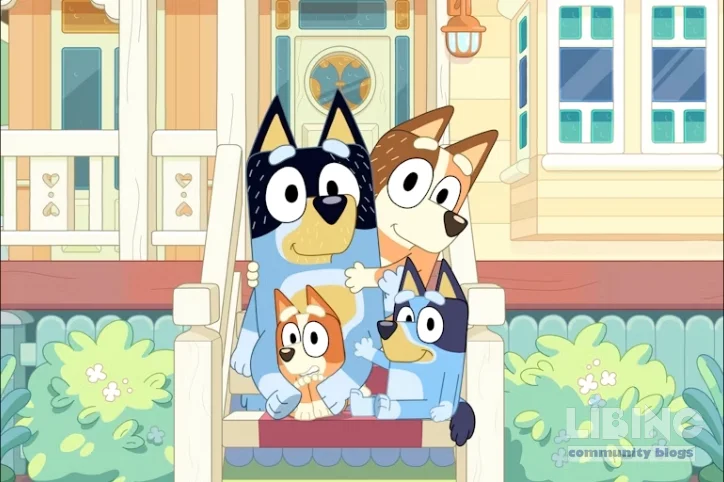
Bluey resilience as a blueprint: modeling child coping through animated storytelling
Table of contents
Bluey, the six-year-old Australian pup, is often described as a beacon of family warmth and playful realism. But beneath the charm lies a structured portrayal of resilience in everyday family life. Resilience is not merely a hardy façade; it is the capacity to cope with challenges, adapt to setbacks, and recover from difficulties. When we analyze Bluey through the lens of child development, the show becomes a live, ongoing demonstration of coping skills, emotional regulation, and interpersonal trust. This article asks what a rigorous examination of Bluey reveals about how early media can model resilience in a way that supports healthy growth rather than just entertain audiences.
Our focus weighs heavily on two questions: what concrete resilience messages appear on screen, and how they might translate into real-world outcomes for young viewers. In a landscape where youth mental health challenges are rising, including anxiety and emotional dysregulation, the medium matters. A 2023 resilience survey of nearly 140,000 students shows substantial distress among primary and secondary students, underscoring the urgency of early, evidence-informed support. The analysis here uses the Grotberg Resilience Framework to identify how three interconnected elements—external supports, practical coping skills, and inner strengths—play out in a widely watched children’s program.
What follows is an analytic synthesis structured to move beyond summary: it asks why Bluey’s resilience moments occur, how they cluster around caregiving dynamics, and what this implies for parents, educators, and content creators aiming to cultivate durable coping skills in early childhood. The study examined every episode from seasons one to three, totaling 150 episodes and 18 hours of on-screen life with Bluey, Bingo, Chilli, Bandit, and their circle of friends. The findings point to a consistent, actionable pattern: resilience is most often modeled by caring adults, while children practice skills in context, underpinned by inner optimism and self-regulation.
Analytics lens: mapping resilience in Bluey
The article’s core matrix rests on a close, episode-by-episode audit, guided by the Grotberg Resilience Framework. This framework partitions resilience into three interlocking domains: I have (support systems), I can (coping skills), and I am (inner strengths). The core discovery is that resilience appears in nearly half of all episodes. In total, 73 of 150 episodes contain a clear resilience message as a primary or secondary theme. This density is not accidental; it reflects a design choice to integrate coping narratives into family life rather than isolate them as didactic interludes.
Within this body of content, two findings stand out for analytical clarity:
- Dominant mode is I have: caregiver modeling fuels resilience — Approximately two-thirds of the resilience moments are facilitated by a parent. In practice, Bluey’s mum most often embodies the caregiver archetype, shaping how children perceive distress, regulate emotion, and recover with calm. This pattern aligns with empirical evidence that secure attachments and adult scaffolding strengthen coping repertoires during early childhood.
- Child-driven coping is prominent but contingent on role models — The episodes frequently present practical strategies that children can internalize, but they emerge most reliably when a caregiver demonstrates the approach first. The Show (season 2, episode 19) offers a vivid illustration: Bingo’s tears after a breakfast tray drop are met with a calm, coached response—"I have a little cry, I pick myself up, dust myself off, and keep going." Such lines become durable scripts that children replay in moments of disappointment, reinforcing the I can dimension through modeled behavior.
Three concrete examples anchor the analysis:
- The Show (season 2, episode 19): Emotions are acknowledged, then calmed through a coached sequence. The parent’s verbal cue and visible coping process demonstrate how to transform distress into actionable behavior. This is a textbook illustration of the I have category in practice.
- Keepy Uppy (season 1, episode 3): The balloon pops; the characters pause, reframe the moment, and smile. The sequence models reframing and emotional regulation, elevating the I can dimension through concrete steps—pause, breathe, reframe, proceed.
- Seesaw (season 2, episode 27): Pom Pom showcases determination and self-confidence—an instance of I am, where inner resolve and self-efficacy drive action under pressure.
Across the corpus, the show broadly touches on competencies central to resilience: trusting relationships, emotional communication, problem-solving, self-regulation, empathy, and reciprocity. The portrayal of self-care—e.g., the 20-minute alone-time moment in Sheepdog (season 3, episode 11)—extends resilience into a nuanced domain where rest is a strategic asset, not a deficit.
Contrast and comparison: modeling vs. instruction
Bluey’s approach stands out in contrast to more didactic resilience messages typical of some children’s programming. The evidence suggests that, rather than preaching, the show integrates resilience through relational dynamics and narrative consequences. This distinction matters for parental interpretation and for media designers attempting to replicate durable learning outcomes.
Key contrasts emerge across several axes:
- — Bluey embeds coping skills within character interactions and play, not through direct instruction. Children observe and imitate, a process tied to social learning theory and reinforced by repeated exposure during shared viewing.
- — The I have dimension is rarely enacted by a distant mentor; it is anchored in the family unit and community patterns. This realistic framing reinforces the social ecology necessary for resilience development.
- — The choice of animal characters reduces defensiveness and increases engagement, leveraging natural affinity for non-human figures to facilitate affective engagement with coping behaviors. This aligns with the literature on anthropomorphic storytelling as a hook for early moral and emotional education.
From a practical standpoint, co-viewing with a caregiver shifts resilience from passive reception to active practice. Dialogic viewing—pausing to ask what a character felt, what they could do differently, or what personal strategies the viewer might try—becomes a crucial mediator of learning. The prompts—"What do you think Bluey felt then?" or "If you were in that situation, what would you do?"—trigger reflective processing that strengthens the I can and I am pathways.
Cause and effect: how resilience scripts shape development
The evidence from Bluey aligns with a broader causal logic in child development: caregiver modeling of coping strategies enhances emotional regulation, problem-solving, and social competence. When caregivers acknowledge distress, articulate a coping sequence, and recover with composure, children internalize these scripts. The effect is a durable, transferable set of responses that children can call upon across contexts—school, friendships, and family life.
Specific causal channels emerge from the analysis:
- — Children copy observed regulation strategies and soon deploy them in novel settings, reinforcing neural pathways for self-regulation and flexible problem-solving.
- — Asking children to articulate feelings and to map steps to cope converts passive watching into active cognitive rehearsal, a prerequisite for transfer to real-life scenarios.
- — Recurrent exposure to resilience scripts via the same characters and household dynamics embeds coping scripts into working memory, strengthening retrieval under stress.
- — The research landscape emphasizes that early resilience-building interventions yield better long-run outcomes, reducing vulnerability to anxiety and dysregulation later in life.
These causal relations are not claims about a magical cure. They describe a pathway where consistent, scaffolded resilience messages within a trusted family context contribute to adaptive responses when children face real-world stressors. The Bluey data supports the argument that early, relationally grounded modeling, reinforced by audience engagement and guided reflection, yields measurable gains in coping skill repertoires.
Expert reconstruction: translating findings into practice
Extracting practical implications from this analysis yields four directional strategies for parents, educators, and content creators who aim to foster durable resilience skills in early childhood.
- — In content design or home routines, foreground the I have, I can, I am triad as a repeated scaffold. Encourage caregivers to model support networks (I have), teach explicit coping steps (I can), and nurture inner strengths like optimism and self-regulation (I am).
- — Use structured prompts after episodes to activate reflection: "What did Bluey feel? What helped her cope? What would you try in a similar moment?" These questions convert observation into practice and deepen learning.
- — Recognize screen media as a catalyst for resilience training only when paired with real-life experiences and caregiver guidance. Media can scaffold skills, but family context completes the transfer to daily life.
- — For creators, embed the resilience triad into every arc, ensure caregiver presence in two-thirds of resilience moments, and weave non-linear problem-solving into play sequences. Build observational checklists for researchers and educators to track shifts in emotional regulation, prosocial behavior, and self-efficacy over time.
Beyond this, future work should consider longitudinal tracking of children exposed to resilience-rich content and examine how prompts and co-viewing frequency influence the durability of coping skills. The current analysis offers a robust baseline, but ongoing research could quantify how specific prompts and caregiver interactions predict reductions in distress and improvements in school performance over multiple years.
In sum, Bluey provides more than entertainment. It offers a structured, translatable model of resilience grounded in real-life family dynamics. When parents watch with their children and engage in guided reflection, the show’s on-screen resilience becomes a tool for developing emotional regulation, problem-solving, and a robust sense of self—all central to healthy childhood development.
Kelly Bohl, a CQUniversity student, and Mary Bolling, co-host of the Bluey podcast Gotta Be Done, contributed to the original research on which this analysis is based. Their collaboration underscores how academic inquiry and popular media can converge to illuminate practical pathways for fostering resilience in young minds.
Note: The material references the Grotberg Resilience Framework, which segments resilience into I have, I can, and I am elements. It also reflects a broader body of evidence on the protective role of caregiver modeling, emotional coaching, and early intervention in child development.
What this means for families is simple yet powerful: when you watch Bluey with your child, you have a chance to turn a routine viewing into an active resilience-building session. The show’s recurring patterns—caregiver guidance, practical coping steps, and emphasis on inner strength—are not incidental in a children’s program. They are deliberate design choices with potential long-term benefits for how children handle life’s ups and downs.
Final takeaway: resilience is learned most effectively through relationships, repeated practice, and reflective dialogue. Bluey offers a compact, compelling model of that process—one that families can adapt to everyday moments, inside and outside the screen.
Key terms used
- Grotberg Resilience Framework
- I have, I can, I am
- emotional regulation
- problem-solving
- inner strengths
Practical routines to anchor resilience at home
To translate Bluey’s on-screen resilience into everyday skills, families benefit from a simple, repeatable routine that pairs caregiver modeling with child participation. The key is to move from observation to practice via clear emotional regulation strategies and small, safe challenges. A three-step cycle—pause, respond, reflect—provides a stable scaffold that mirrors the I have, I can, I am triad. For example, after dinner when a plate slips, the caregiver says: "Let’s pause. I feel disappointed. What can we do now?" Then demonstrates a coping sequence such as breathing, labeling the emotion, choosing a small action, and then reflecting together. This routine can be practiced in 2–3 minutes, multiple times per day, increasing fluency and transfer.
- Scenario 1: a missed turn during a game — Child feels frustration; caregiver models: "It’s okay to feel upset. Let’s breathe and try again." The child repeats the steps and gains self-efficacy.
- Scenario 2: anxiety before a new activity — Family uses a "challenge ladder": small steps with encouragement, then celebrates progress.
- Scenario 3: conflict with a peer — Role-play: name the feeling, suggest a repair, practice a calm reply.
Practical play-based activities
| Activity | What it teaches |
|---|---|
| Pause-breath-respond | Calm-upregulation and wording |
| Story-time debrief | Emotion labeling, narrative reflection |
How does Bluey model resilience for kids?
Bluey demonstrates resilience primarily through a trusted caregiver who notices distress, labels the emotion, and guides a concrete coping sequence that the child can imitate, then follows with reflective dialogue to consolidate learning, repeatedly showcasing the idea that difficult feelings are normal and manageable; by centering emotional coaching within everyday family life and play, the show provides a clear template for children to rehearse calm responses, problem-solving steps, and social repair in low-stakes contexts before trying them in school or peer settings. This pattern supports emotional regulation and social competence in early childhood.
Analytically, the episodes foreground modeling and scaffolding, then invite the child to practice and reflect, which strengthens transfer of skills to real-life moments and enhances self-efficacy over time.
What are the I have, I can, I am pillars and how do they work at home?
The three pillars—I have (support networks), I can (coping steps), and I am (inner strengths)—work at home by ensuring caregivers first establish safety and social support, then coach concrete strategies, and finally nurture optimism and self-regulation; practical routines integrate these pillars in sequence across daily moments, turning watchable scripts into living habits that children can draw on during stress, school transition, or social friction.
How can caregivers use co-viewing prompts effectively?
Effective prompts are short, concrete, and action-oriented. After an episode, ask questions like: What did Bluey feel in that moment? Which step helped most? What would you try if you faced a similar situation? Repetition of these prompts strengthens cognitive rehearsal and helps children internalize the coping sequence as a ready-to-call toolkit.
Analytically, dialogic viewing turns passive watching into active practice, using the show as a rehearsal space for real-world challenges.
What practical activities promote resilience in daily routines?
Active routines such as pause-breath-label-respond, brief emotion naming during play, and reflective debriefs after moments of frustration have been shown to improve emotional regulation and social problem-solving; these activities should be short (2–5 minutes), repeated, and embedded in familiar contexts like meals, playtime, and bedtime.
Such practices reinforce the I can and I am pathways by providing concrete steps and positive feedback loops.
What evidence supports early resilience messaging in children’s media?
Findings from analyses of Bluey indicate that resilience cues—caregiver modeling, emotion coaching, and repeated exposure—are associated with improvements in children’s coping repertoires; this aligns with broader research showing that early, relationally grounded interventions support emotional regulation and social competence later in school years.
Analytically, media-based modeling serves as a scalable, accessible catalyst for resilience-building alongside real-world practice.
How can content creators measure impact of resilience-themed episodes?
Measurement can combine qualitative feedback from caregivers, observational checklists tracking emotion labeling and coping attempts, and short-term pre/post scales of self-efficacy during play; long-term tracking may assess changes in school readiness, peer interactions, and regulatory behaviors across the year.
Practically, the triad of caregiver presence, structured prompts, and reflective discussions provides a replicable framework for evaluation.








Add a comment
To comment, you need to register and authorize
Comments
Prompts could include: what did the character feel, what helped them feel calmer, what would you try in a similar moment, and how might we adapt that strategy for tomorrow’s challenge. But the effectiveness of these prompts depends on how caregivers respond. Training and simple coaching for parents could improve fidelity, turning co viewing from a ritual into a structured learning activity. Educators could translate this into classroom routines, pairing observational checklists with quick debriefs after resident social problem solving tasks.
It is also important to acknowledge potential limitations. Media moments may oversimplify complex emotions or imply a neat sequence from distress to calm that does not always occur in real life. Children vary in temperament and exposure to stress, and not every family has the luxury of time or space to enact guided reflection. A responsible implementation plan would include screening for signs of excessive pressure to cope or masking of distress, and would pair media based learning with supportive adult conversations that validate emotions rather than suppress them.
Finally, measuring impact will require careful, developmentally appropriate metrics. Observational checklists, teacher reports, and brief parent diaries could track growth in emotional labeling, regulation, and prosocial responses across months rather than days. When scaled up, this approach could become a modest, practical contribution to public health goals around child mental well being.
The analytic method—a careful episode by episode audit across many episodes—offers concrete, transferable examples, yet it should be complemented by qualitative work with families and longitudinal observation. Dialogic viewing, where caregivers pause and ask questions about feelings, motives, and possible actions, emerges as a plausible mediator of learning. The article’s advocacy for co viewing is well founded, but it would be valuable to specify how prompts should evolve as children grow older, and how to balance guiding questions with space for the child’s own interpretations.
Finally, the cultural and stylistic frame of Bluey matters. The anthropomorphic, warm Australian setting may reduce defensiveness and improve engagement, but resilience is not one size fits all. Cross cultural replications and adaptations could reveal universal coping scripts and helpful localizations. In sum, Bluey offers a compact, transferable model of resilience that can inform both parenting practice and media design, while inviting careful attention to context, equity, and developmental nuance.