

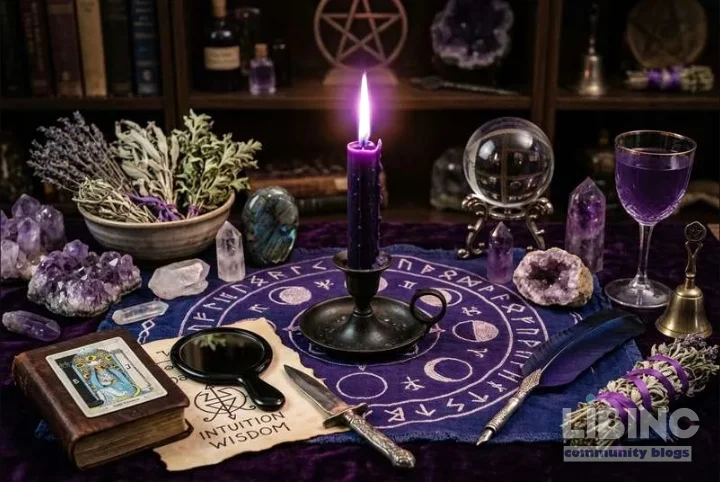
Purple Candle Magic: A Rigorous Framework for Psychic Development and Divination
Purple candle magic offers more than ambiance; it promises a disciplined channel for inner sight to meet external outcomes. In a landscape flooded with quick fixes, practitioners seek a method that aligns intention with subtle energy. Yet belief and experience collide here: how much of the effect is psychological, how much is spiritual, and how do we measure progress without reducing mysticism to sentiment? This article presents four analytical lenses—data-driven assessment, contrasts with other modalities, chain-of-cause reasoning, and expert reconstruction—to build a robust framework for purple candle magic. The aim is not to flatten mystery but to sharpen practice, so skilled readers can distinguish genuine signal from noise and maintain ethical, effective discipline in their divination work.
Table of Contents
- 1. Analytical View of Purple Candle Magic
- 2. Contrast & Boundaries
- 3. Cause-and-Effect Relationships
- 4. Expert Reconstruction
1. Analytical View of Purple Candle Magic
From a theory-first stance, purple candle magic operates as a form of sympathetic magic that aligns cognitive and spiritual channels through color. Its central claim is that purple functions as a conduit to higher perception, enabling clearer divination and deeper spiritual insight. Practically, the flame becomes a focused interface where will meets the unseen. The mechanism is not reducible to a single cause, but a constellation of factors—symbolic resonance, ritual precision, and the timing of inner attention. The claim must endure scrutiny: does the color alone yield perception, or does disciplined technique unlock what the mind already possesses?
Key propositions:
- Color-energy alignment: Purple channels the faculty attributed to Spirit, setting a context for intuition to surface with less cognitive friction.
- Intention-energy coupling: A clearly articulated aim guides attention, enhancing signal-to-noise in psychic processing.
- Chakra pairing: The third eye (indigo-violet) receives stabilizing input when purple is used as a focal point, potentially increasing clarity of perception.
- Measurement caveats: Psychic readings resist simplistic quantification; progress often shows as consistency of discernment, depth of processing, and qualitative shifts in awareness.
Why purple, specifically? The symbolism of purple has historical weight—royal authority, mystery, and sacred access. In candle-magic theory, those associations translate into a tonal field in which inner guidance feels both elevated and accessible. This is not mere ritual theater; it is an attempt to harmonize interior state with exterior signs. The risk is mistaking mood elevation or wishful thinking for genuine insight, which is why the practice requires disciplined preparation, ethical framing, and careful interpretation of outcomes. The analytic core, then, lies in acknowledging the limits while extracting reliable correlates from practice—the temperature of the flame, the cadence of attention, and the content of realized impressions.
LSI: divination work, third eye activation, psychic development, spiritual awakening, energy work.
Mechanisms in practice
- Symbolic resonance: The scene around the purple candle becomes a symbolic sandbox where cognitive patterns can reorganize to reveal hidden connections.
- Focused attention: The candle narrows mental bandwidth to the intended inquiry, reducing scatter in perception.
- Contextual framing: Aligning with moon phases and chakra considerations creates predictable structure for interpretation.
In sum, purple candle magic behaves as a structured attentional discipline. The aim is to produce reliable alignment between inner cues and external readings while maintaining critical awareness of the limits of subjective experience. This is where theory meets practice: without rigorous context, purple becomes a mood rather than a method.
2. Contrast & Boundaries
To appreciate purple candle magic, contrast matters. Different candle colors map to different energetic grammars, and purple occupies a distinct borderland between psychology, symbolism, and spirit. In this section, we compare purple with other color correspondences, examine where it excels, and acknowledge its boundaries. The goal is not to diminish its value but to situate it within a realistic toolkit for divination and spiritual work.
Compared to red candles, which emphasize action and heat, purple prioritizes perceptual refinement and spiritual connectivity. Blue candles emphasize communication and calm, while white candles strip to universal purification and clarity. Black candles (when used carefully) can probe shadow work but may also attract heavy energy or misinterpretation. Purple sits closest to Spirit—the generative field that underwrites perception itself—yet it does not replace the practicalities of disciplined divination. Its strength lies in facilitating inner access to guidance rather than coercing external outcomes.
Additionally, purple candle magic benefits from compatibility with other tools. Integrating lavender oil for mental clarity, mugwort for psychic dreamwork, or amethyst for amplification can elevate results—but only if the practitioner maintains rigorous ethical boundaries and precise intention. The risk of over-interpretation increases when purple is used in isolation, without cross-checks from journaling, corroborative readings, or ecological checks. This is why the color is most potent when embedded in a coherent ritual system rather than treated as a standalone gesture.
LSI: divination protocols, psychic enhancement, spiritual tools, ritual practicality.
What purple cannot guarantee
- Absolute certainty: Psychic impressions often arrive as probabilistic cues, not certainties.
- Immediate material results: Spiritual work typically unfolds through time, resonance with circumstance, and the cultivation of clarity.
- Manipulation of others: Ethical practice requires consent and alignment with free will; purple does not override moral boundaries.
The boundary conditions remind practitioners to maintain skepticism where appropriate and to document experiences for ongoing refinement. Purple candle magic becomes more credible when complemented by disciplined inquiry, repeated practice, and transparent interpretation of signals.
3. Cause-and-Effect Relationships in Purple Candle Magic
A causal chain underpins purple candle magic: intention informs preparation, preparation influences perception, and perception guides subsequent action. Although the exact mechanism remains partially subjective, a robust framework reveals consistent patterns that practitioners can rely on. The following chain captures typical causal relationships observed in seasoned practice.
First, a clearly articulated intention creates a cognitive target. When you write or vocalize a precise aim—such as enhancing discernment in divination—the mind narrows to relevant cues, reducing interference from unrelated stimuli. The flame acts as a symbolic antenna that conducts intention into a perceptual field where subtle signals can register as intuitive impressions. The moon phase modulates this field by adjusting emotional resonance and attention capacity—full moon amplifies exposure to insights, while the new moon sharpens inner work and discipline. Finally, the ritual artifacts—the oil, herbs, crystals—provide consistent ecological anchors that support the interpretive process, not magical loopholes.
Cause-and-effect in purple candle magic can be captured in practical steps:
- Define the aim: A precise formulation reduces cognitive drift and guides interpretation.
- Prepare the space: Cleansing, neutral scent, and comfortable lighting minimize ambient noise that could distort perception.
- Dress the candle: Oils and herbs align with intention, creating tactile cues that the mind associates with the desired outcome.
- Light and observe: The flame's behavior becomes a live feedback channel—steady, dancing, or irregular patterns signal different perceptual states.
- Interpret with restraint: Note impressions, verify with journaling, and seek corroboration over time rather than forcing a single reading.
When this chain works well, the practitioner notices a disciplined clarity: impressions arrive with focus, not chaos; a sense of sequence emerges; and the unfolding insight aligns with subsequent events, offering a coherent narrative rather than a scattering of disjointed hints. If any link in the chain falters—a distracted mind, an uncontrolled environment, or a rushed interpretation—the entire reading loses reliability. The causal model thus depends on iterative discipline, not on a single magical cue.
LSI: ritual timing, energy alignment, perceptual clarity, intuitive processing.
4. Expert Reconstruction: An Advanced Framework for Purple Candle Magic
Experts approach purple candle magic as a disciplined protocol rather than a one-off gesture. The reconstruction below synthesizes practical ritual steps with evaluative criteria, enabling practitioners to scale accuracy while preserving ethical boundaries. This framework emphasizes reproducibility, reflective practice, and safeguards against overreach in spiritual work.
Advanced ritual framework:
- Intention architecture: Start with a primary aim, followed by two supporting sub-aims that clarify scope and boundaries.
- Environmental control: Minimize drafts, set stable lighting, and ensure a non-toxic, well-ventilated space for clear perception.
- Dressings and tools: Use lavender oil for calm focus, frankincense for spiritual channeling, mugwort for enhanced dreamwork, and amethyst for amplification. Keep crystals placed where they can be visually observed during readings.
- Moon-phase timing: Align the ritual with the lunar cycle to harmonize intention with cosmic rhythms—full moon for expansive divination, new moon for new practices, waning moon for release work.
Practical protocol:
- Prepare the journal: A dedicated divination journal captures impressions, timing, and outcomes. Review weekly to track patterns and calibrate expectations.
- Flame-reading discipline: Observe the flame for 3 to 5 minutes, noting steadiness, height, and color fluctuations. Record qualitative signals in your journal and cross-check with subsequent readings.
- Wax-signal interpretation: Look for pooling, directional melt, and residue patterns as cues about the direction and quality of energy flow.
- Ethical guardrails: Always respect autonomy and consent; avoid influencing others without consent, and avoid coercive manipulation under the guise of psychic work.
Expert practice also encompasses integrity in interpretation. Purple candle magic thrives when the reader guards against wishful thinking and maintains a clear separation between subjective experience and external claims. The most durable outcomes emerge from iterative cycles: ritual, journaling, verification, and adjustment. In that sense, purple candle magic becomes a craft of disciplined perception, not a solitary spark of guesswork.
LSI: ritual protocol, ethical practice, journaling, outcome verification, energy amplification.
Final observation: purple candle magic, when employed with rigor, offers a durable framework for developing inner sight and aligning it with meaningful readings. The practice remains an art of disciplined perception, anchored in intention, preparation, and ethical restraint. Practitioners who integrate these elements tend to experience more consistent readings, clearer interpretations, and deeper spiritual resonance over time.
5. Practical Measurement Template
To close the gap between insight and traceable progress, adopt a concise measurement routine that blends qualitative impressions with lightweight, repeatable checks. This keeps practice rigorous without sacrificing nuance.
Signal tracking lets you distinguish signal from noise across sessions. Use the compact tool below daily.
The following table records observable cues, interpretations, and next steps.
| Signal | Interpretation | Next Step |
|---|---|---|
| Flame steadiness | Focused state or drift | Note timing, resume observation |
| Impression clarity | Quality of intuitive signals | Cross-check with journaling |
| Session-to-session consistency | Pattern emerges | Compare with prior readings |
| Context cues (moon phase, mood) | Ecological anchors | Record phase and mood |
Analysis: This compact tool makes subtle signals legible and invites disciplined follow-through without overclaiming results.
Ritual cadence (brief checklist):
- Set intention — define scope
- Prepare space — minimize noise and distractions
- Dress and light — align with purpose
- Observe — record impressions and later verify
With consistent use, purple candle work matures into a reliable pathway for inner sight, refined by data-driven reflection and ethical restraint.
Ethical guardrails ensure responsible practice across readings.
Proceed to the final integration step in the next section.
6. Expert Reconstruction: Integration
Final observation: purple candle magic, when employed with rigor, offers a durable framework for developing inner sight and aligning it with meaningful readings. The practice remains an art of disciplined perception, anchored in intention, preparation, and ethical restraint. Practitioners who integrate these elements tend to experience more consistent readings, clearer interpretations, and deeper spiritual resonance over time.
How can purple candle magic be effective for developing inner sight?
Purple candle work delivers a direct, practical answer: when practiced as a disciplined energy practice that couples a clearly stated aim with steady, mindful observation, it helps distinguish genuine perceptual cues from mood or wishful thinking by building a reproducible cycle that translates attention into incremental clarity over weeks, not moments, and it does so by anchoring perception in consistent ritual structure, ethical boundaries, and transparent journaling that can be reviewed and adjusted. The outcome is not certainty but a growing signal-to-noise ratio, where repeated sessions yield converging impressions that can be evaluated against events and corroborated with readings.
What steps help measure progress in purple candle readings and ensure ethical practice?
A practical routine starts with a clearly stated aim, a brief observation period (3-5 minutes), and meticulous journaling. Track how impressions evolve across sessions, compare readings to context, and verify with corroboration. Ethics are upheld by avoiding manipulation, obtaining consent where applicable, and treating readings as guidance rather than control. Regular review helps separate transient mood from meaningful patterns, turning impressions into a trackable development over time.
What role do moon phases and color choices play in the practice?
Moon phases shape attention and emotional resonance: the full moon tends to amplify receptivity, while the new moon supports discipline and new practices. Purple as a color is a symbolic helper that can prime a perceptual field toward Spirit-linked guidance, but it operates within a reliable ritual framework. The color alone does not guarantee results; it enhances alignment when paired with intention, environment control, and ethical interpretation.
How should a practitioner set up a safe and disciplined space for purple candle rituals?
Create a clean, well-ventilated area free from distractions, with stable lighting and non-toxic oils. Define personal boundaries and consent, document expectations, and keep a dedicated journal for impressions and outcomes. Use calming fragrances and a simple setup to reinforce focus. The discipline comes from routine checks, non-coercive interpretation, and a clear separation between subjective impressions and external claims.
What is a simple daily routine to start with for beginners?
Begin with a four-step daily ritual: write a precise aim, light the candle, observe for 3-5 minutes, and record impressions in a journal. Review weekly to identify patterns and calibrate expectations. Start with small, testable aims such as sharpening discernment in one question, then gradually increase scope as consistency improves.





Add a comment
To comment, you need to register and authorize
Comments
Another fruitful thread is to interrogate the role of expectation. The claim that intention-energy coupling reduces cognitive friction sits near contemporary accounts of attention and cognitive load. Yet the practice remains deeply personal: a practitioner enters a subtle field of awareness where memory, emotion, suggestibility, and symbol-laden imagery co-create meaning. In that space, how do we separate genuine perceptual structure from mood elevation or selective recall? A possible answer is to triangulate experiences with independent outcomes over time. For example, a reading may point toward a decision that subsequently aligns with a real-world constraint or opportunity rather than simply feeling inspirational. Carefully designed follow-ups could examine whether the perceived accuracy correlates with subsequent events that logically connect to the intention, not merely with subjective impression.
Moreover, the framework’s attention to boundary conditions and ethical guardrails is essential. If purple candle work is framed as a discipline for discernment rather than manipulation, then the standards for consent, autonomy, and relational integrity must be baked into every stage. In practice, that suggests adding a reflective step where practitioners actively consider potential unintended effects on others and document safeguards taken to prevent coercive influence. Could we also benefit from cross-cultural sensitivity to color symbolism, acknowledging that purple’s resonances vary across traditions and contexts? The article hints at historical weight, but a deeper survey could illuminate how to adapt the practice responsibly in diverse communities without diluting its core aims.
In sum, the analytic framing is valuable because it invites disciplined practice rather than solitary superstition. The challenge lies in building a language and a method that honor interior experience while offering credible modes of accountability. If we can articulate precise, testable expectations while preserving the mystery that makes psychic development compelling, the result could be a shared vocabulary for growth. How might we structure long-term studies that honor phenomenology while providing guardrails against overclaiming, magical thinking, and wishful interpretation?