

The Fourteenth Amendment: Citizenship, Equality, and the Architecture of Reconstruction
The commitments to equality in citizenship and protection under law did not arrive fully formed on the morning after the Civil War. The Fourteenth Amendment emerged from bitter political conflict during Reconstruction, aiming to fix who counts as a citizen and how the state must treat individuals under law. The stakes were existential: if freedpeople could be counted as citizens and enjoyed due process and equal protection, federal power would expand and the promise of emancipation would endure. Yet the path to ratification required bridging deep political fault lines between Radical Republicans and factions aligned with the old South. This article traces the drafting, the strategic choices, and the enduring consequences of the amendment, revealing how a constitutional text shaped citizenship for generations. By examining the wording and the political calculus behind its sections, we uncover why birthright citizenship, the end of the Three-Fifths representation, and the mechanisms to bar former rebels from office mattered beyond the courtroom, influencing civil rights jurisprudence for a century and a half.
Only by treating the Fourteenth Amendment as a calculated constitutional pivot can we explain its reach. The first section defines citizenship in expansive terms, while the second reshapes representation to prevent disenfranchisement of adult male citizens. The third bar on officeholding for those who rebelled ties loyalty to political power, and the fourth and fifth sections provide fiscal and enforceable guardrails. The combined effect is not merely legal punctuation; it reorders political incentives, redistributes power, and creates a framework for future rights claims that courts would leverage in ways the drafters could scarcely anticipate. This analytic arc helps explain why the amendment remains the most litigated portion of the constitutional text after the Bill of Rights, and why its legacy travels well beyond the courtroom into schools, legislatures, and public life.
Table of Contents
- Block I — Through Analytics: Origins, Drafting, and Semantics
- Block II — Through Contrast: Reconstruction Politics and Policy
- Block III — Through Cause-and-Effect: Representation, Voting, and Rights
- Block IV — Through Expert Reconstruction: Reading the Text, Debate, and Legacy
Block I — Through Analytics: Origins, Drafting, and Semantics
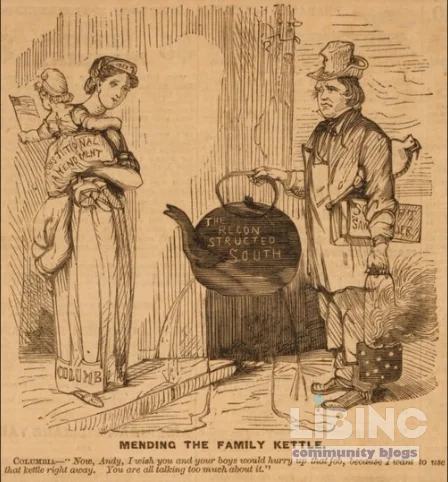
The Reconstruction era brought together a coalition of abolitionists, wartime pragmatists, and political strategists who believed the war's victory required more than victory on the battlefield. The Freedmen's Bureau, established in 1865, aimed to translate emancipation into practical daily life—education, livelihoods, family stability, and even land reform in some proposals. Yet the bureau faced sustained opposition from Andrew Johnson and many Southern leaders who sought to restore antebellum authority. Lincoln’s assassination left a policy vacuum; his successor faced an inherited political minefield, where any fix to citizenship or rights would trigger a direct clash with the South’s old guard and its Democratic allies. In this crucible, the Fourteenth Amendment emerged as a deliberate rewrite of citizenship and a shield for civil liberties against state rollback.
John A. Bingham, the Ohio congressman who emerged as the principal drafter, understood that the law’s power rested on precise language and strategic breadth. The amendment’s first section defines citizenship as birth or naturalization, but it does so with a structural intent: to extend the full privileges of national citizenship to persons under the jurisdiction of the United States, and to bind states to the same standard of protection. In key respects, Bingham’s draft used the word person rather than male, signaling an intentional openness to future challenges from women and other groups seeking equal protection under the law. This choice matters not simply as a historical footnote; it established a semantic anchor that later civil rights movements would reuse to press broader equality claims. The emphasis on due process and equal protection embedded a method to constrain state action, not merely to grant broad rights on paper. It anchored a logic that future courts could apply to diverse constitutional questions, from school desegregation to same‑sex marriage.
Deep context mattered for the drafting process. In late January 1866, the Joint Committee on Reconstruction proposed a plan that would penalize states for denying male citizens the franchise by shrinking their representation in Congress. The idea aimed to deter repressive voting practices while acknowledging the practical constraint that Black men, though newly enfranchised, faced barriers to voting in many jurisdictions. The proposal passed the House but stalled in the Senate, where some Radical Republicans worried that the remedy did not go far enough and others questioned the risk to federalism. Senator Charles Sumner openly opposed a compromise that left room for states to dodge rights protections by tradeoffs in political power. The debates crystallized the central paradox of Reconstruction: how to reward emancipation with constitutional guarantees while maintaining a workable federal structure that could withstand Southern resistance.
As the drafting moved forward, Bingham and his colleagues refined the text to preempt future evasions. They sought a robust yet flexible instrument that would shield freedpeople while offering a path forward for national unity. The Mississippi-to-New England coalition of supporters recognized that the amendment would not settle every dispute overnight, but it would forge a constitutional baseline that could be expanded through later acts and court decisions. In this sense, the Fourteenth Amendment functioned less as a final verdict and more as a dynamic framework—the instrument through which constitutional interpretation could evolve as political and social conditions changed. The text that emerged linked citizenship to birth and naturalization, obligation to due process, and the equal protection of rights—an architecture designed to constrain state power, even as it empowered federal oversight of core liberties.
Block II — Through Contrast: Reconstruction Politics and Policy
To grasp the Fourteenth Amendment, we must contrast Radical Reconstruction with Presidential Reconstruction. Johnson’s approach—granting amnesty to many ex-Confederates, restoring confiscated lands to former masters, and resisting expansive civil rights protections—produced a political countercurrent that threatened to erode the gains of emancipation. The Black Codes that emerged in the postwar South illustrate the stark difference between what a constitutional amendment aimed to do and what state governments attempted to practice in daily life. Where the amendment enshrined equality before the law in principle, the Black Codes sought to reimpose a racial hierarchy in practice. The friction between federal ambition and local resistance mattered because it forced Congress to articulate a harder boundary between loyalty to the Union and state autonomy.
The period's constitutional experiments were not just about rights in the abstract; they were about concrete political power. The Joint Committee on Reconstruction faced the dual tasks of repairing the Union and redesigning the federal–state balance to prevent retrograde politics from erasing emancipation’s gains. The late 1860s saw more than 70 proposed amendments, each wrestling with questions of representation, suffrage, and postwar order. A notable argument within the debate was whether states could maintain control over social policy while complying with a national standard of citizenship. Radical Republicans argued that the Union needed a robust constitutional mechanism to anchor newly won rights, while Democrats insisted on a more limited federal role and greater respect for states’ prerogatives. In this contrast lies the enduring tension that underpins American constitutional reform: autonomy versus protection, state sovereignty versus national duty, and consensus-building versus principled fidelity to core rights.
At the heart of this debate lay a practical question: how would the amendment translate into political power across the nation? The proposed penalization for denying voting rights to male citizens—if adopted—would recalibrate representation in Congress and in the Electoral College. Yet even this instrument proved insufficient to secure universal Black suffrage in the immediate postwar era. The era’s realities—violence, intimidation, and legal labyrinths—constrained the amendment’s immediate effect, highlighting how constitutional design interacts with political will and enforcement capacity. The period’s outcomes reveal a crucial lesson for constitutional reform: drafting a text is only the first step; implementation, political capital, and judicial interpretation determine its actual reach. The 1867 Reconstruction Acts, which tied Southern readmission to ratification of the Fourteenth Amendment, demonstrate how many rulers used constitutional thresholds as leverage to enforce reform, even as some Southern legislatures resisted. Tennessee’s earlier readmission, in contrast, foreshadowed a more conditional approach to Reconstruction that would shape subsequent power dynamics for decades.
Block III — Through Cause-and-Effect: Representation, Voting, and Rights
The Fourteenth Amendment’s second section links representation to the franchise, tying the federal legislative weight of a state to the political participation of its male citizens. The implicit logic is straightforward enough: punish states that deny the vote to adults by reducing their political clout. The cause-and-effect chain, however, extends far beyond the immediate electoral ledger. In practice, the penalty functioned as a force multiplier for civil rights advocacy, even if in the short term it rarely altered state strategies. State leaders in the Jim Crow era found other avenues to disenfranchise Black men, circumventing the letter of the amendment while exploiting gaps in enforcement. The historical record confirms that the penalty was invoked sparingly, but its presence mattered: it gave Congress a constitutional tool to challenge overt attempts to erode the franchise and created a formal pathway for later federal protection of voting rights under groundbreaking jurisprudence.
Section 3 of the amendment further narrows the power of rebellion as a disqualification, limiting offices for anyone who engaged in insurrection after taking an oath to support the Constitution. The architecture here is revealing: the remedy acts on political service, not on the broader citizenship status itself. This distinction matters because it reveals how the framers balanced punitive measures against the possibility of national reconciliation. As the text stood, Congress could override the disqualification with a two-thirds vote, signaling a belief that political courage, not simply loyalty, should determine who serves in government. The tension between punitive exclusion and the possibility of individual rehabilitative restoration remains a perennial question in constitutional design: when should loyalty be a disqualifying factor, and when should the door to public service reopen?
Section 4 anchors fidelity to national debt and repudiates debts incurred to support insurrection. Its implications extend to the postbellum economy and the legitimacy of federal and state obligations. While the clause is framed in financial terms, its effect intersects with political legitimacy and the state’s capacity to govern. The practical effect of this provision is not immediately transformative for daily life, but it signals the deeper constitutional commitment to wartime and postwar order—one that prioritizes the integrity of the national ledger and the supremacy of national policy during upheaval. The fifth section empowers Congress to enforce the amendment with appropriate legislation, closing the loop between text and enforcement. The combination of these features creates a constitutional instrument designed not only to respond to the Civil War but to anticipate future struggles over civil rights, federal power, and the reach of national guarantees across state lines.
Block IV — Through Expert Reconstruction: Reading the Text, Debate, and Legacy
Experts view the Fourteenth Amendment as the culmination of Radical Reconstruction’s political ingenuity and legal imagination. Manisha Sinha emphasizes that the use of the word person in place of male signals a deliberate expansion of rights that would later facilitate claims by women and LGBTQ+ people to equality before the law. The amendment’s drafting captured a methodological shift in constitutional design: a text that binds states to fundamental standards while permitting the federal government to enforce them through legislative means. The exact wording became a strategic instrument that judges could interpret across an evolving jurisprudence of equality, liberty, and citizenship. In this light, the amendment’s legacy rests on its flexibility as much as its ambition.
The political arc surrounding ratification reflects the political arithmetic of Reconstruction. The Republican majority’s willingness to push through a far-reaching amendment despite resistance from Johnson and the former Confederates demonstrates how constitutional reform can break the deadlock of partisan politics. The final ratification, achieved in 1868 after a grueling, multi-year battle, did not erase the era’s lingering tensions, but it established a durable framework that subsequent generations would test, refine, and sometimes expand. The amendment’s first section would underpin landmark cases such as Brown v. Board of Education, which ended state-sanctioned segregation; Loving v. Virginia, which struck down bans on interracial marriage; Roe v. Wade, which guaranteed federal protection of abortion access until its Dobbs reversal in 2022; and Obergefell v. Hodges, which legalized same-sex marriage. Each decision reflects how the Fourteenth Amendment provides a living mechanism for interpreting evolving understandings of citizenship, liberty, and equality.
Radical Republicans pressed for a comprehensive reform agenda, and the Reconstruction Acts, passed in 1867, enforced the prerequisite ratification by Southern states for readmission. Tennessee’s relatively rapid reentry became a foil to harsher conclusions about Reconstruction’s scope. The amendment’s adoption on 9 July 1868 marked a watershed moment in constitutional history, not merely as a legal milestone but as a political reorientation that redefined the nation’s understanding of belonging. The Fourteenth Amendment thus stands as a quintessential instrument of Reconstruction: a bold attempt to reform both the nation’s legal architecture and the social order that had upheld slavery for centuries. Its afterlife in jurisprudence confirms that constitutional design, properly understood, can outpace political cycles and adapt to new social demands even as it contends with resistance rooted in history.
In sum, the Fourteenth Amendment forged a durable link between citizenship and equal protection, turning the promises of emancipation into constitutional guarantees. Its drafting exemplified a strategic resolve to reshape political power in a divided nation, while its implementation required a persistent, multi-generational effort to translate text into practice. The amendment’s enduring relevance lies in its capacity to frame questions of who belongs, who governs, and how rights are protected under a system that continuously tests itself against the ideals it professes.
When we read the Fourteenth Amendment today, we see more than a legal clause set. We see the legacy of a political compromise aimed at ensuring that freedom becomes a fixed, enforceable standard for every person within the United States. The journey from the 1860s to the present reveals how constitutional imagination, strategic lawmaking, and judicial interpretation together sustain a living framework for citizenship and equality.
Extracting the historical logic behind the text helps illuminate why this amendment remains central to constitutional debates, from classroom pedagogy to courtroom advocacy. Its reach extends beyond the letter of the law to the spirit of how Americans imagine their collective identity—a continual negotiation between national authority and local autonomy, between universal rights and practical politics, and between the past’s wounds and the future’s possibilities.
With this lens, the Fourteenth Amendment emerges not as a single historical act but as a perpetual project: to secure citizenship through birth and law, to guarantee equal protection under the law, and to empower the nation to enforce these guarantees even as new challenges arise. The text was crafted to endure, and its jurisprudential life confirms that it can adapt to changing understandings of liberty, dignity, and belonging. In that sense, the Fourteenth Amendment does more than define who is a citizen; it defines what the nation owes to every person it claims to protect.
Closing the practical integration of citizenship guarantees
Even with a clear text, the real effect depends on enforcement in schools, courts, and communities, where birthright citizenship and equal protection meet daily decisions about who can participate and how rights are protected. This small but vital section shows how courts, policymakers, and administrators translate core ideas into concrete practice in education, housing, employment, and voting, ensuring federal oversight when local policy undermines fundamental rights, and illustrating how due process and equal protection guide contemporary decision making.
| Provision | Core Idea | Practical Impact | Example |
|---|---|---|---|
| Section 1 | Citizenship broadly defined | Sets standard for state treatment | Birthright in a school policy |
| Section 2 | Representation linked to the franchise | Influences redistricting and funding | Voting rights enforcement efforts |
| Section 3 | Disqualification for insurrection | Balancing punishment with reconciliation | Public office eligibility cases |
| Section 4–5 | Debt and enforcement | Ensures national authority during upheaval | Federal enforcement actions |
Practical scenarios for policy translation
- Education rights
- Desegregation and equitable access to schooling
- Protection against discrimination in admissions
- Voting and political participation
- Access to ballots for marginalized communities
- Federal standards vs state policy in elections
- Labor and housing rights
- Protection against employment bias
- Equal housing opportunities
In practice, every new rights claim tests the balance between federal authority and state autonomy, and the Fourteenth Amendment continues to guide how we interpret belonging and protection under law.
What is the Fourteenth Amendment about?
At its core, the Fourteenth Amendment redefines national belonging by making birth inside the United States or naturalization the basis of citizenship, while binding states to protect the due process rights and the equal protection of all persons under the law, a combination that transformed who could claim basic liberties, how state power could be exercised, and what redress people could seek when rights were denied, creating a durable framework that courts would later interpret to strike down discriminatory laws, regulate school integration, advance voting rights, and shape debates about gender and relationship rights for generations. These provisions also established a procedural baseline that courts could apply across a wide range of disputes, from criminal procedure to equal access in public life, strengthening the union through a consistent standard of liberty and protection.
Analytically, the clause connects citizenship to legal equality and federal oversight, ensuring that the rights the nation promises persist even when state governments face pressure from local politics.
How does birthright citizenship work under the amendment?
Birthright citizenship means that individuals born in U.S. territory, subject to certain exceptions, acquire citizenship by birth, and naturalization provides a path for others to join as full members of the polity, a framework that anchors identity and participation in public life. The practical effect is broad inclusion while maintaining a means to verify legitimacy through due process and lawful procedures. Courts regularly interpret this framework to resolve questions about residency, parental status, and the status of children born to noncitizens, ensuring that basic protections apply regardless of place of birth or parentage. This principle remains central in debates over immigration and civil rights.
Analytically, the interpretation has widened over time to influence policy beyond nationality, touching family rights and equal opportunity in education and employment.
What does Equal Protection require in practice?
Equal Protection requires that governments treat people in similar situations similarly, and that laws do not discriminate on unjust or inferable bases, a standard that compels courts to scrutinize government actions when a policy appears to privilege one group over another. In practice, this means legal challenges to segregation, exclusion, or biased enforcement are evaluated under heightened scrutiny in many contexts, including education, voting, and housing. The outcome tends to be a test of whether differences in treatment are justified by a legitimate government interest and whether they are narrowly tailored to achieve that interest. This has driven major reforms and ongoing litigation across generations.
Analytically, Equal Protection functions as a central instrument for aligning state power with universal norms of fairness and dignity.
Why is Section 2’s representation tied to voting significant?
Section 2 links a state's representation in Congress to the political participation of its adult male citizens, creating a constitutional incentive to avoid outright disenfranchisement and to promote inclusive governance. The practical effect is that widespread suppression of the franchise could reduce a state’s political weight, encouraging federal action or reform to protect voting rights. While historically the penalty was not always applied aggressively, its existence provided a powerful lever for civil rights advocates to challenge discriminatory practices and to push for broader suffrage protections in later eras. This tie between representation and the franchise reshapes political strategy at the state and national levels.
Analytically, it shows how constitutional design uses structural incentives to promote inclusion and accountability in government.
How has the amendment shaped landmark civil rights cases?
The Fourteenth Amendment provided the legal foundation for Brown v. Board of Education, Loving v. Virginia, and many others by offering a framework to challenge state-supported discrimination and protect personal autonomy, family life, and intimate relationships. Its due process and equal protection clauses enabled courts to interpret rights in light of contemporary values, allowing evolving standards to guide decisions on desegregation, gender equality, same sex marriage, and reproductive rights. The living character of the amendment means that new disputes can be analyzed through its lenses, even as precedent remains contested in some domains. This dynamic keeps constitutional interpretation responsive to social progress.
Analytically, this adaptability helps explain the enduring reach of constitutional rights beyond the courtroom into everyday life.
Why is the amendment considered a living framework?
Its provisions invite ongoing interpretation as society evolves, permitting courts to address emerging questions about citizenship, equality, and liberty, including digital privacy, workplace fairness, and nontraditional family structures. The framework also supports federal enforcement when state laws threaten fundamental rights, ensuring that the original aims of emancipation era reform remain relevant in the 21st century. This dynamic quality makes the Fourteenth Amendment a persistent engine of civil rights policy and constitutional law, guiding reforms long after the initial ratification.
Analytically, its resilience lies in the balance between universal guarantees and adaptable enforcement that keeps pace with social change.






Add a comment
To comment, you need to register and authorize
Comments