

AI Kitchens and the Societal Transformation of Food: An Analytical Thesis on Automation, Creativity, and Culture
- Analytics lens on AI kitchens
- Contrast with past kitchen technologies
- Causes and effects on society and economy
- Expert reconstruction and governance
Automating food is unlike automating anything else. AI kitchens are not distant visions but a global reality reshaping how access, preparation, and consumption intertwine with daily life. Robots already flip burgers, fry chicken, assemble pizzas, and craft sushi; AI can craft recipes from ingredient chemistry and in-stock inventories. Yet the deeper stakes are social: convenience may erode communal meals, artisanal craft, and even labor markets. The paradox is that a tool designed to free time could also redefine what meals mean. This piece analyzes AI kitchens through four analytic prisms—analytic, comparative, causal, and expert-reconstructive—to ask what we gain, what we risk, and how to steer development toward inclusive, sustainable culinary futures.
Analytics lens on AI kitchens
From an analytic standpoint, AI kitchens compress labor, decision-making, and time into software-driven routines. The result is not merely faster cooking; it is a reconfiguration of expertise, workflow, and the value chain surrounding food. The following dynamics capture how AI kitchens alter the culinary landscape and what that implies for practitioners, firms, and communities.
- Creativity and exploration — AI kitchens extend chefs’ imaginations by modeling ingredient interactions, optimizing plating, and proposing novel presentations beyond traditional heuristics, driven by neural networks and recipe-optimization algorithms.
- Operational efficiency — robotic cooks and sensor fusion reduce repetitive tasks, stabilize output across shifts, and constrain human error, enabling tighter batch control and predictability in service—an essential edge in high-throughput environments.
- Personalization at scale — AI can tailor menus to allergies, diets, and cultural preferences, unlocking nutrition-led customization that would be infeasible with manual workflows alone.
- Food safety and waste reduction — precision trimming, real-time quality checks, and predictive analytics improve safety and reduce waste, while enabling clear traceability across the supply chain.
The analytics also reveal friction points. AI kitchens depend on data quality, model reliability, and system resilience. A miscalibrated sensor or biased recipe model can distort flavor, misstate nutrition, or misallocate storage, affecting health outcomes and customer trust. These systems can inadvertently gatekeep culinary innovation through opaque algorithms or restricted access to data. The net effect is not merely a speed boost; it is a recalibration of knowledge, skill, and authority within professional kitchens and consumers’ homes.
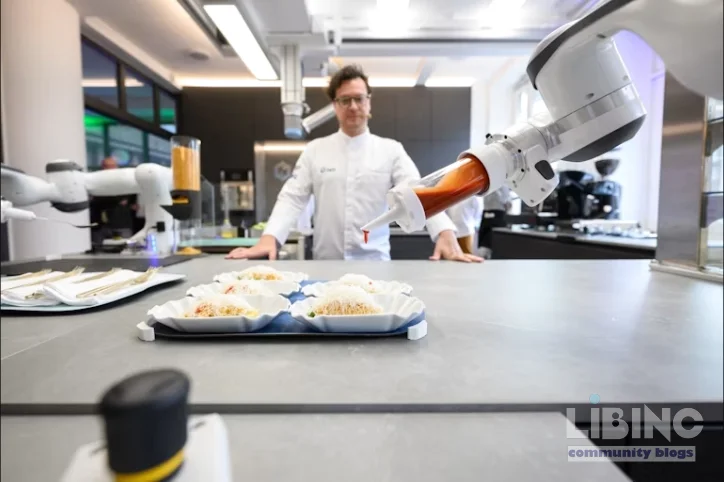
To illustrate the physical and perceptual shift, consider an inline depiction of an AI kitchen: a compact robotic arm above a modular stove, sensors tracking ingredient freshness, a display suggesting adjustments in real time, and a central control unit orchestrating outputs. The visualization communicates a future where human cooks supervise intelligent agents rather than labor through repetitive drudgery alone. This shift creates new forms of expertise—algorithmic literacy, calibration discipline, and systems thinking—without eliminating traditional culinary craft entirely.
Contrast with past kitchen technologies
The microwave revolution demonstrated that single-user convenience could trigger profound social shifts, yet AI kitchens promise a more pervasive, embedded transformation. Unlike the microwave, which normalized single-occupant meals and quick fixes, AI kitchens can permeate professional operations and households alike, shaping the tempo and texture of daily life. The key contrast lies in capacity and scale: microwaves amplified speed at the individual level; AI kitchens scale intelligence across crews, menus, and supply networks, potentially redefining the kitchen as a centralized intelligence hub rather than a purely hands-on craft space.
That difference matters for culture and social life. If the home becomes a locus of algorithmic food governance, communal rituals around cooking could erode or morph into new forms of shared practice—perhaps less about handcraft and more about curation, taste profiling, and collaborative experimentation. The microwave’s disruption is easy to observe; the AI kitchen’s disruption is slower, subtler, and more uneven across geographies and income groups, which makes governance and inclusive design essential. As with earlier tech shifts, the question is not only what technology can do, but how people experience food, time, and community when automation participates in meal decisions.
Causes and effects on society and economy
The adoption of AI kitchens proceeds through a cascade of causal channels, with feedback loops that propagate beyond the kitchen walls. This section lays out major mechanisms by which automation in cooking could realign labor markets, education, health, and culture—each a lever that can be pushed toward desirable or undesirable outcomes.
- Labor market transitions — AI kitchens shift routine tasks into software and robotics, potentially creating higher-value roles (systems integration, culinary data science) while displacing low-skill, repetitive labor. The net impact on employment hinges on retraining policies and wage dynamics in adjacent sectors.
- Skill demands and education — as kitchen work becomes more data-driven, curricula must incorporate microbiology basics, process optimization, and human-robot collaboration. Without reform, workers may be excluded from the more sophisticated roles that automation enables.
- Nutrition and personalized health — AI can align meals with individual health needs, reducing sodium loads, allergens exposure, and wasteful portions. If implemented with care, this supports public health; if not, it risks over-automation eroding self-knowledge about nutrition.
- Safety, liability, and trust — automated cooking raises questions about who is responsible for errors or injuries, especially under hacking or sensor failures. Clear governance and fault attribution become prerequisites for broad adoption.
- Cultural diversity and culinary heritage — algorithms trained on broad data might generate homogenized menus, potentially narrowing regional diversity. Preserving local traditions requires intentional design choices and input from diverse culinary communities.
These causal pathways interact. For example, incentives to deploy AI kitchens in high-volume venues accelerate workforce shifts, which pressure education systems to adapt quickly. Meanwhile, consumer trust rests on demonstrable safety, transparent decision logic, and reliable performance in varied contexts. The result is a dynamic system where technical capability and social acceptance reinforce one another, for better or worse.
Expert reconstruction and governance for AI kitchens
Experts converging on AI kitchens emphasize the need for deliberate design strategies that maximize benefits while mitigating risks. The reconstruction proposed here assembles practical principles from diverse domains—culinary arts, safety engineering, ethics, and policy design—into a usable framework for developers, operators, and regulators.
- Preserve human-in-the-loop craft — keep skilled cooks involved in supervision, quality control, and creative decisions to maintain authenticity and accountability, while leveraging automation for repetitive labor.
- Ensure transparency and explainability — document how AI decisions influence flavor, texture, and health outcomes; enable engineers, chefs, and customers to understand the basis for selections.
- Strengthen safety regimes — implement redundant sensors, fail-safes, and rigorous testing to prevent misfires that could burn, cut, or contaminate. Establish clear incident-response protocols.
- Design for inclusivity and access — avoid price barriers and ensure that benefits extend to diverse communities, including schools, small businesses, and homes with limited resources.
- Protect culinary heritage — actively curate data and models to respect regional cuisines, avoid stereotyping, and preserve authenticity through diverse input and continuous evaluation.
- Develop governance and liability frameworks — clarify responsibility for robot-enabled decisions, create standards for interoperability, and align with food-safety regulations across jurisdictions.
In practice, the reconstruction calls for a portfolio approach: (1) pilot programs in varied settings to observe social responses; (2) collaboration with chefs and communities to codify local knowledge into AI systems; (3) ongoing auditing of algorithmic bias, safety, and environmental impact; (4) public communication that manages expectations about what AI kitchens can and cannot do. The aim is not robotic replacement but a re-architected ecosystem where automation augments humanity, rather than displaces it.
What follows is a concise synthesis for policymakers, business leaders, and researchers: the path to responsible AI kitchens requires deliberate design choices, rigorous evaluation, and a steadfast commitment to preserving the human dimension of food. If the right governance is in place, AI kitchens can enhance creativity, safety, and personalization while safeguarding cultural richness and economic opportunity across communities.
As the technology matures, expect a spectrum of outcomes. Some markets will experience accelerated growth in high-end dining and mass-service contexts; others will see gradual diffusion into home kitchens, schools, and non-profit food programs. The question is not whether AI kitchens will become more prevalent, but how societies will steer their adoption to maximize nourishment—body and soul—without sacrificing social cohesion, tradition, and agency.
In closing, the story of AI kitchens is a test case for how technology intersects with a deeply human domain. The stakes are high because food touches health, identity, labor, and ritual. The design choices we make today will shape whether automation nourishes or erodes the social fabric surrounding meals, and whether creativity remains a shared human enterprise in the age of intelligent kitchens.
Practical rollout framework for AI kitchens
Turning AI kitchen concepts into measurable value demands a concrete playbook. Begin with a pilot that tracks food safety incidents, waste per plate, order accuracy, and guest satisfaction, then estimate break-even time under realistic capex and staffing assumptions. Across contexts, data quality, human-robot collaboration, and governance are the levers that determine ROI. In a small cafe, automation can cover repetitive prep and line checks, freeing staff for service and upsell opportunities; in a school canteen or hospital kitchen, stable quality and allergen controls boost safety and trust.
| Scenario | Capex | Opex/mo | Breakeven (months) | Notes |
|---|---|---|---|---|
| Small cafe | $25k | $3k | 9–12 | Moderate automation |
| Mid-size restaurant | $100k | $12k | 12–18 | Consistency + labor shift |
| School canteen | $150k | $15k | 18–24 | Safety, allergen controls |
| Home kitchen | $5k | $0–1k | 6–9 | Personalization |
From there, design for modularity: swap in new recipes with minimal downtime, retrain staff on oversight, and monitor algorithmic bias to preserve menu diversity. A staged rollout lowers risk, clarifies ROI, and keeps safety and accountability front and center.
Error rate: -50 to -60% with checks
Labor shift: 1-2 FTE per site
- Assess readiness
- Data hygiene
- Safety baseline
- Pilot data pipelines
- Scale with governance
- Audit outcomes
In practice, the journey is iterative: begin with data hygiene, test with small menus, expand to full service, and extend to home and community kitchens. With disciplined execution, AI kitchens deliver predictable quality, waste reductions, and new roles in culinary data stewardship.
What tangible benefits can AI kitchens deliver in the first year?
AI kitchens deliver immediate value by raising consistency, cutting waste, and speeding service through automated prep, real-time sensing, and data-driven adjustments, while freeing staff to focus on higher-value tasks like quality oversight and guest engagement; the result is lower unit costs, safer allergen handling, and a more reliable dining experience that supports scalable personalization across meals. In early deployments you may notice smaller venues achieving faster turnover, fewer mislabels, and clearer inventory control as cooks gain confidence with automated prompts and alerts.
From a broader perspective, the first-year benefits stem from improved process fidelity, better data feedback loops, and the ability to experiment with menu iterations at a manageable risk level. Organizations that couple automation with staff training tend to see higher morale and customer satisfaction alongside measurable efficiency gains.
What are the main challenges to adoption in small businesses and households?
Adoption challenges center on cost, data quality, and trust: the upfront capex and ongoing maintenance must be balanced against expected gains; small businesses and homes may face limited access to high-quality data, integration with existing devices, and concerns about losing flavor control or cultural identity. To overcome, start with modular, lower-cost devices, run parallel human-in-the-loop oversight, and implement clear safety protocols; run beta programs with staff training and feedback loops; ensure vendor support and transparent data handling to preserve control over outcomes.
How does AI kitchen adoption affect workers and skill requirements?
AI kitchens re-skill workers by shifting repetitive tasks to automation, freeing staff to supervise, interpret data, and innovate on recipes; this expands career pathways into culinary data stewardship and equipment maintenance. The right approach combines hands-on chef input with data literacy training, so teams can tune algorithms to local tastes while maintaining craft standards. Organizations that invest in upskilling report higher retention and better collaboration between kitchen staff and technologists.
How can governance ensure safety and inclusivity in AI kitchens?
Governance should establish safety standards, data privacy, transparency, and inclusive menu design; involve chefs, front-line staff, and community representatives in setting evaluation criteria. Clear incident-response plans, independent audits, and open documentation for model decisions help build trust. Inclusive governance also means preserving regional cuisines and avoiding homogenization by actively curating data inputs and inviting diverse culinary perspectives into the system design.
What data is needed and how is data quality and privacy managed?
Required data include sensor readings (temperature, timing), ingredients, nutrition attributes, allergen profiles, and provenance details; quality hinges on consistent data formats, calibration, and timely updates. Privacy is managed through data minimization, access controls, and encryption, with transparent policy disclosures to users. Organizations should implement regular data hygiene checks and bias audits to ensure models reflect real-world diversity without eroding safety or trust.
What is the typical timeline for ROI and scaling?
ROI timelines depend on scale, venue type, and integration depth, but a pragmatic path begins with a 90-day pilot to validate safety, waste, and throughput, followed by staged expansion over 6–24 months; full national or multi-site deployment can take 1–3 years. Key indicators include waste per plate, variance in output across shifts, customer repeat rates, and staff redeployment metrics. A clear governance framework and phased funding plan accelerate adoption while reducing risk.





Add a comment
To comment, you need to register and authorize
Comments