

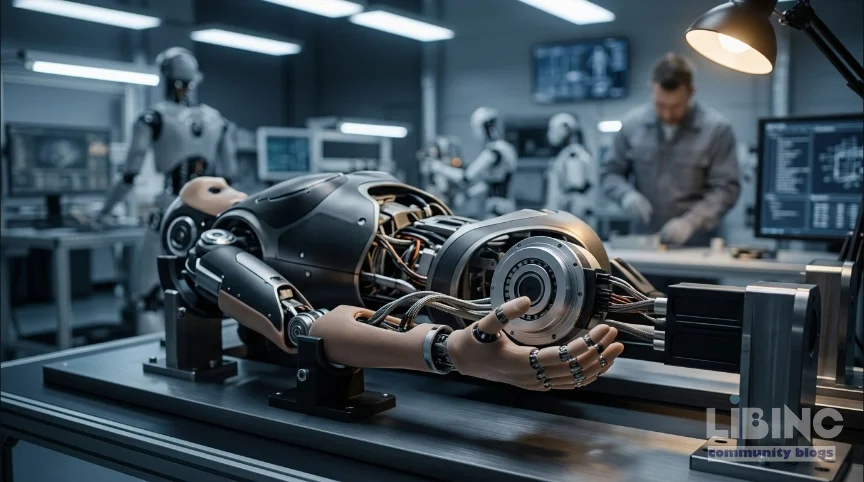
Robot-as-a-Service and the joint actuator backbone: How Schaeffler's Humanoid deal redefines factory automation
Two structural details matter more than the four digit HMND humanoids in the Schaeffler Humanoid deal signed on May 13 2026. First, Schaeffler is subscribing to the robots rather than owning them. Second, the supplier signs a five year pact to supply the joints that power the devices. Strip away the science fiction framing and you have a procurement decision and a sourcing strategy that will shape factory automation far more than the robot count itself. The May agreement binds a deployment across Schaeffler sites by 2032, with Reuters estimating roughly 1,000 to 2,000 units, and first systems rolling out in Germany by the end of 2026. It also locks in a Robot-as-a-Service model that bundles the hardware with fleet management software, maintenance, 24/7 support, software updates, and ongoing performance management. At the same time, Schaeffler becomes the preferred supplier for more than half of Humanoid joint actuators through 2031, a seven-digit order flow that ties a component maker to the robot system. The result is a binding, scale-ready framework rather than a one-off collaboration, and it raises questions about how incumbents will embed themselves in the humanoid value chain.
Table of Contents
- Analytics view of the deal
- Contrast: deployment and joint actuator supply
- Cause-and-effect dynamics in RaaS adoption
- Expert reconstruction for scaling humanoids
- What this means for manufacturers
Analytics view of the deal
The May 13 binding agreement divides into two operational rails. The deployment arm moves under a Robot-as-a-Service model that delivers a fleet of wheeled HMND humanoids, managed as an ongoing service rather than a one-time purchase. The second rail fixes a reciprocal, five-year supply agreement for joint actuators and related motion components, handed to Humanoid by Schaeffler. This bifurcation is not merely clever bookkeeping. It redefines the economics of automation by converting capex risk into opex risk, and by tying the vendor’s revenue to fleet uptime and software performance rather than to a single sale. The effect is a shift from a capital-intensive gamble on autonomy to a repeatable, service-led growth model where resilience and optimization become revenue drivers rather than ancillary considerations.
From a pure cost view, the rotation of the model matters more than the robot count. A purchased robot is a fixed asset that depreciates and becomes an obsolescence liability as autonomy software advances. A subscribed robot is a dynamic operating expense that scales with demand and remains current as the platform evolves. The Robot-as-a-Service structure elevates uptime, reliability, and software maintenance to core contractual obligations. It also reframes the project as a portfolio operation rather than a single asset deployment, aligning incentives between Schaeffler and Humanoid around continuous improvement and long-run throughput.
The actuator commitment crystallizes the economics of risk sharing. A seven-digit, multi-year order for precision joint actuators routed through a Tier 1 supplier means the cost curve for the robot’s core motion system becomes visible far earlier in the decision process. This is not a peripheral supply contract; it is a signal of volume and a quality standard that shapes the entire value chain. With Schaeffler providing the heart of the joint mechanism, the system becomes less about guessing at component quality and more about locking in a reliability profile that underpins factory throughput gains. The RaaS model thus becomes a lever for predictable returns on automation investments, reducing the unknowns that typically deter early-scale pilots.
Two further dynamics mark the analytics of this deal. First, the involvement of Bosch as contract manufacturer for Europe aligns Humanoid with a German industrial cluster that already coordinates device integration with strong local suppliers. Second, the plan for a phased validation—Schweinfurt following Herzogenaurach—frames the deployment as a controlled progression from capability demonstration to near-production operation. These elements harden the business case by reducing execution risk and by building reference capabilities that can travel beyond the specific platform. The market will watch whether the Schweinfurt gate becomes a reliable threshold for rapid scale or a persistent choke point that tempers the forecast.
For operators evaluating feasible business models, the takeaways are clear. The campaign shifts from a single ROI calculation to a portfolio view of labor displacement, throughput, maintenance cost, and software improvement cadence. The presence of a Tier 1 actuator supplier within the deal compresses the risk associated with part quality, failure rates, and supply continuity. It also signals a potential pattern: incumbents with core motion control competencies may seize a middle ground between pure hardware supply and full automation ownership, creating an integrated stack that customers can buy as a service. The result is a more interpretable path to scale, where the question is not just how many robots to deploy, but how the service contract, uptime guarantees, and component reliability will deliver sustained productivity gains.
Strategy-wise, the deal sets a precedent for how automation vendors and customers think about architecture. If RaaS proves its financial viability at scale, more OEMs and Tier 1s may embed themselves in the humanoid value chain rather than simply selling a robot. The impact extends beyond Humanoid, potentially reshaping procurement and risk allocation across the broader automation market. The next phase will reveal how far management teams will press the model toward mass deployment, and how the balance between service quality and unit cost will evolve as autonomy software matures and the joint actuator supply tightens.
Contrast: deployment and joint actuator supply
The two halves of the May agreement sit in productive tension. On one hand, the deployment under the RaaS umbrella converts the upfront cost of automation into a recurring service expense, with the supplier responsible for fleet management, maintenance, software updates, and performance optimization. On the other hand, the joint actuator commitment anchors the robot in a cost-critical subassembly controlled by a traditional motion technology giant. Taken together, the arrangement reframes the value chain: the customer no longer merely buys a robot, it licenses a capability, and the supplier controls the reliability of the robot’s soul — its joints and motion fidelity.
The deployment leg is a direct nod to the economics of scale. A three to five year horizon with a plan to deploy thousands of units implies that the service pricing must cover not just the hardware but the costs of software lifecycle management, remote diagnostics, and continuous improvements. This is where fleet management software and data feedback loops become essential revenue streams. The service bundle is not an afterthought; it is the core delivery model that determines whether a deployment remains viable when labor costs shift or the autonomy stack requires substantial revalidation. This is the fundamental reason why the RaaS model is more than a payment method — it is a performance contract that determines how quickly factories will adopt humanoids and how aggressively suppliers will push improvements to the fleet.
The actuator supply segment changes the risk profile for Humanoid itself. The seven-digit actuator orders through a major Tier 1 vendor compress the risk of part quality and supply continuity, reducing the probability of production stoppages caused by a critical component. This is not a marginal improvement; it packs the most expensive and failure-prone element of the robot into a stable supply relationship. The dependency creates a vertical integration layer that was previously unusual for a startup in this space. By aligning the customer and supplier around a common cost curve, the deal invites other incumbent components players to emulate the pattern, potentially accelerating a broader shift in the humanoid ecosystem toward integrated, end-to-end solutions rather than standalone devices.
The combined effect is a procurement model that is as important as the robot fleet itself. A single, binding framework binds deployment horizons to component supply, raising the stakes for how performance is measured and how risk is allocated across the contract. The model incentivizes the vendor to invest in reliability and software-driven enhancements because uptime and performance are tied directly to revenue. For Schaeffler, the strategic reward is a longer foothold in the robotic value chain, an opportunity to monetize its core motion competencies while still being embedded in customer operations. For Humanoid, the price of speed is the ongoing confirmation that the joint actuation and fleet health will meet production needs over a multi-year horizon.
The contrast also highlights a potential tension: if the Beta and Gamma milestones slip or if autonomy lags, the same structure could become a constraint rather than a catalyst. The Schweinfurt validation phase is designed to prevent that outcome by translating pilot learnings into near-production stability. The question is whether the joint actuator supply will keep up with the scale plan without compromising quality. If not, the cost of capital and the risk premium embedded in the RaaS price tag could become a drag on adoption. The next few quarters will reveal whether the plan achieves a virtuous cycle of uptime, actuator reliability, and continuous improvement or if it reveals the limits of trying to accelerate humanoid deployment through a single deal.
Cause-and-effect dynamics in RaaS adoption
The shift to Robot-as-a-Service reorders incentives for both sides of the transaction. The customer gains flexibility to scale or unwind deployments in response to demand and labor-market dynamics. The supplier benefits from a durable revenue stream tied to fleet health, not a one-time sale that becomes a sunk cost if a newer robot arrives. This alignment reduces the financial exposure of factory automation programs and encourages a more aggressive stance on reliability and software cadence.
In a broader sense, the RaaS model is a proxy for how the industry will finance automation going forward. Moving from capex heavy pilots to service contracts makes the economics more predictable and manageable for manufacturing operations. It shifts performance risk toward the vendor, who must guarantee uptime and deliver measurable improvements in throughput and quality. The implicit assumption is that the vendor can extract incremental value from the fleet through software updates and proactive maintenance, creating a feedback loop that rewards ongoing investment rather than one-off sales. The potential payoff is scale-driven cost reductions that reduce barriers to entry for other actors in the humanoid ecosystem.
The joint actuator commitment actively compounds these effects. If the seven-digit actuator orders translate into high-volume production, the cost curve for the robot aligns with typical industrial components, making automation more affordable and sustainable over time. A reliable actuator supply reduces downtime and improves repeatability, which is essential for mass deployment. This dynamic also increases the probability that Humanoid can meet its reliability targets, gradually closing the gap to autonomous operation without constant human intervention. The risk, of course, is that the integration of a complex joint system with a new autonomy stack could reveal new failure modes that require deep software and mechanical iteration. The Schweinfurt phase is precisely the mechanism to surface and address those issues before full-scale rollout.
Taken together, the two halves of the deal define a chain of cause and effect: RaaS makes deployment affordable and scalable; actuator supply reduces unit risk and improves reliability; and the combination invites incumbents to participate more deeply in the humanoid value chain. The result is a model that could reframe how factories buy automation, shifting preference toward integrated partnerships that manage both the fleet and the parts that matter most for performance. If the approach proves durable, the pattern could become a template for other industrial domains seeking to balance speed, cost, and risk in automation adoption.
Expert reconstruction for scaling humanoids
From an expert perspective, the May 2026 agreement looks like a deliberate attempt to de-risk early scale through architectural choices rather than hardware breakthroughs alone. The Robot-as-a-Service framework decouples deployment from ownership, enabling a staged ramp that reduces the friction of initial investment and accelerates learning across user sites. The joint actuator commitment embeds a reliability backbone in the very heart of the robot, addressing the most expensive and failure-prone subsystem. This is not a peripheral collaboration; it is a vertical integration attempt that positions Schaeffler as both customer and critical component supplier within Humanoid’s platform.
If this model succeeds, several pathways open for incumbents in the industrial motion space. First, OEMs and Tier 1s could pursue similar dual-role partnerships, deploying automation while supplying the key hardware they control. Second, the economics of scale could compress the per-unit cost of actuation long before the robot itself becomes economically dominant. Third, the service layer opens new data-driven monetization options, from fleet health analytics to prognostics that inform maintenance windows and replacement schedules. The result is a more resilient, data-rich automation stack that customers trust for long horizons rather than a brittle capital asset subject to rapid obsolescence.
Humanoid as a platform will increasingly depend on the ability of partners to coordinate across hardware, software, and manufacturing processes. Bosch's involvement as a European contract manufacturer and Schaeffler's role as actuator supplier create a model in which the ecosystem becomes a competitive differentiator rather than a single vendor proposition. For Humanoid investors and potential IPO aspirants, this signals a path to scale that relies less on one heavy roll of the dice in autonomy and more on steady, auditable improvements in reliability and maintenance economics. The market will judge this approach on turnover, uptime, and the ability to translate improvements into measurable throughput gains across sites and across years.
What this means for manufacturers
Two signals stand out for operators with no humanoid on their roadmaps today. The first is the actuator commitment. A seven-digit, multi-year order routed through a reputable Tier 1 is a leading indicator that there is meaningful confidence in volume, capacity, and the reliability of the joint actuation stack. It shifts the focus from a one-off robot count to a broader, supply-chain based demand signal that promises scale and consistency. The second signal is the procurement model itself. Robot-as-a-Service demotes capital intensity and emphasizes ongoing performance, with the provider bearing uptime and maintenance risk. If this model proves robust, it will accelerate automation adoption across manufacturing by reducing the upfront cost and the risk of obsolescence tied to quarterly firmware upgrades.
The Schweinfurt validation gate is as telling as the numbers. It represents a disciplined transition from piloting to near production, a necessary step to avoid the common pitfall of large-scale rollouts that overpromise and underdeliver on reliability. For incumbents, the implications are clear: embed yourselves in both the hardware and software ecosystems, demonstrate quantifiable gains in throughput, and build reference cases that prove you can maintain performance at scale. For Humanoid and its backers, the question becomes how quickly the Beta and Gamma stages translate into mass production without destabilizing the supply chain or inflating service costs beyond ROI expectations. The coming year will tell whether this architecture can withstand the pressures of real-world manufacturing at scale.
Ultimately, the May 2026 deal signals a shift in how factories buy and run automation. The emphasis moves from owning a robot to owning a capability, and from a single component sale to an integrated service and supply relationship. If Robot-as-a-Service and the joint actuator backbone hold firm under scrutiny, incumbents will likely follow suit, and the humanoid playbook could become a new template for industrial automation across sectors. The logic is simple: reliability, access to scale, and continuous improvement create a better assurance of throughput than any standalone asset ever could.
What it means going forward for manufacturing
The two signals worth watching are actuator commitments and the spread of RaaS style procurement. If the seven-digit actuator orders prove the volume necessary to justify deeper supplier integration, we should expect more Tier 1s to migrate from one-off sales to ongoing partnerships that bind the cost curve of the robot to the cost curve of its most critical components. If the Robot-as-a-Service model proves cost-effective, more manufacturers will calibrate their automation plans around operating expenses rather than upfront capital, lowering barriers to pilot programs and speeding time to scale. The outcome could be a more resilient, data-driven automation landscape where incumbents and startups co-create value through integrated systems, shared software, and joint optimization of labor, throughput, and maintenance. This is less a single deal than a blueprint for how large factories will adopt humanoids in the coming decade.
In short, the May 2026 agreement does not merely count robots. It quantifies a new collaboration model that links the fleet, the joints, and the software into a single, revenue-generating ecosystem. That is the real story: not thousands of machine bodies, but thousands of hours of productive uptime driven by a shared commitment to reliability, continuous improvement, and integrated supply chains.
Strategic focus: ROI, governance, and the ecosystem
Beyond the headlines, the Schaeffler‑Humanoid framework offers a pragmatic blueprint for automation ROI. Robot‑as‑a‑Service converts capital outlays into operating expenses and places uptime, software cadence, and fleet health at the center of value realization. For operators, this means defining service levels, data access, and joint dashboards as part of the procurement language, not afterthoughts. In parallel, a stable joint actuator supply anchors reliability and reduces unplanned downtime, turning hardware quality into a measurable production gain.
| Dimension | Ownership | RaaS |
|---|---|---|
| Upfront cost | High capex | Low capex |
| Ongoing costs | Maintenance billed separately | Fleet mgmt, updates, and support included |
| Risk allocation | Buyer bears obsolescence risk | Vendor bears uptime and performance risk |
| Revenue model | One-time sale | Recurring service revenue |
| Governance needs | Procurement, integration | SLAs, dashboards, data sharing |
Two dynamics reinforce confidence: a seven‑digit actuator order signals volume and quality commitments, and Bosch’s European footprint anchors local integration. To scale safely, view pilots as staged gates with predefined success criteria and data access controls.
Milestone ladder and governance help translate a pilot into mass production. Schweinfurt should be treated as a production readiness gate, not a mere milestone.
Deployment milestones
- Beta: capability demonstration in a single site
- Gamma: near-production validation across two sites
- Schweinfurt: scale gate with measured throughput
A forward view shows the value of an integrated service model but also the need for careful governance, including data ownership, firmware control, and cost-tracking across sites.
Frequently asked questions
What is Robot-as-a-Service in humanoid deployment?
Robot-as-a-Service (RaaS) redefines why a factory buys automation by turning a one-off asset into an ongoing capability, with service level targets, uptime guarantees, continuous software upgrades, and remote diagnostics forming the core of value. In practice, the buyer pays a predictable operating expense tied to fleet performance, while the supplier shoulders manufacturing, maintenance, and evolution costs. This alignment creates a long horizon of measurable throughput gains and quality improvements, since every software update or sensor recalibration becomes part of a contract that improves productivity rather than relying on a single hardware purchase.
Strategically, RaaS lowers entry barriers for pilots and builds a governance framework around data access, SLAs, and cost-tracking across sites.
How does the actuator commitment influence risk and scale?
In practice, the seven-digit order for joint actuators anchors reliability and supply continuity, reducing the probability of unexpected downtime. This creates a dependable backbone for the robot’s motion system, supporting near-production planning and predictable ramp-up. The economics shift toward volume-driven cost curves, where incremental capacity lowers unit costs and incentivizes consistent performance improvements by the supplier.
With a stable actuator backbone, manufacturers can plan multi-site deployments with shared standards and fewer bespoke fixes.
What governance metrics should operators track under RaaS?
Key metrics include fleet uptime, mean time between failures (MTBF) for joints, software update cadence, and DPI (data per interaction) quality. Operators should maintain dashboards that correlate throughput with uptime, track maintenance windows, and quantify the ROI from software-driven refinements. Clear SLAs, data ownership terms, and escalation paths prevent friction as the fleet scales.
These governance layers turn a pilot into a scalable program with auditable performance outcomes.
How can a company compare RaaS with traditional ownership?
Compare using a total cost of ownership (TCO) lens over a multi-year horizon. RaaS reduces upfront cash demand and shifts risk to the provider, but requires trust in service quality and data sharing. Traditional ownership may offer lower long-run maintenance if the asset is highly specialized, but exposes the buyer to obsolescence risk and costly updates. A hybrid approach is possible when a company wants core capability retention while monetizing uptime guarantees from the vendor.
In both cases, measurable uptime, throughput, and maintenance cost trajectories are the decisive factors.
What challenges might arise at Schweinfurt and beyond?
The Schweinfurt gate tests production readiness and supply chain coordination. Risks include integration delays, software‑hardware compatibility issues, and ramp fatigue across sites. Mitigation relies on staged pilots, clear data-sharing rules, and a disciplined change-management plan that ties updates to production outcomes.
Managed governance and escalation processes help keep scale on track.
Could this model reshape the broader automation ecosystem?
If RaaS proves cost-effective at scale, incumbents may align hardware, software, and services into end‑to‑end offerings rather than selling isolated robots. That could compress cost curves, accelerate adoption, and encourage data‑driven maintenance and optimization across sectors. The ecosystem would reward reliability, interoperability, and a robust partner network over single-asset sales.





Add a comment
To comment, you need to register and authorize
Comments