

The 2026 Stellantis-UAW conflict: production-location shift, supplier leverage, and cross-border reallocation
Table of Contents
The 2026 Stellantis-UAW confrontation is not a rerun of the 2023 Stand Up Strike. Coverage that treats it as a wage fight with picket lines misses the core dynamic. The bargaining arena has shifted to production location—where plants operate, and where capital and tooling are committed—so leverage rests as much on geography as on pay. The result is a more granular, longer cycle where small timing differences cascade into regional consequences.
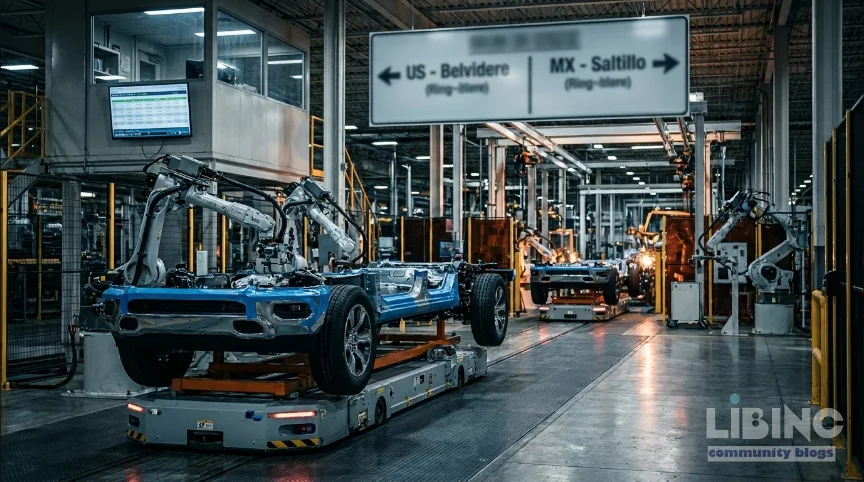
In October 2025 Stellantis announced a $13 billion manufacturing commitment across Illinois, Michigan, Indiana, and Ohio. The package reopened Belvidere for Jeep Cherokee and Compass (roughly 3,300 jobs with about 1,500 UAW recalls), funded a Toledo midsize Ram plus Wrangler/Gladiator line expansion, and backed a next-generation Durango and a Kokomo engine program. Three months later, the schedule began drifting, shifting the dispute from a single plant map to a multi-plant allocation problem that binds suppliers and local labor in new ways.
The hidden conflict is a lattice of sunk capital and cross-border sourcing. Saltillo expansion in Mexico, a target of 100,000-plus HEMI V8 engines for 2026, and a broader Dare Forward footprint create a portfolio of risk that can override wage concessions. The UAW’s Keep the Promise framing ties investment compliance to labor leverage, reframing the fight as a production-location question rather than a pure pay dispute. In other words, the 2026 sequence tests who controls the plant map and who bears the cost if plans slip.
Analytics through a production-location lens
The central analytic question in the 2026 cycle is allocation geometry, not wage arithmetic. When a company ties a program to a particular plant, it creates a fixed capital exposure for Tier 1 suppliers and a financing signal for investors. The four-state commitment signals a regional production spine that relies on predictable timing, stable supply chains, and the ability to retool without triggering a cascade of license and warranty disputes. In this frame, the real leverage rests on how fast and how reliably Stellantis can move capital to the right plant, at the right time, with the right supplier mix.
- Key levers: program timing, plant readiness, supplier commitments, and the ability to redeploy tooling between facilities.
- Risk vectors: sunk capital in Tier 1 tooling, stranded inventories, and the potential for cross-border sourcing to reallocate volumes away from midwest facilities.
- Strategic constraint: maintaining a synchronized timeline across Belvidere, Toledo, Detroit, and Kokomo while ensuring Mexico-based capacity can fill gaps if US facilities slip.
- Data signal: 6-K disclosures, capacity utilization rates, and supplier earnings calls become frontline indicators of how the allocation is evolving in real time.
The 2026 framework reframes the problem beyond a simple price-for-output bargain. It becomes a real options game on the plant map. The market’s tolerance for risk depends on whether Stellantis can credibly redeploy capital to Saltillo or other Mexican suppliers as a hedge against Midwest slip risks. The keep-the-promise framing then functions as a political lever, pressuring the company to maintain a coherent allocation plan across borders while the union tests that plan's credibility at the plant level.
Within the allocation math, a crucial dynamic is the burden of sunk costs. When a plant is retooled for a given vehicle, suppliers commit to tooling cycles and component investments that carry multi-year amortization. If Belvidere or Toledo drift, the capital already committed to the Belvidere Cherokee/Compass or the Toledo Ram line risks becoming a stranded asset, with knock-on effects for Magna, BorgWarner, and American Axle as the program roadmap shifts across a grid of facilities.
Another layer is the Dare Forward footprint, which expands the geographic footprint of Stellantis’ production network beyond the Midwest. The Saltillo expansion, in particular, introduces a credible cross-border hedging strategy that can dampen the political shock of plant-level disputes. The strategic calculus thus hinges on which supplier clusters and which regional plants receive the priority programs, and whether those decisions are made in a transparent, auditable fashion or through back-channel pressure that short-circuits formal procurement reviews.
Finally, the plant-by-plant vote approach itself represents a signaling mechanism. By authorizing labor action at individual facilities rather than a blanket nationwide move, the UAW keeps the allocation argument live, tests management’s responsiveness, and avoids a single binary outcome. This granular approach plants the seed of a broader negotiation about how future programs will be allocated in a production-line economy rather than merely how much workers earn in one contract period.
Contrasts with prior cycles
Historical labor battles centered on wage scales and broad stoppages, with the union seeking leverage through industry-wide actions. In 2019 and 2023 the bargaining geometry was clear: OEMs versus unions, with suppliers rehearsing the risk of collateral exposure. The 2026 collision deviates from that script by shifting leverage toward plant-level location and supplier capital, turning what used to be a macro wage dispute into a micro-geography problem.
In practice, the 2026 cycle frames the union’s leverage around which factories receive investment and which suppliers must tool for the original timeline. When the plan calls for Belvidere or Toledo to be retooled earlier, the entire network bears the cost of capital and capacity planning. The difference is stark: instead of forcing a wage concession to unlock program funding, the union demands credible commitments that the factory map will be honored, or the consequences will flow through the supplier network and regional economies.
That shift alters coalition dynamics. Previously, OEMs faced a simple, centralized labor pressure. Now, the risk matrix includes a supplier base with sunk Midwest tooling that depreciates faster if work migrates to Saltillo. The cross-OEM context in Mexico Business News and related outlets underlines a broader industry pattern: automakers are reconfiguring US-Mexico production splits to preserve capital efficiency and cushion the risk of delayed product launches.
The Keep the Promise narrative becomes a broader argument about regional investment and job security rather than a narrow wage-demand campaign. The union’s emphasis on investment compliance is no longer a domestic policy demand; it becomes a geopolitical issue about where high-volume programs should be built and how quickly a company can reallocate capital when a plant is underperforming or under pressure from labor action.
Public signaling matters as well. The UAW’s messaging and Stellantis’s countermeasures—robocalls urging a vote against certain terms—illustrate how the dispute is fought in local communities and through state-level political calculus. In the end, the 2026 cycle operates within a new dialect of bargaining where production location and supplier readiness are as potent as wages in determining outcomes.
Causes and effects in the 2026 cycle
Belvidere’s retooling schedule is a linchpin. The original timeline anticipated an earlier start; a confirmed kickoff in 2026 would substantially defuse Fain’s headline argument by linking the Belvidere restart to actual production commitments. Ongoing slips, however, sharpen the perception that the original program map is failing to materialize, reinforcing the union’s case for allocation leverage and supplier exposure to change orders.
Saltillo’s HEMI volume disclosures anchor the dispute in a concrete production target. If the company can sustain 100,000-plus engines in 2026 while maintaining quality and cost targets, it weakens the argument for urgent reallocation away from US plants. Conversely, if volumes diverge from plan and Mexican capacity scales more quickly than US allocation, the leverage shifts further toward cross-border sourcing and a rebalanced supplier ecosystem.
The Tier 1 base stands at the center of this risk picture. When an OEM announces a program that requires a specific assembly location, Tier 1 suppliers must commit tooling capital against that location. The Belvidere, Toledo, and Detroit commitments are not just license to hire; they are capital calls on a supplier network whose sunk investments determine the cost of redirecting work mid-program. If Belvidere slips toward 2027–28, the supplier base loses the opportunity to amortize tooling as planned, which compounds the political pressure to force a keener allocation prognosis.
Mexico’s expansion, including the Saltillo complex and related clusters in Nuevo León, presents a credible alternative to midwestern production in a rising-cost environment. The broader industry pattern is clear: OEMs are reconfiguring the US-Mexico production split to optimize labor costs, supply chain lead times, and inventory buffers. The supplier coalition’s response to this shift will determine whether a hard bargaining stance yields a durable settlement or a protracted stalemate.
A final cause-effect thread is the bundling of commitments. Utilities like WTOL report the Belvidere and Toledo packages as a single allocation promise; the bundling creates a mutual escalation mechanism: if either commitment slips, both communities have leverage to press for faster action. In this sense, the 2026 cycle encodes a production-location logic that binds wages indirectly through capital commitments and program timing rather than through direct wage concessions alone.
Expert reconstruction and scenarios
Scenario A: a softening through de-escalation. If Stellantis can realign volumes with the existing plant map and accelerate certain retoolings with aggressive supplier financing, the company could avert a broader Midwest allocation clash. In this path, the cross-border footprint becomes a managed hedge rather than a lever for coercion, and a cautious cadence of 6-K disclosures signals a more predictable capital plan. The union could accept a staged compliance framework tied to hold-to-commit milestones, reducing the risk of sudden plant shutdowns while preserving a credible path to a future expansion in Saltillo or other Mexican sites.
Scenario B: escalation through localized votes. If plant-by-plant authorizations intensify, producing a sequence of walkouts at Toledo, Detroit, and other nodes, the supplier capital and inventory positions would be stressed. The cross-border competition intensifies as Mexican suppliers sharpen their cost and delivery advantages, potentially accelerating near-shoring strategies and shifting some volume away from Midwest assembly lines. This would force a more explicit renegotiation of the program map and could trigger a rebalancing of Tier 1 sourcing across borders.
Scenario C: coalition counter-moves by Magna, BorgWarner, and American Axle. If the supplier coalition intensifies its own program-timing discipline, these firms could push for more multi-sourcing from Mexican Tier 1s like Nemak and Metalsa, and less reliance on traditional Midwest suppliers. The effect would be a more diversified, resilient supply base but with heightened risk for the original program schedule at Belvidere and Toledo. The strategic implication is a capital-intensive shift that factions in labor and management must navigate together, not separately.
Scenario D: a set of watchpoints that would mark the turning of the tide. These include concrete signs in 6-K disclosures of capacity utilization shifts, credible evidence of multi-sourcing from Mexican Tier 1s, and a clear reallocation plan for the 100k HEMI volume. The emergence of a transparent, auditable allocation framework would signal a move toward de-escalation; a lack of clarity would amplify the risk of a protracted production-location battle with escalating capital and political costs.
In all scenarios, the operators—labor, management, and suppliers—should watch the same signals: retooling start dates, volume plans, and the pace of supplier investment. The 2026 conflict has become a test of how a global automaker coordinates capital expenditure, supplier commitments, and regional labor interests across a geographically dispersed production network. The central question is not simply whether wages rise or fall; it is whether the plant map can be held steady while the capital commitments keep pace with the evolving supply chain architecture.
Closing assessment
The 2026 Stellantis-UAW dispute is best understood as a production-location cycle rather than a traditional wage battle. Allocation decisions, supplier capex, and cross-border sourcing dominate the bargaining agenda, with Belvidere, Toledo, Saltillo, and Kokomo acting as the anchors of a broader network. The outcome depends on whether the allocated plan can withstand the pressures of timing, financing, and political signaling across multiple jurisdictions. The stakes extend beyond a single contract: supplier exposure, regional employment, and the strategic configuration of a transnational production system hinge on how the next set of plant decisions is resolved.
Closing the plant-map risk with an actionable cadence
Beyond framing, the next moves must translate into a tangible governance rhythm that keeps capital, capacity, and people aligned. A production location strategy works when management and labor share a transparent, auditable allocation plan that ties program milestones to plant readiness and supplier commitments. This alignment reduces the chance that a single hiccup derails an entire program and gives teams concrete triggers to reallocate work without triggering a cascade of cost overruns.
| Plant | Location | Program | Retool Start | Capex Committed | Risk Level |
|---|---|---|---|---|---|
| Illinois | Jeep Cherokee/Compass | Q1 2026 | $1.2B | Medium | |
| Toledo | Ohio | Ram/Wrangler line | Q2 2026 | $1.0B | Medium-High |
| Detroit | Michigan | Next-gen Durango | Q3 2025 | $0.9B | Medium |
| Kokomo | Indiana | Engine program | Q4 2025 | $0.6B | Low |
In this frame, the central question becomes not only what is paid, but where and when the work is physically executed. The plant map is a live risk metric: it shifts with retoolings, supplier ramp-ups, and cross-border allocations. Cross-border sourcing and capacity utilization data become frontline indicators, while 6-K disclosures and supplier earnings calls turn into real-time signals of where capital is flowing and where bottlenecks may appear.
Key actions to operationalize the cadence include establishing quarterly milestones, publishing auditable progress dashboards, and creating a clear stage-gate process for tooling amortization. These steps transform the negotiation from a one-off wage argument into a sustainable production-location discipline that binds labor, management, and suppliers around a single, transparent plan.
Illustrative scenarios show how this works in practice: if Belvidere slips, a pre-agreed transfer window to Saltillo or another Mexican Tier 1 can be opened with a defined cost cap, while the Midwest rework proceeds in parallel. The goal is to preserve program timing, protect jobs, and maintain a balanced, diversified supply network that can adapt without abrupt cost shocks.
Key capacity indicators
These metrics translate strategy into observable actions and reduce the likelihood that the map remains a static plan while capital sits idle elsewhere.
Watchpoints for de-escalation
- Transparent allocation map: a public, auditable diagram showing program-to-plant assignments with quarterly updates.
- Multi-sourcing milestones: explicit signals that Mexican Tier 1s can supplement or replace Midwest suppliers on a defined cadence.
- Clear retooling windows: timing gates that prevent mid-program capital misalignment and safeguard tooling amortization.
Frequently Asked Questions
How does production-location strategy shift bargaining leverage in the 2026 cycle?
Production-location strategy shifts bargaining leverage by tying the scale, timing, and sequencing of program funding to the actual siting and readiness of individual plants, which makes capital commitments, tooling, and supplier networks central levers alongside wages; management must credibly map where high-volume programs will run, while the union tests that map at the plant level and monitors execution through milestones and disclosures. In practice, this dynamic creates a real options framework where a seemingly small delay at one facility can cascade into cross-border adjustments that affect cost, schedule, and risk for all parties involved. This changes the bargaining model from a pure wage contest to a coordinated capital and location strategy that requires tight governance and transparency, with both sides watching capacity utilization and supplier performance indicators to justify or challenge the allocation.
Analytically, expect attention to program sequencing, tooling amortization, and cross-border contingencies as core negotiation levers, with public disclosures serving as the verification mechanism. The impact is a more complex but potentially more durable settlement that aligns worker interests with a stable production backbone and diversified supplier risk.
What role does Saltillo play in the 2026 program mix?
Saltillo acts as a critical cross-border hedge that buffers the Midwest from shocks in plant readiness or supplier delays. Its role is twofold: absorbing a portion of high-volume programs when Midwest facilities slip, and serving as a strategic hub for HEMI engine production through Mexico-based capacity and supplier networks. In practice, Saltillo’s contribution reduces single-plant exposure and improves the flexibility of the overall allocation, making credible the Keep the Promise framing while preserving capital discipline.
How can suppliers adapt to a more geographically diversified production network?
Suppliers can adapt by building multi-site capabilities, standardizing component platforms for cross-border interchange, and agreeing to shared investment timelines with OEMs. The objective is to minimize stranded tooling and accelerate ramp-up in Mexico if Midwest programs stall. Supplier diversification improves resilience, but it requires aligned cost accounting, synchronized cadence with plant milestones, and transparent transfer mechanisms for volumes and warranties to avoid disputes over liability when programs shift.
What indicators show the allocation plan is holding versus drifting?
Key indicators include capacity-utilization rates by plant, 6-K disclosure updates detailing tool deployment and backlog, supplier earnings calls referencing cross-border volumes, and the cadence of retooling approvals. When these signals align with announced program timelines, the allocation plan is holding; deviations in any element typically presage a reallocation decision or a need to adjust capital commitments across sites.
What are practical steps to move toward de-escalation in a plant-level vote framework?
Practical steps include establishing quarterly gates tied to measurable milestones (retooling, ramp, and volume), publishing an auditable live plant map, and creating a cost-cap framework for cross-border transfers. Implementing a staged milestone approach keeps both sides accountable, reduces the risk of abrupt shutdowns, and fosters a collaborative path to future expansion in Saltillo or other sites if performance targets are met on time. This approach makes political signaling consistent with operational reality, diminishing the clarity of win-lose narratives.






Add a comment
To comment, you need to register and authorize
Comments