

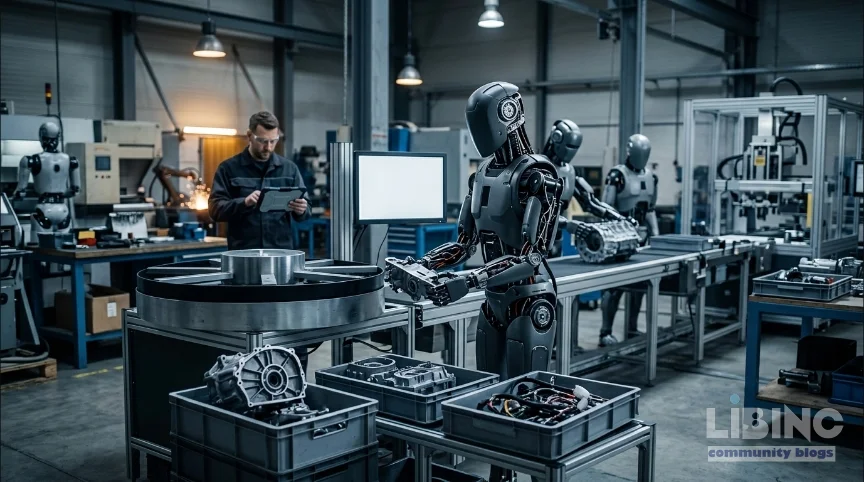
Atlas Humanoid Deployment: Hyundai's Vertical Integration and the Race to 30,000 Units
Atlas humanoid deployment at Hyundai signals a deliberate shift from hype to cadence. By tying 100% of Boston Dynamics' 2026 Atlas output to RMAC and to Google DeepMind, Hyundai embeds a cognitive stack inside a vertically integrated production framework. The plan presses a concrete timetable onto the field: 2028 for the first factory-floor work at HMGMA near Savannah, expanding to full component assembly by 2030. The stakes extend beyond a single robot platform: the corporate fabric includes Hyundai Motor Group, Hyundai Mobis as actuator supplier, and a cognitive layer from DeepMind, creating a rare example of a fully owned, cross-border robotics value chain. This Atlas humanoid deployment forces a reckoning on what scale, cost, and reliability actually look like in production environments.
The discussion shifts from whether humanoids can perform in manufacturing to whether a single corporate construct can underwrite both hardware roadmap and customer demand. The announced cadence requires not only a capable platform but an operating model that can absorb and monetize the associated risk. In that sense, Hyundai’s approach seeks to answer a core question: can a single ecosystem deliver 24/7, kit-to-station throughput that justifies a multi‑billion-dollar investment? The answer will hinge on early metrics—throughput, takt-time, and uptime—that have yet to be published by any OEM at scale. For now, Hyundai’s contribution redefines the field by making the economics of humanoid deployment testable and auditable, not merely aspirational.
Analytics in the Atlas deployment
The Hyundai strategy rests on three intertwined capabilities: a fully owned hardware-and-cognition stack, a supplier network tuned to high-volume humanoid work, and a production philosophy that sequences labor like a fixed automation line. This triad promises several advantages over typical partnerships where a single vendor provides the robot and a separate integrator handles the line. With Atlas integrated into RMAC and DeepMind’s cognitive layer, Hyundai can curate both demand and the technical levers that influence line performance. The result is a potential reduction in scheduling friction, a tighter control over takt-time, and a clearer path to fleet-wide reliability.
- Vertical integration as risk management: Hyundai owns the OEM, the robot platform, and the actuator ecosystem through Hyundai Mobis, aligning incentives across supply and demand.
- Dedicated production capacity: a 30,000-unit/year target from a single robotics facility signals scale that dwarfs current humanoid pilots and reshapes the cost-per-part moved calculus.
- Cadence with cognitive uplift: the DeepMind integration enables foundation-model-driven decision support, planning, and fault prediction across the Atlas workflow.
- First tasks framed by safety and quality: initial 2028 work at HMGMA emphasizes parts sequencing and kit movement rather than welding or final assembly, prioritizing predictable throughput and human-robot interfacing metrics.
- Supply-chain synchronization: with Boston Dynamics routing Atlas output entirely to RMAC first and to external customers later, the scale biology of the operation becomes a measurable variable, not a rumor.
The performance envelope of Atlas—56 degrees of freedom, a 2.3-meter reach, 50 kg lift, fully electric with autonomous battery swap, and an operating range of 20 °C to 40 °C—becomes meaningful only when coupled to real-world throughput. The cognitive layer does not simply add intelligence; it constrains variability, improves decision latency, and, crucially, supports continuous operation over long shifts. In practical terms, this makes the first 2028 phase less about monumental assembly feats and more about robust sequencing accuracy, reliable part handoff, and predictable station-to-station timing. The second-order effect is a potential shift in labor planning, with human workers redirected toward higher-skill tasks as the robot handles repetitive sequencing and kit placement.
From a metrics standpoint, the missing piece is the actual cycle times and mean time between failures for the RMAC operation, as well as the cost-per-unit-equivalent versus cobots or fixed automation. Until Hyundai publishes those numbers, the value proposition rests on capacity and the security of a vertically integrated supply chain. The early indicators, however, point to a model where hardware, software, and process design are tuned in concert rather than in isolation. The Atlas stack with DeepMind could distort traditional ROI calculations in favor of a fleet-based, asset-heavy approach that assumes continuous utilization and rapid iteration.
Key analytical levers
- Throughput potential: 30,000 units/year implies aggressive line productivity even if each robot handles discrete, non-welding tasks initially.
- Cycle-time transparency: the first publicly disclosed KPI will likely be takt-time per station, not a blanket global metric.
- Uptime discipline: autonomous battery swaps enable around-the-clock operation if reliability targets hold.
- Cost discipline: a single, vertically aligned ecosystem can compress supplier margins, provided the volume justifies the capex.
- Cognition integration: DeepMind’s models influence planning, anomaly detection, and fault diagnostics, reducing human-in-the-loop overhead.
Contrasts across OEM strategies
The Hyundai play stands in sharp relief against peers, most of whom publish dates without a comprehensive, vertically integrated platform. BMW has provided its Spartanburg data as a quantified benchmark, while Leipzig’s HV battery-focused program signals a different set of constraints. Mercedes-Benz is pushing intra-logistics with Apptronik Apollo, and Tesla is pursuing a high-volume, if slower ramp for Optimus V3. These varying geographies and task scopes create a mosaic where Hyundai’s straight line from sequencing to assembly is unusual in its completeness and its claimed control of the supply chain.
- BMW Spartanburg: 1,250 operating hours, >90,000 sheet-metal components, ~1.2 million steps over roughly 10-hour shifts for about ten months; the only quantified field benchmark so far.
- BMW Leipzig: European HV battery-assembly pilot with Hexagon AEON, plus a new Center of Competence for Physical AI in Production; a more demanding, assembly-adjacent scope than Spartanburg.
- Mercedes-Benz Berlin and Hungary: intra-logistics-focused deployments using Apptronik Apollo; the emphasis here is on parts delivery to assembly workers rather than autonomous line work.
- Tesla Fremont: Optimus V3 projected for mid/late 2026 with a plan to convert the Model S/X line toward humanoid production and a claimed capacity approaching a million units per year, though ramp timing remains disputed.
The critical takeaway is not that each OEM has a different task scope, but that nearly all have opted to start with material handling, sequencing, and kit placement rather than final assembly. The absence of welding, fastening, or end-to-end assembly in the early roadmaps underscores a common risk: can a humanoid justify its cost by replacing multiple single-task machines, or does the form factor only pay off when it replaces a substantial fraction of value-added assembly? The answer hinges on future KPI disclosures and the ability to demonstrate cost-per-part equivalence against fixed automation and cobot alternatives.
Cause and effect: what the schedules imply
Hyundai’s cadence creates a chain of causal effects that extend beyond the factory floor. First, a tightly scheduled ramp reduces the financial exposure of a multi-year robot program. Second, it aligns supplier economics with long-term demand, particularly given Hyundai Mobis’ role as actuator supplier and supply-chain partner. Third, the integration of DeepMind with Atlas introduces a cognitive layer that promises to improve consistently over time, potentially reducing downtime and improving material-handling precision. These effects, in turn, alter the expected ROI calculus, shifting risk from a speculative, novelty-driven investment to a production-scale program whose economics are trackable at the line level.
- Risk transfer: vertical integration transfers some uncertainty from appetite to execution—if one component underperforms, the entire value chain has a direct feedback loop to the program plan.
- Supply-chain lock-in: with 30,000 units/year target, actuator content and battery infrastructure become recurring revenue streams and strategic constraints for the ecosystem.
- Operational predictability: early sequencing work concentrates on right-place, right-time movement, enabling takt-time discipline and streamlined human-robot collaboration.
- Economic scalability: the ability to amortize fixed costs over tens of thousands of units could compress unit costs, provided yield and uptime hold under mission-critical conditions.
The risks remain tangible. Until RMAC throughput targets are disclosed and external Atlas customers come online in 2027, the economic case rests on capacity milestones and the credibility of the operational model. In other words, the schedule creates a testable framework for evaluating a humanoid’s real-world value, turning abstract promises into measurable performance. If the numbers check out, this could redefine the baseline for what constitutes credible humanoid automation in production ecosystems.
Expert reconstruction and what to watch next
If Hyundai sustains its trajectory, several key data points will shape the conversation over the next 18–24 months. Observers will be watching for four critical disclosures that transform speculation into an evidentiary basis for budgeting humanoid programs in 2027 and beyond:
- RMAC throughput targets: the first true indicator of whether Atlas can deliver cost-per-part advantages at scale.
- First non-Hyundai Atlas customer: this will reveal external demand tolerance and practical integration challenges across different line configurations.
- BMW Leipzig KPI outcomes: once the AEON deployment runs for a full quarter, the data will map a credible performance envelope for HV battery assembly and associated takt-time.
- Optimus V3 ramp timing: formal reveal and field performance will anchor the broader competitive landscape and influence fleet economics across makers.
The independent press and analysts will likely triangulate around these milestones, but the decisive signals will come from the line-side economics: cycle times per station, uptime statistics, and the comparative cost per unit moved against fixed automation and cobot-based solutions. Hyundai’s integrated approach—owning the OEM, the robot, and the actuator supply chain—sets up a scenario where the largest unknown becomes not whether a humanoid can perform, but whether a single platform can underwrite both the hardware roadmap and the customer demand that follows.
In the near term, the most credible path forward for Atlas is a staged expansion: 2028 sequencing at HMGMA, 2030 expansion to component assembly, and ongoing improvements through a DeepMind-backed cognitive layer that learns from every cycle. If the plan holds, the field will shift from debating feasibility to debating value, with clear yardsticks for cost, throughput, and reliability that competing OEMs will need to match or surpass to stay relevant.
In sum, Hyundai’s Atlas humanoid deployment reframes the robotics ROI problem from a speculative bet on a single robot to a portfolio-based, vertically integrated production strategy. The road to 30,000 units per year is as much about process discipline and supplier economics as it is about the robot’s capabilities. The next disclosures will determine whether this emerges as a sustainable competitive advantage or a high-profile experiment with a narrow window of applicability.
Keywords in practice: Atlas humanoid deployment, DeepMind integration, RMAC, HMGMA, 30,000 units/year, Hyundai Mobis, physical AI, AMR, sequencing, assembly
Endnote
This analysis treats Hyundai’s timeline as a credible inflection point rather than a speculative roadmap. The real test will be the ability to convert the stated schedule into consistent, line-level performance and a demonstrably lower cost per part moved when compared to fixed automation and cobots. Until then, the field should measure progress not by the spectacle of a production-ready Atlas, but by the cursor on the throughput graph and the reliability of the end-to-end value chain that supports it.
Operational metrics blueprint for Atlas rollout
The most credible reading of Hyundai's plan hinges on line-level metrics that translate robot capability into business value. A transparent KPI framework aligns cadence with ROI and makes the cognitive uplift measurable alongside uptime. Throughput, takt-time, cycle-time, and cost-per-part anchor the plan to real-world performance.
| Station | Task Type | Target Throughput (units/hr) | Notes |
|---|---|---|---|
| Seating & kit staging | Material handling | 120 | Baseline |
| Part sequencing | Part positioning | 200 | High impact |
| Battery swap prep | Energy management | 180 | Critical for 24/7 ops |
In practice, this table becomes a live decision tool. If sequencing underperforms, the cognitive layer can rebalance tasks across stations in near real time, reducing takt-time drift. A 5% uptime uplift from predictive maintenance can drop the cost per part moved, improving fleet economics.
The second focal point is the phase cadence: 2028 sequencing at HMGMA and 2030 expansion toward full assembly. The cognitive stack delivers learning across lines, turning surprises into predictable deviations. External customers will test the same framework under varied configurations, validating the model's scalability.
| Phase | Milestone | Expected Outcome | Risk |
|---|---|---|---|
| 2028 | Sequencing at HMGMA | Robust takt-time and handoff | Moderate |
| 2030 | Component assembly | Full value stream active | Lower |
With these anchors, Hyundai translates the plan into a budget-friendly, scalable path that preserves reliability and predictable pricing for customers in the next decade.
What is the purpose of Hyundai's Atlas deployment with RMAC and DeepMind integration?
The Atlas program aims to prove that a vertically integrated robotics stack can deliver reliable throughput at scale, through coordinated hardware, software, and supply chain. It seeks measurable improvements in takt-time, uptime, and cost-per-part by tying the robot to a cognitive layer and a controlled production framework.
Analytically, this translates into a testable ROI model where line-level performance drives capital allocation and supplier economics, reducing uncertainty about project payback.
Which KPIs are most critical in the early rollout, and why?
The essential KPIs are takt-time per station, cycle-time, uptime, and cost-per-part moved. These metrics directly map robot actions to throughput, enable rapid anomaly detection, and help compare Atlas against fixed automation or cobots in real-world costs.
Early visibility of these indicators enables proactive line balancing and budget adjustments before scaling to full assembly.
How does vertical integration affect risk and cost discipline?
Vertical integration aligns incentives across hardware, actuators, and cognitive software, reducing supplier-induced variability. It can compress margins if volumes justify capex, while also providing faster iteration cycles and clearer accountability for performance outcomes.
In practice, this means a more predictable cost base and a faster path to fleet-wide reliability once the first units are deployed.
What timeline milestones are most informative for evaluating progress?
The milestones to watch are RMAC throughput targets, the first external Atlas customer, KPI outcomes from BMW Leipzig’s AEON-based program, and the ramp timing of Optimus V3. These signals reveal whether the framework scales beyond Hyundai’s plants and into broader markets.
Task-level data and line-side economics will determine whether the model is scalable and economically sustainable.
How will DeepMind integration influence operational decisions?
DeepMind adds predictive insights, anomaly detection, and planning optimization across the Atlas workflow. This reduces human-in-the-loop burden, improves fault diagnostics, and enables near-real-time re-planning when disruptions occur.
The practical effect is more consistent takt-time, higher uptime, and better utilization of fleet resources.
What external demand implications could shift the program?
External demand introduces configuration diversity, which tests the cognitive layer’s adaptability and the supply chain’s flexibility. A proven ability to service external lines at predictable costs could accelerate ROI and broaden Atlas deployment beyond Hyundai’s plants.
In essence, external adoption is the ultimate stress test for the integrated model.




Add a comment
To comment, you need to register and authorize
Comments