

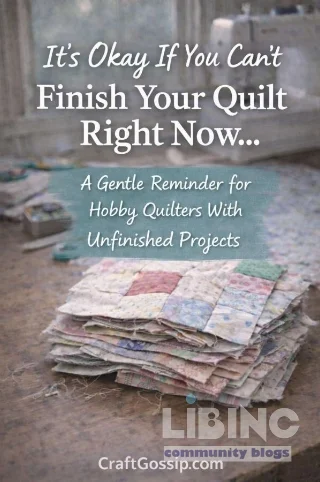
Unfinished Quilting Projects: An Analytical View of Momentum, Burnout, and Creative Pauses
Table of contents
- Through analytics
- Through contrast
- Through cause-and-effect relationships
- Through expert reconstruction
In the world of quilting, a kept-in-progress quilt is not a failure, it is a data point. If you have an unfinished quilt folded neatly in a cupboard, tucked into a project bag, or spread across your sewing table for the last six months, this analysis speaks to you. The problem is familiar, but the framing matters. Finishes shine on social feeds and in gallery walls, yet the emotional trail of unfinished work remains largely private. The guilt, overwhelm, and fluctuating motivation are real forces that shape how we treat creative projects. A quilt is not a quick craft; it is a multi-stage commitment that can stretch across weeks or months. When life shifts, momentum falters. This is not a sign of weakness; it is a natural signal from a complex creative system.
What you stand to lose if you pretend the lapse never happened is not just hours or fabric. You risk eroding your sense of belonging in a community that values curiosity and process as much as results. The stakes are not merely about finishing a single item; they include your ongoing relationship with making. If you interpret a pause as moral failure, you may stop listening to your own needs and end up burning out. The hidden conflict is that creativity often travels in seasons—bright bursts followed by quiet intervals. The direction of this analysis is simple: we examine unfinished quilting projects as a normal, even essential, part of a living practice. We will explore four lenses—analytics, contrast, cause and effect, and expert reconstruction—to reveal how to pause, pivot, or proceed with intention.
So, tell me honestly: how many unfinished quilting projects are in your sewing space right now? No judgment here. The goal is clarity, not confession. This article offers a framework you can apply across any project, from a baby quilt to a queen-sized design. It treats momentum as a measurable phenomenon, not a moral absense. By examining patterns, outcomes, and feasible next steps, you gain authority over your craft schedule rather than letting it own you. The journey from unfinished to purposeful is not a single leap but a sequence of informed moves. And you can begin with the next stitch.
Through analytics, through contrast, through cause and effect, and through expert reconstruction, we build a practical map. You will learn to recognize the signs of stall, reframe disappointment, and cultivate a sustainable habit of making. Most importantly, you will feel permission to pause, pivot, or start anew without surrendering your identity as a quilter. The quilt will wait, and your relationship with making can become more resilient, not more brittle.
Through analytics
Unfinished quilting projects are not random acts of procrastination. They follow a detectable pattern when you view them as a system of work, energy, and decision points. The first analytic question is simple: what are the actual steps from fabric selection to binding, and where does momentum tend to drop? By enumerating the phases, we turn a subjective sense of fatigue into an objective workflow with measurable risk points.
The core steps of most quilting projects can be listed succinctly:
- Choosing fabric and coordinating colors
- Cutting accurately
- Piecing blocks
- Pressing seams
- Layout decisions
- Basting the layers
- Quilting the top
- Binding and finishing
- Adding a quilt label
Each step carries cognitive and physical load. The initial phase, out of the gate, is energy-rich because novelty dominates. As the project grows, the energy curve often declines, especially during baste and quilting stages that demand sustained focus and repetitive motion. This is precisely where quilt burnout becomes a salient factor—an energy cliff that can derail progress if not anticipated. Recognizing the energy curve invites a shift from willpower to design: you can restructure work sessions, adjust expectations, and align tasks with your current capacity.
Analytically, unfinished quilting projects are best treated as multi-period commitments rather than single tasks. When you map time, energy, and decision fatigue across every phase, you identify safe intervention points. For example, reordering steps to front-load decision-heavy tasks (like fabric selection and layout) while conservation tasks (like trimming and basting) are scheduled for lower-energy days helps maintain forward motion. The practical takeaway is straightforward: you cannot finish a quilt with last-minute intensity alone. You finish by managing the cadence of work and protecting the parts of the process that sustain momentum.
Another analytic lever is scope modulation. The risk of burnout rises as the project remains overly ambitious or incompletely defined. A strong metric is the ratio of completed steps to planned steps within a given time window. If that ratio dips below a threshold, you should re-scope or pause. Quitting is not the conclusion; re-scoping is a design choice that preserves the project’s value while honoring your energy constraints. This approach turns unfinished quilting projects from a problem into a diagnostic tool for your creative system.
In sum, analytics reframes unfinished projects as a predictable pattern rather than a personal failure. It reveals when and why momentum declines and shows how to reorganize steps to prevent the energy spike that leads to quilt burnout. The result is a clearer sense of the project’s landscape and a set of concrete, data-informed actions you can implement this week.
Through contrast
Contrast illuminates the gulf between the myth of the quick finish and the lived reality of multi-stage quilts. The common fantasy—an impulsive start, a burst of inspiration, a flawless finish—ignores the daily grind of cutting, pressing, and checking alignment. The reality requires a longer arc, with pauses, recalibrations, and perhaps competing demands from life. The contrast matters because it reframes what success looks like for a quilting project. Finishing fast is not the only measure of progress; finishing well, or adjusting the plan without self-recrimination, often yields stronger outcomes over time.
In practice, many quilters feel pressure to wrap up a project to preserve their reputation or to meet social expectations. The social contrast is stark: people post finished quilts, but few share the quiet, disciplined art of pausing and reimagining. Quilt burnout can exaggerate this tension, painting delays as moral lapses rather than strategic pauses. When you allow yourself to slow down for a season, you preserve the integrity of your fabric choices, the accuracy of your seams, and the joy you initially felt when you bought the fabric. The contrast teaches a counterintuitive lesson: slowing down is often a prerequisite for sustainable momentum later on.
Consider this contrast in concrete terms. A large, highly detailed quilt may be alluring late at night, but it is rarely the project you will finish in a single sprint. A smaller, complementary finish—say a table runner or a patchwork mug rug—can restore your confidence and prove to yourself that you can complete a project with clear boundaries. The contrast here is not compromise; it is strategic pacing. When you prize the craft of completion at multiple scales, you reduce the cognitive load for each finish and sustain your creative identity across seasons.
Another contrast emerges when you compare different color palettes. A seasonal palette shift can refresh your motivation by presenting a new aesthetic with minimal risk. A quick, satisfying finish in a different scale can rewire your expectations and reduce the sense of obligation around the old, longer project. The upshot is practical: you can honor your creative impulse without forcing a single quilt to carry the entire emotional and logistical weight of your sewing room for months on end.
In short, contrast helps you reframe unfinished quilting projects as a dynamic part of a broader practice rather than a terminal state. It supports a healthier relationship with the craft by validating multiple types of finishes and by recognizing that the timing of those finishes will vary with life and energy cycles. Quilt burnout, reframed, becomes a signal to shift gears rather than a verdict on your competence as a quilter.
Through cause-and-effect relationships
Cause-and-effect thinking zeroes in on how decisions propagate through a project. The causal chain begins with life events that demand attention, time, or money. The immediate effect is a pause or a slowdown in quilting activity. The longer-term effect can be either a renewed surge of energy or a permanent drift away from the project. Identifying these links enables you to intervene before disengagement becomes permanent.
One clear causal path is this: when you face a prolonged interruption, the subsequent re-engagement depends on the structure you preserved during the pause. If you left the top unbasted or the backing uncut, you inherit extra steps, which raises the cognitive load at the moment you return. The result is a higher probability of quilt burnout upon return. Conversely, if you paused with a modular approach—holding aside a small, clearly defined subset of the project—you lower the barrier to return and preserve momentum. The causal insight is straightforward: define the return path at the moment you pause, not when you feel the pressure to finish.
Another causal mechanism centers on decision fatigue. Each choice—fabric pairing, block layout, seam alignment—drains mental energy. When a project stretches across days or weeks, the brain tires of decisions, and errors creep in. The effect is a downward spiral: more errors lead to more hesitations, which leads to further delays. Countering this pattern requires pre-commitment to a reduced decision set for each session. You can fix a palette for a week, or lock in a layout grid for a stretch of sewing sessions. By narrowing the decision space, you convert a potentially paralyzing moment into a series of manageable actions, sustaining progress and questionably avoiding quilt burnout.
Cause-and-effect insight also clarifies the role of small wins. Finishing a small component after a long block of time resets the cognitive scale and shows you that progress is possible again. These micro-closures accumulate into real momentum over time. The causal logic is thus: small, well-scoped wins reduce fatigue, rebuild confidence, and lower the risk of burnout on the larger project. The opposite is also true: neglecting small milestones can compound anxiety about the overall finish and erode your commitment to return at all. This is why a deliberate cadence matters as soon as you sense a stall.
From a causal perspective, unfinished quilting projects are not a single moment of weakness. They are a chain of decisions and environmental factors that either support or erode momentum. By designing pauses, reducing decision friction, and celebrating micro-wins, you steer the project back toward a sustainable rhythm. The cause-and-effect frame turns uncertainty into a programmable process, enabling you to pick up the needle with less resistance when the time is right.
Effective management of cause and effect thus rests on two practices: capturing the pause with a clear, low-friction plan, and re-entering with a defined micro-goal. When you do this, you align your energy, your time, and your craft toward a reliable finish path rather than an open-ended commitment that weighs on you. In this sense, unfinished quilting projects become controlled experiments in momentum, not unsalvageable failures.
Through expert reconstruction
The final lens, expert reconstruction, translates analysis into actionable routines. It moves from theory to practice by offering a playbook for pausing, pivoting, or continuing with intention. The goal is not to eliminate pauses but to optimize their impact on future finishes. The following strategies reflect a disciplined, craft-centered approach to managing unfinished quilts.
- Preserve the work-in-progress with artifacts: Fold the quilt top neatly, gather all pieces, and write a brief note about where you left off. This preserves cognitive landmarks and reduces search time when you return.
- Create a safe storage system: Store pieces together in labeled bins or a dedicated project bag. A physical cue reinforces the intention to return rather than abandon.
- Define a precise pause intention: State a single sentence about what the next move will be if you pick the project up again this month. This converts ambiguous waiting into a concrete plan.
- Schedule a micro-finish as a restart ritual: Plan a one- or two-hour session to complete a small, well-scoped portion. The objective is to demonstrate momentum in a short burst, not to conquer the entire quilt at once.
- Experiment with smaller scales and palettes: Use a simplified color palette or a reduced block count to re-engage without recreating the initial scale of effort. This lowers the barrier while keeping the core idea intact.
- Reframe the project in a new light: Consider shifting the setting or purpose of the final quilt. A fresh meaning—such as a seasonal display—can renew motivation without demanding a full redo.
These steps are not compromises; they are tactical reconstructions designed to protect the creative thread. They acknowledge that energy fluctuates and that the craft benefits from adaptive planning. The expert reconstruction mindset treats unfinished projects as living parts of your practice, capable of continuing with renewed clarity rather than dying on the shelf. By embedding a simple, repeatable pause and restart routine into your quilting life, you transform a potential sinkhole of procrastination into a sequence of purposeful moves.
In practice, expert reconstruction combines the lessons from analytics, contrasts, and cause-and-effect into a practical workflow. It is not a rigid formula but a flexible toolkit you can apply across different projects and seasons. The aim is to sustain your identity as a quilter, preserve the value of your fabric and time, and keep your creative energy aligned with your life. The result is a robust practice in which unfinished quilting projects exist not as evidence of failure but as evidence of ongoing making.
Ultimately, the path from unfinished to finished involves more than technique. It requires an attitude that embraces pausing as part of progress, respects the energy your craft demands, and builds a reliable system for recommitment. When you treat your in-progress quilts with thoughtful reconstruction, you preserve both the material and the inspiration they carry. And with that foundation, you can return to the next stitch with confidence—and perhaps a clearer sense of why the journey matters as much as the finish.
As you close this piece, consider how many unfinished quilting projects you hold and what a practical pause would require to move forward. The process you adopt today shapes your future finishes, your creative resilience, and your ongoing connection to the craft you love.
If you found this examination helpful, you might try a focused experiment this week: select one unfinished project, choose a micro-goal, and document the result. The data you collect will inform future decisions and reinforce your role as a maker who thrives on learning through practice rather than perfection. Your quilt will wait, but your momentum can grow—one intentional stitch at a time.
| Step | Action | Energy tip | Outcome |
|---|---|---|---|
| Pause & Define | Record exact point where you stop | Pre-select palette | Clear re-entry path |
| Set Micro-goal | Choose a one-session target | Limit options | Momentum restored |
| Schedule Micro-finish | Plan a 60–90 min sprint | Structured time | Visible progress |
| Re-enter with Review | Start top/backing check | Decision limit | Smooth re-entry |
Structured restart plan
When momentum stalls, treat the pause as a new project with a defined start. Begin with a single, well-scoped task you can finish in one session to rebuild rhythm and reduce cognitive load.
For example, if a queen-sized quilt stalls at border setup, reframe the next session as "sew two border corners and press" within 60 minutes. This preserves design intent while easing re-entry and increasing the odds of a successful finish.
Each completed micro-task increases the odds of finishing the larger quilt by a measurable margin over time.
| Project type | Micro-goal |
|---|---|
| Baby quilt | Finish 2 blocks and press seams |
| Wall hanging | Assemble 1 border row |
| Table mat | Attach 1 motif and baste |
Keep these restart elements visible in your workspace to turn pauses into productive steps within your quilting workflow, supporting momentum in quilting and burnout prevention.
How can I tell momentum is slipping on an unfinished quilt?
Momentum is slipping when sessions become infrequent and progress stalls at a key stage.
In practice, you’ll notice longer gaps, repeated bottlenecks, and a sense that the finish has moved out of reach. Addressing this early with small, defined tasks maintains cadence and protects your creative energy.
How can I design a restart plan for a paused project?
A restart plan starts with a precise pause statement, then a single micro-goal for the next session, followed by a short, scheduled restart. This creates a repeatable loop that rebuilds confidence and reduces cognitive load.
By formalizing a tiny re-entry ritual, you convert hesitation into action and sustain progress across seasons.
What is a micro-goal in quilting?
A micro-goal is a tiny, well-scoped task that fits into a single practice session.
Setting micro-goals aligns effort with energy and produces tangible, quick wins that compound into larger finishes.
How can I reduce decision fatigue during quilting sessions?
Reduce decision fatigue by fixing a palette for a set period and locking in a layout grid or a limited set of blocks. This narrows choices and keeps your focus on execution rather than design fatigue.
This approach preserves creativity while sustaining momentum during longer projects.
How do I decide which unfinished project to resume first?
Prioritize by energy alignment, likely quick wins, and personal meaning. A project with a clear next action that rejuvenates your motivation should take precedence.
This helps you reclaim momentum without forcing a full-scale commitment that exceeds current capacity.
What storage practices help maintain momentum?
Keep pieces together in labeled bins or dedicated project bags and add a simple pause note outlining the next step. Clear organization reduces search time and reinforces the decision to return.
Good storage becomes a practical cue to re-engage rather than abandon a project.





Add a comment
To comment, you need to register and authorize
Comments