

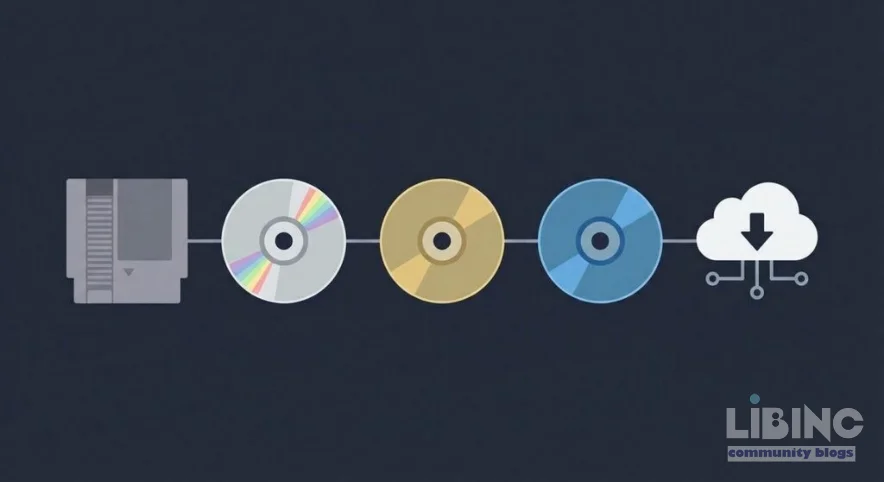
The Evolution of Game Media Formats: An Analytical View on How Delivery Methods Shaped Gaming
Delivery has always shaped what games can be. The way titles reach players changed as dramatically as the games themselves, from rigid hardwired setups to seamless digital downloads. Each new medium expanded possibility: larger worlds, richer audio, cinematic cutscenes, and libraries accessible without swapping hardware. The history of game media formats is a story of capacity, cost, and the tension between physical ownership and digital convenience. This analysis traces that arc—not as a nostalgia trip but as a map of the incentives that still govern design, pricing, and policy. The problem is simple: format choices redefine ownership and access. The stakes are equally clear: lasting access for players, viable economics for developers, and meaningful preservation for the future. The hidden conflict is that every leap creates opportunity while complicating reliability. Four analytical lenses will guide the map: what changed, why, and what follows.
Table of Contents
Analytics of the Evolution of Game Media Formats
The first era of game media formats centers on hardwired consoles. Magnavox Odyssey (1972), Atari Pong (1975), and countless dedicated Pong clones embedded the entire game in fixed circuitry. In that world, ownership equaled hardware: buy the console, enjoy what it shipped with, and there was no software library to expand. This stark constraint reveals the core analytics of the period: capacity was sealed inside silicon, and there was no practical way to monetize software beyond selling another box. The problem, from a strategic perspective, was obvious: a short shelf life for a product with no easy way to refresh content. The stakes were economic: without removable media, developers could not sustain a long-tail catalog or recurring revenue from software.
The ROM cartridge revolution began with the Fairchild Channel F (1976) and was popularized by the Atari 2600 (1977). A plastic shell cradling a read-only memory chip enabled swapping software without new hardware. The central analytic takeaway is that a modular medium decouples software from hardware economics, creating scale. Cartridges offered near-zero load times—the console read directly from ROM—and durability without moving parts. They also invited hardware augmentation: the SNES used co-processors like the Super FX to boost performance, and the SA-1 to expand processing. But cartridges carried a price: ROM chips, boards, and shells added up. In the measured calculus of game media formats, cost per unit constrained ambition as games grew larger and more graphically demanding. Capacity limits shaped design decisions, forcing developers to innovate around memory density and compression rather than unlimited expansion.
The cartridge era persisted into handhelds as well. The Game Boy, GBA, DS, 3DS, PS Vita, and Nintendo Switch all rely on card-based media. The portable form factor benefits from durability and instant access, but the economics remain stubborn: manufacturing a high-density cartridge or card remains costlier than optical or digital alternatives. This persistence across devices is a telling data point: the durability and reliability of a non-volatile storage medium often outweigh the convenience of other formats, especially in on-the-move contexts. When we examine the cost-performance curve across game media formats, cartridges create a bottleneck but deliver immediate play and long-term resilience. The tension is clear: the more capacity you demand, the more you pay upfront, and the more you risk price pressure on consumers. The core lesson for game media formats is that design constraints—especially storage and access—drives a discipline that later formats must learn to relax without sacrificing reliability.
From this analytic base, one observes four recurrent drivers that push transitions forward: capacity, cost per unit, manufacturing complexity, and ownership economics. These drivers interact with evolving software ambitions, from arcade-scale experiences to sprawling single-player epics and online-enabled live services. In the language of game media formats, capacity expands with new storage media, but costs and complexity swing with new formats and licensing regimes. The result is a predictable but disruptive rhythm: a new medium opens possibilities, raises new constraints, and shifts the leverage between publishers, developers, and players. This rhythm underpins the continuities and discontinuities you see across the history of game media formats and explains why the transition from cartridges to optical discs felt inevitable yet disruptive.
The dominant capacity leap arrived with optical discs, a shift that redefined production, distribution, and scale. The PC Engine CD-ROM² (1988) pioneered optical media in living rooms, but the Sony PlayStation (1994) made CD-ROM the industry standard. A single disc carried 650–700 MB—a leap of more than two orders of magnitude over cartridge capacity for many titles—at a fraction of the manufacturing cost. The analytics here are straightforward: more data per disc reduces per-game manufacturing overhead, enabling bigger worlds, richer audio, and full-motion video. Yet, the trade-offs began to emerge as soon as discs replaced ROM: load times increased, memory management became more complex, and developers learned to balance streaming data with preloaded assets. The displacement of cartridge bottlenecks by disc capacity shifted game design toward larger, more cinematic experiences, while introducing new dependencies on drive performance and disc integrity. In short, the disc era widened what was possible, but it also recast the risk profile for players, publishers, and operators.
As disc-based systems matured, the industry explored proprietary formats and memory cards to manage saves, content, and cross-title data. The Neo Geo AES used arcade-grade cartridges, while the N-Gage experimented with removable media that required hardware maintenance steps. Proprietary memory cards for the PS Vita, UMDs, and other formats attempted to solve the same problem—data portability and rapid access—through costly, device-specific solutions. These episodes illustrate a key motif in game media formats: different media shapes the economy of ownership. When formats lock players into a single ecosystem, publishers can extract value through licensing and digital rights management; when formats are open and interoperable, players gain freedom but face new balancing acts for developers and retailers. The analytics show that format work is never merely technical; it is a negotiation over value, risk, and control within a rapidly changing ecosystem.
Why formats change: capacity, cost, and control
- Capacity expansion unlocks larger, more complex games and richer media assets.
- Manufacturing economics determine the optimal grosser, profit margin, and retail pricing.
- Control of ownership drives licensing, resale, and backward compatibility decisions.
- Platform strategy shapes whether a given format becomes a standard or a footnote.
Contrasts Between Media Types
The transitions between media types—cartridges, optical discs, and digital distribution—represent not only technical shifts but also strategic recalibrations of value, risk, and user experience. In each case, the gains in capacity or convenience were balanced by new costs, new forms of fragility, and new questions about ownership and access. The central contrast is not merely speed or size; it is the way a medium encodes, transfers, and enforces control over software. The following contrasts highlight how game media formats restructured what games could be, how players paid, and how titles endured beyond launch.
Cartridges vs optical discs reveal the core trade-off between immediate play and scalable content. Cartridges deliver near-instant loading and rugged durability but cap capacity and inflate production costs. Optical discs dramatically increase storage and reduce per-unit cost, enabling sprawling worlds and multimedia assets, yet introduce slower load times and sensitivity to disc scratches. The PS1 era illustrates the win-win: more data per game, fewer manufacturing hurdles, and a new set of performance concerns tied to disc access patterns. The consequence for developers is a shift in design emphasis—from compression and memory budgeting to streaming strategies and data locality. For players, the transition promises scale but demands tolerance for longer load moments and disc maintenance.
Optical discs vs digital distribution marks the move from physical to licensed software as the primary distribution channel. Digital storefronts slash manufacturing overhead, enable instant purchases, and render patches as standard practice. They unleash unprecedented accessibility and a vibrant indie scene, but they also recast ownership as licensing. When storefronts vanish or licenses lapse, access to libraries becomes precarious. The 2010s witness a convergence where the digital model becomes dominant, while the risk to culture and preservation steadily rises because availability is tethered to platform policies and corporate decisions. The lesson is not anti-digital; it is that distribution rights and long-term access require robust governance and, ideally, open standards that survive vendor shifts.
Digital distribution vs streaming underscores the continuum from download to cloud. Downloads maintain ownership and local control but demand storage space and patch management. Streaming removes local storage completely, reintroducing a dependency on network reliability and data centers. The potential is vast—instant access on any screen, cross-device play, and reduced hardware requirements—but the cost is strategic: control over libraries shifts toward service providers, and the supply chain becomes a data-centric infrastructure problem. The net effect on game design is a pivot toward lightweight clients, server-authoritative gameplay, and interfaces that tolerate latency. The overarching contrast shows that the most transformative shifts are not merely in how data moves but in who owns, who pays, and how persistence is guaranteed across time.
Cause-and-Effect Dynamics in Delivery Media
Every major delivery medium change in game media formats triggers a cascade of cause-and-effect outcomes across design, economics, and culture. Understanding these chains clarifies why past transitions happened and how future shifts might unfold. The central causal thread is simple: format choices unlock new design space while constraining current capabilities. This tension repeatedly pushes developers toward new architectures, which in turn alters the cost structure, licensing regimes, and the expectations of players and retailers.
Cartridges caused tight coupling between software and hardware. Because capacity was fixed, game designers learned to compress, reuse assets, and rely on hardware-assisted features (co-processors, optimization tricks) to achieve ambitious visuals within tight budgets. The consequence was incredibly tight, highly optimized experiences that rewarded optimization over experimentation. When the market moved to disc-based storage, the scalability unlocked blockbuster worlds and cinematic sequences but forced a shift in production pipelines toward pre-rendered media, full-motion video, and more aggressive debt in terms of storage. The effect was a renaissance of narrative scope and technical ambition, tempered by longer lead times and higher publishing risk during development cycles.
Digital distribution changed the economics of who pays for games and how they are maintained. By removing manufacturing steps, storefronts lowered barriers to entry for independent developers and created a globalization of supply. The trade-off was a intensification of licensing friction: ownership became a spectrum of rights, platforms governed by policies, and revenue models tied to storefronts rather than pure sales. The resulting effect on game design included ongoing patching, day-one updates, and post-launch monetization in many forms. Players gained access to a broader catalog, but preservation risk increased as storefronts shift, contracts expire, or stores close. This chain of cause and effect makes digital distribution a pivot point for both opportunity and fragility in the game media formats landscape.
Streaming, as the apex of cloud delivery so far, redefines the operational fabric of games. The immediate effect is a dramatic reduction in local hardware requirements and a shift toward server-side computation and streaming pipelines. The design implications include latency-aware mechanics, server-authoritative gameplay, and new approaches to content streaming that emphasize progressive disclosure and dynamic assets. The downside is a new dependency on network reliability and data center governance. The ownership question returns in a different guise: players enjoy access to libraries, but the line between ownership and license becomes subtler, and long-term access becomes contingent on corporate strategy and connectivity. The causal chain here suggests that streaming accelerates accessibility while intensifying systemic risk around availability, policy, and resilience.
Finally, the tension between preservation and delivery becomes most acute with every major transition. Physical media offered durable artifacts and a form of longevity grounded in hardware ecosystems; digital stores aggregate libraries but risk obsolescence as platforms close or shift direction. The cause-and-effect of this tension is that preservation strategies must address both hardware longevity and software licensing. Emulation, archival dumps, and open, export-friendly formats become essential levers for maintaining accessibility. In the context of game media formats, the preservation challenge is not merely technical but strategic: how do we ensure that future players can access, study, and enjoy games even if their original delivery medium no longer exists?
Expert Reconstruction for the Next Era
The future of game media formats will demand a principled blend of openness, resilience, and disciplined licensing. Expert reconstruction centers on four interlocking strands: open standards, robust preservation, sustainable business models, and hybrid delivery architectures that balance control with accessibility. The following syntheses offer practical paths forward that can improve both current outcomes and long-term survivability of games as cultural artifacts.
- Open standards and cross-platform compatibility: Encourage format-agnostic data models and metadata schemas that survive vendor shifts, enabling emulation and interoperability without forcing players into a single ecosystem.
- Preservation through redundancy: Combine archival dumps, legal deposits, and emulation-friendly packaging to ensure playability across decades, reducing dependence on a single storefront or hardware lifecycle.
- Hybrid delivery strategies: Embrace disc or cartridge backups for compatibility, while leveraging digital distribution for updates, patches, and access to large catalogs. The design goal is resilience, not reliance on a single channel.
- Licensing models aligned with cultural value: Develop preservation-friendly licenses and licensing windows that protect access even as business strategies evolve. This includes encouraging long-term access commitments and archival rights in platform agreements.
From an expert standpoint, the next era of game media formats must reconcile the efficiency of digital delivery with the stubborn realities of ownership, preservation, and long-term access. Streaming will likely coexist with downloadable and physical media for an extended period, each serving different segments of players, budgets, and risk tolerances. The challenge is not to declare a winner but to design a framework where formats converge toward accessibility, reliability, and durability without sacrificing the creative ambition that drives game development. The path forward requires governance that transcends individual storefronts and a commitment to open, durable architectures that encode not just data but the context, assets, and rights that make games meaningful across time.
The arc of game media formats is not only a technological history; it is a lesson in how value and memory travel through systems. By aligning design, economics, and preservation around principled standards, the industry can ensure that the innovations of today remain accessible to players and researchers tomorrow. In the end, the media that deliver games should empower play without erasing the past, and formats should enable exploration without locking players into a single path.
Summary thoughts for practitioners
- Prioritize durability in the chosen delivery path to maximize long-term access.
- Plan for preservation from the start, not as an afterthought.
- Balance control and openness to avoid creating artificial dead ends for libraries.
- Design with licensing in mind to minimize disruption when platforms evolve or stores close.
Ultimately, the evolution of game media formats reveals a recurring truth: greater capacity and convenience always provoke new design ambitions, but the true test lies in how societies choose to preserve and share those ambitions across time. The coming era will reward clarity of standards, foresight in licensing, and a commitment to resilience that ensures games remain a living part of our cultural landscape, not a temporary library tied to a single storefront or hardware cycle.
Access, preservation, and value construction are not separate problems but threads of the same tapestry. If game media formats are to fulfill their enduring promise, the industry must embed resilience into every layer—from core data models to storefront policies and from hardware compatibility to archival practice. The future is less about choosing a single path and more about engineering an ecosystem where multiple delivery modes reinforce each other, enabling players to enjoy, study, and remember games long after the initial release fades from memory.
Preservation as a Strategic Pillar: Practical Pathways
Long-term access to games depends as much on governance and packaging as it does on today’s load times. A practical gap exists when teams treat preservation as an afterthought, leaving libraries vulnerable to platform shifts and licensing changes. The remedy is a repeatable preservation workflow that spans data models, metadata, licensing, and storage redundancy, enabling playable libraries across engines and eras.
Below are pragmatic steps with concrete artifacts and real-world context that teams can start applying now.
| Aspect | Open standards | Proprietary formats | Preservation impact | Examples |
|---|---|---|---|---|
| Data model | JSON/XML schemas | Vendor-specific binaries | Improved interchange and future rendering | JSON manifests |
| Metadata | Dublin Core/PREMIS | Platform-native fields | Better provenance and discovery | JSON-LD bundles |
| Packaging | Open packaging (BagIt) | Closed wrappers | Higher portability | Open packaging scripts |
| Access rights | Preservation-friendly licenses | Storefront licenses | Long-term re-use | Open license language |
| Emulation readiness | Broad emulator support | Limited support | Future-proofing | Archived builds |
Open standards reduce lock-in and enable archiving, while fostering provenance research, asset graph reconstruction, and cross-platform playability that survives platform shifts.
These actions translate into concrete steps: define a minimal preservation spec, lock in multi-location backups, and publish license language that allows preservation copies without penalizing future access.
- Open standards adoption
- Define common data models
- Use documented metadata
- Redundancy and integrity
- Two or more archival copies
- Regular checksums and migrations
- Licensing for persistence
- Preservation-friendly terms
- Archival rights in platform agreements
Adopting these practices creates resilience and clarity about who can access what, when, and how, regardless of platform dynamics.
In practice, teams should start with a lightweight policy document that integrates these elements into the production cycle, then expand as proven successful on a handful of titles.
Why is preservation critical in game media formats?
Preservation is critical because games are cultural artifacts that encode history, technical practice, and creative evolution, and without deliberate preservation access to many titles can vanish as storefronts close or hardware becomes obsolete, depriving researchers, educators, and players of authentic artifacts to study and enjoy; a robust preservation approach ensures asset availability, provenance, licensing clarity, and the ability to replay experiences across generations, which in turn supports education, scholarly work, and a richer understanding of how design decisions respond to constraints, taste, and technology cycles. Analytically, this requires governance spanning developers, librarians, and rights holders, plus repeatable workflows that protect assets during porting, updates, and platform transitions.
How do open standards help sustain game libraries over time?
Open standards enable data models, metadata, and packaging to survive platform shifts, reduce vendor lock-in, and improve discoverability, making it possible to reconstruct playable libraries even when hardware stacks or storefronts change; they create a durable base that researchers, educators, and archivists can rely on to map dependencies, asset graphs, and provenance across decades. Analytically, realising this requires ongoing governance and alignment across publishers, archives, and libraries to ensure standards remain interoperable as formats evolve.
What practical steps can publishers take to preserve catalogs?
Publishers should adopt a preservation-first policy, define a minimal data model, implement multiple archival copies, and publish licensing that permits preservation keeps; they should also bundle metadata with assets and test retrieval via emulation on a regular cadence. Analytically, a phased approach mirrors other digital asset management programs and ensures that small titles can be included without huge upfront costs.
What role does emulation play in ensuring long-term access?
Emulation lets modern systems run legacy environments, allowing players to experience titles beyond their native hardware; it requires careful documentation of system dependencies and testing across multiple emulators to guarantee fidelity and minimize drift. Analytically, emulation should be part of a broader strategy, not the sole solution, with preservation-ready packaging that decouples assets from original hardware.
How should licensing evolve to support preservation and access?
Licensing should explicitly permit preservation copies, redistribution for archiving, and access by researchers, educators, and audiences beyond the original market; it should also clarify rights to migrate formats and provide time-limited access that survives business model changes. Analytically, without archival-friendly terms, even otherwise preserved libraries may become inaccessible as stores close or platform policies shift.
What risks do digital storefronts and platform changes pose to libraries?
Storefronts and platform shifts can sever access to large catalogs if licenses expire or terms change; this risk grows as services consolidate, and it emphasizes the need for legal deposits, platform-agnostic packaging, and cross-platform interoperability. Analytically, a diversification of delivery modes and explicit preservation commitments mitigate these risks and help maintain cultural continuity.






Add a comment
To comment, you need to register and authorize
Comments