

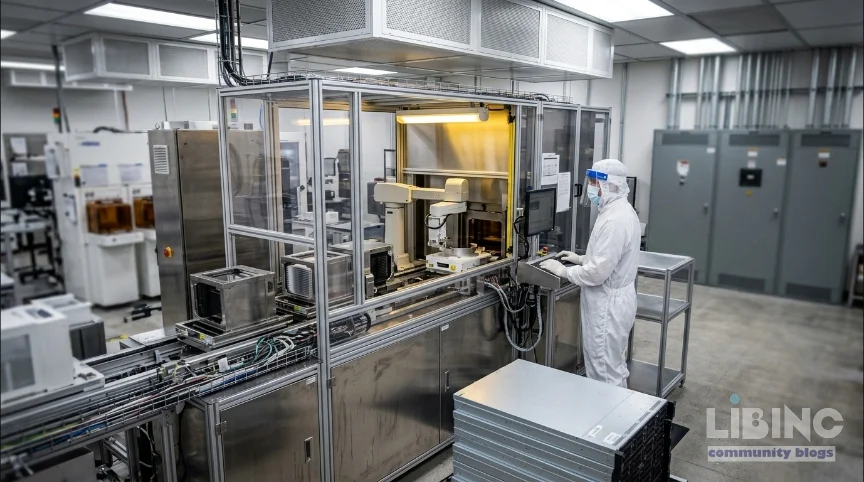
Micron's 1α DRAM at Manassas: Transforming a trailing-node DDR4 site into a node-current East Coast memory hub
Micron's May 22, 2026 announcement that 1α DRAM is now in production at its Manassas, Virginia fab reframes a long-standing East Coast asset into a node-current production line and creates a second active U.S. fab geography. The move delivers two strategic bets in one: it shifts a trailing-node DDR4 footprint toward 1α readiness, and it hardens U.S. memory supply by adding a second domestic mass-production site beside the existing Boise complex. The numbers are explicit: more than $2 billion in expansion and modernization, supported by a $275 million direct-funding award from the NIST CHIPS Program Office. Manassas will quadruple its DDR4 wafer supply, with qualified production expected by the end of calendar 2026. The product mix leans into long lifecycle DDR4 and LP4 memory for automotive, defense and aerospace, industrial, networking, and medical-device customers where 7- to 15-year visibility matters more than density. The tension lies in execution: can a Virginia footprint credibly absorb the grid, water, and interconnection realities that have become the bottleneck of U.S. semiconductor capex? The analysis that follows interrogates this move from multiple angles to reveal what changes—and what could still unravel.
Analytics
At its core, the Manassas 1α ramp is not about breaking memory density records. It is about turning a trusted, long-life DDR4 footprint into a node-current, supply-visible operation that can serve customers with mission-critical timing. This distinction matters because the most compelling U.S. memory stories of the past decade centered on density wars and front-end migrations. Micron's pivot to 1α DRAM at Manassas reframes the calculus: the company seeks to de-risk the U.S. supply chain by anchoring a second domestic node-current capability inside a familiar regional ecosystem. The $275 million CHIPS award is not a free lunch; it is a bridge to a different risk profile—the risk of reliability over rapid technological escalation. In practice, the Manassas project embeds a counterweight to Taiwan- and Korea-sourced components by targeting markets that prize lifecycle stability and regulatory alignment. Why this matters: long-cycle sectors such as automotive ADAS, defense radar, and medical devices typically demand 7- to 15-year supply visibility, not the newest density bins. By this metric, 1α DRAM at Manassas aligns Micron with the strategic imperative to diversify the U.S. memory stack beyond high-volume, high-density nodes. LSI: memory supply chain resilience, long lifecycle memory, U.S. domestic manufacturing strategy.
The project economics reflect a deliberate choice to trade cutting-edge fabs for steady, scaleable output. The expansion quadruples the DDR4 wafer supply rather than adds a new, dramatically denser node. This is a risk-adjusted bet: the company can monetize near-term demand certainty while awaiting the broader market's adoption of 1α across other geographies. A crucial element is the timing: qualified production is slated for the end of calendar 2026, implying a ramp that dovetails with the long lead times for automotive and aerospace programs. If demand remains robust in the 2027–2030 window, 1α DRAM at Manassas could stabilize a portion of the U.S. memory pipeline that has historically depended on a limited geographic footprint. LSI: U.S. memory manufacturing resilience, DDR4 lifecycle markets, capex cadence.
Beyond the economics, the project answers a structural question: where will 1α DRAM be produced in meaningful volume in the United States? Micron's own roadmap shows Boise and Idaho as leading-edge nodes, with a second Idaho fab scheduled for 2026 start-up and a scheduled 2028 operation. The New York HBM cluster has faced delays and CHIPS funding reallocations, with supply expectations pushed to 2030+. Bringing Manassas to 1α acts as a hedge against this delay path, offering an immediate East Coast node-current capability and reducing single-region concentration risk. The strategic logic is thus twofold: (1) demonstrate that the East Coast can host a node-current operation, and (2) preserve a broader U.S. memory ambition by avoiding a drift toward an over-reliance on one geography. LSI: regional diversification, East Coast data center load.
Operationally, the ramp faces the same grid headwinds that bedevil other large industrials and hyperscalers. The interconnection queue, substation constraints, and the timing of transmission upgrades complicate even small-scale expansions. Dominion Energy reports a data-center load growth trajectory that outpaces 1:1 upgrades in transmission capacity across the relevant footprint. PJM's interconnection clock remains among the longest in North America, and the addition of a sizeable new load inevitably interacts with ratepayer protections and regulator-approved plans. In short, a fab is not a hyperscaler, but it competes for the same kilowatts at the same substations and within the same queue. In the Manassas context, the energy and water profile matter almost as much as the process node. LSI: grid constraints, PJM interconnection.
From a workforce perspective, Micron couples a regional apprenticeship strategy with a broader corporate effort to shift talent to higher-value locations. NOVA's community-college pipeline targets roughly 400 direct manufacturing roles at Manassas and up to 2,700 community jobs at peak. The program emphasizes technician-level competencies—equipment operation, process-tech, and yield engineering support—rather than high-density, PhD-heavy roles. The strategic takeaway is clear: a node-current DDR4/LP4 fab requires a different talent mix than a leading-edge, heterogenous logic or memory stack. The Virginia footprint thus reflects a talent strategy aligned with a specific production profile, while senior process-engineering and yield optimization will continue to pull from Boise, Hsinchu, and Pyeongtaek. That dynamic creates relocation costs and housing pressures, which feed into wage inflation and broader regional pricing in the next capex cycle. LSI: industrial talent pipelines, NOVA workforce.
Contrast
Manassas' 1α ramp contrasts sharply with Micron's West Coast and Idaho strategies, underscoring a broader US memory policy experiment. On one axis, the contrast is about node-current volumes versus density-first lines. Boise's leading-edge 1x/1β machine counts will drive phased volume into high-density stacks later, while Manassas focuses on the reliability and supply stability that major automakers, defense primes, and medical OEMs demand. The contrast is not merely technical; it maps to risk profiles. Leading-edge facilities operate at the frontier of yield learning, supply chain volatility, and wafer-fab complexity. Node-current lines face different yield trajectories and material readiness but offer higher schedule certainty for long-cycle customers. The result is a dual-track strategy: continue to push density on the West Coast and Asia while building a parallel, shielded supply channel on the East Coast that can weather geopolitical and policy turbulence. LSI: supply chain resilience, East Coast vs West Coast memory.
Another axis of contrast lies in customer mix. Manassas targets long-life DDR4/LP4, serving automotive, defense, aerospace, industrial, networking, and medical markets—segments with tight BOM qualification, FDA and avionics standards, and extended program lifecycles. Boise and Idaho, in contrast, push into leading-edge DRAM densities and hybrid memory cube systems that prioritize performance per watt and bandwidth. The New York HBM cluster, meanwhile, has faced delays and funding reallocations that shift risk away from the immediate domestic memory supply trajectory and toward an extended timeline. The result is a segmentation of risk: Virginia handles the non-discretionary, long-cycle demand; Idaho and New York handle density and frontier performance. The policy environment intensifies these differences, since funding and interconnection justify or challenge each location's business case. LSI: customer segmentation, long-cycle demand.
The energy-water nexus is another stark contrast point. Manassas sits in a region where water rights and wastewater capacity shape expansion decisions. The Upper Occoquan capacity has a finite headroom, currently allocating roughly 9.19 million gallons per day for municipal use, with expansion costs potentially near $100 million to accommodate high-flow process-water needs. In practice, this means a future third expansion, packaging line, or co-located supplier would collide with a water ceiling absent further multi-jurisdictional coordination. In Boise or New York, the water and wastewater equations unfold differently, but all large fabs face similar constraints: power affordability and reliability, wastewater scalability, and the regulatory drag on interconnection timing. The practical implication is that Virginia's utility and regulatory framework, while offering CHIPS incentives, simultaneously imposes a structured cap on how quickly an expanded memory footprint can scale. LSI: water constraints, wastewater capacity.
Cause and Effect
The Manassas move creates a cascade of effects across the U.S. memory ecosystem. First-order cause: Micron converts a drifted, trailing-node DDR4 footprint into a node-current 1α operation on the East Coast. Effect: the company hedges against New York HBM delays and Idaho capex slippage, preserving a 40% domestic-DRAM target and maintaining a broad U.S. production map. A second effect ties directly to grid realities: the Manassas ramp heightens the need for transmission upgrades and interconnection reforms in PJM’s queue, aligning a private facility’s load with the public planning process. If PJM reforms interconnection timing or if Dominion accelerates capacity additions, the economics of a second fab geography in Northern Virginia become more favorable. If not, the project faces a tighter subsidy envelope and higher risk of schedule pull-ins. LSI: interconnection risk, capacity planning.
- Cause: Node-current 1α production replaces trailing-node DDR4 at Manassas. Effect: Diversified U.S. memory supply with a dedicated East Coast node-current hub and heightened reliance on Virginia's grid upgrades.
- Cause: CHIPS funds paired with site expansion. Effect: Accelerated ramp and leverage for long-cycle markets, but with scrutiny on project-readiness and regulatory hurdles.
- Cause: Water and wastewater constraints. Effect: Potential bottlenecks for future expansion phases, requiring multi-jurisdictional capital and coordination.
- Cause: Workforce pipeline via NOVA community college and Micron apprenticeships. Effect: Local technicians feed initial operations while senior engineering talent remains distributed globally.
From a policy standpoint, Virginia's environment adds both upside and friction. Independent review of Dominion's data-center-driven load forecasts introduces a new, external check on industrial interconnections. This governance layer can decelerate, or at least recalibrate, the capacity releases needed to sustain a multi-hundreds-of-megawatts expansion. The trade-off is clear: the same policies designed to protect ratepayers also raise the bar for large industrials to forecast, interconnect, and fund the kilowatts that fabs demand. For Micron, the decision to press ahead with Manassas means accepting a regulatory frame that rewards long-term reliability while demanding disciplined capacity planning and transparent reporting. LSI: ratepayer protection, regulatory oversight.
Expert Reconstruction
Viewed through an expert lens, the Manassas 1α ramp looks like a modular bet designed to weather mixed futures. If New York’s HBM program remains delayed and Idaho Fab 2 faces an on-schedule slip, Manassas becomes the anchor of a two-regional U.S. DRAM supply strategy that balances risk, cost, and time-to-market. The next waves could include a co-located supplier footprint or a packaging line that serves as a bridge to more integrated module-level solutions. Expect a gradual expansion path rather than a single, large leap: additional 1α lines could appear in adjacent blocks if water and grid upgrades prove scalable and if interconnection reforms accelerate. The potential is for a third or fourth платформа to emerge on the East Coast, linked to manufacturing partners that provide packaging, test, or wafer-level assembly near the Virginia footprint. Each incremental investment will hinge on the interplay of three forces: power price and reliability, water capacity, and the pace of demand in the legacy DDR4/LP4 segments. LSI: packaging integration, co-located suppliers.
Strategically, Micron’s 1α Manassas decision sends a signal about U.S. memory strategy in the 2026–2030 window. The company retains the Boise, Idaho, and New York tracks, but the East Coast ramp becomes the readily actionable lever to maintain a domestic-DRAM target while New York and Idaho navigate longer-cycle risks. For suppliers, the message is clear: plan for multi-site deployment near load centers with strong policy support, but also for the capital intensity of water and power upgrades that accompany large memory footprints. For regional planners, Manassas becomes a case study in how to align utility planning, transmission investment, and industrial growth under a CHIPS-inspired framework that prizes resilience and predictable supply. LSI: regional industrial policy, CHIPS program impact.
A final takeaway: the Manassas ramp will not be judged solely on the immediate production gains. Its influence will be measured by how the broader U.S. memory stack responds to a demonstrated East Coast node-current capability. If the market treats 1α DRAM as a credible, stable supply option for automotive, defense, and medical OEMs, Micron will have bought more than capacity—it will have bought time for the U.S. memory ecosystem to adapt to longer lead times and more stringent interconnection processes. In that sense, Manassas is a strategic experiment in national resilience, with both immediate operational benefits and long-run policy implications that extend far beyond a single fab. LSI: national resilience, memory ecosystem adaptation.
In the final analysis, the Manassas 1α ramp is a calculated balance sheet play and a regulatory risk exercise rolled into one. If New York’s HBM program stalls and Idaho's expansion proceeds on time, the Manassas investment quietly shores up the domestic memory backbone while keeping the company on track to meet a 40% domestic-DRAM target. If, however, interconnection delays accelerate or water capacity requires unexpected capital, the project will test the limits of the CHIPS funding envelope and Virginia's regulatory posture. Either way, the decision to move forward is a statement about where Micron believes the U.S. memory market will land in the second half of this decade: not just faster logic, but steadier supply, managed with a disciplined eye on power, water, and policy. LSI: strategic resilience, policy-driven capex.
Conclusion The Manassas 1α ramp positions Micron to address immediate supply-chain needs while staking a claim on East Coast memory capacity that aligns with U.S. energy, water, and policy realities. The plan achieves a dual objective: keep a substantial U.S. memory ambition on track and test the resilience of the grid-and-water ecosystem that underpins all large-scale fabs. The future hinges on grid interconnections, wastewater capacity, and a regulatory environment that can keep pace with industrial ambition. If Manassas proves scalable, the U.S. memory strategy gains a critical foothold at a time when diversification may prove more valuable than the latest density leap. The question now is how quickly these support systems—the transmission, the water, and the regulatory cadence—can keep up with the tempo Micron wants to set.
Keywords embedded throughout: 1α DRAM, Manassas, node-current, DDR4, long lifecycle memory, memory supply chain resilience, grid constraints, PJM interconnection, water capacity, CHIPS funding, East Coastfab
Bridging operational capacity with resilience
The most actionable gap is a practical plan to turn grid interconnection, water throughput, and supply-chain timing into a daily production discipline. The following steps translate policy incentives into daily manufacturing controls for a reliable ramp.
| Enabler | East Coast readiness | West Coast readiness | Notes |
|---|---|---|---|
| Grid interconnection timing | Queue approaches readiness; regional upgrades planned | Front-end density risk; ongoing upgrades | Critical for ramp certainty |
| Water capacity | Moderate headroom, local reuse possible | Higher water footprint; more reuse options | Key constraint |
| Power reliability and pricing | Strong utility engagement; potential hedges | Familiar volatility risk | Mitigation via PPAs |
| Apprenticeship pipeline | NOVA-led technician program | Boise/Hsinchu staff continuity | Labor strategy alignment |
| Regulatory oversight | CHIPS incentives with state coordination | Similar framework | Shared governance required |
Concrete steps include pre-negotiated transmission capacity, on-site water loops, and co-located packaging near Manassas to shorten throughput. Example scenarios: if interconnection stays on plan, ramp reaches 20% in 2027; if delays occur, contingency packs accelerate packaging on site and flag alternative suppliers.
- CHIPS award: $275M
- Capex: >$2B
- Qualified DDR4/LP4 ramp: end of 2026
Milestones: 2026 Q4 qualification; 2027 ramp; ongoing grid and water upgrades will shape 2028 expansion feasibility. These steps link policy signals to real-world reliability for auto, defense, and medical segments.
- End-2026: qualified production for 1α DDR4/LP4
- 2027: ramp to steady state and near-term domestic DRAM visibility
- 2028+: potential expansion contingent on grid and water capacity upgrades
In this way, Manassas becomes a practical backbone for U.S. memory resilience, not just a single upgrade.
What is 1α DRAM at Manassas?
1α DRAM at Manassas is Micron's East Coast node-current production, converting trailing DDR4 capacity into a stable, 1α-ready line that serves long-cycle markets.
Analytical: This shift reduces geographic concentration and improves supply visibility for mission-critical customers.
Why does East Coast production matter for U.S. memory resilience?
It adds a second domestic site, reducing reliance on one geography and improving timing security for critical programs.
Analytical: It also interacts with grid and water policy to shape capex and planning across regions.
What are the main risks and mitigations for the Manassas ramp?
Grid interconnection delays, water capacity, regulatory pace; mitigations include early interconnection work, water optimization, and tight project governance with regulators.
Analytical: Scenario planning helps reallocate packaging and testing to prevent throughput bottlenecks.
How does CHIPS funding influence the project?
CHIPS funds support expansion and upgrades, lowering net capex while requiring disciplined scheduling and regulatory coordination.
Analytical: Coordination with utilities and regulators is essential to realize the incentive without added delays.
What is the production timeline and ramp expectations?
Qualified production targeted by late 2026, with ramp through 2027 and potential expansion depending on grid upgrades and demand.
Analytical: Early signaling to customers helps maintain long-cycle bookings and supplier commitments.





Add a comment
To comment, you need to register and authorize
Comments
But the flip side is equally important. The project must contend with a set of hard infrastructure realities that are often asynchronous with semiconductor capital expenditure. Grid interconnection queues, substation upgrades, and the timing of transmission capacity upgrades can become the bottleneck that determines whether a ramp is steady or bumpy. Water capacity, wastewater volumes, and cooling water logistics are not abstract constraints in a modern fab—these are real limits that translate into capital escalation, permitting delays, and site selection tradeoffs. In Manassas, these headwinds intersect with a policy regime that is designed to protect ratepayers while encouraging large industrial investments. The result is a dynamic where project-readiness and regulatory cadence can rival, or even exceed, the technical yield curve in importance. From a planning standpoint, this elevates the value of clear, independent oversight of interconnection processes and water-use planning, because a single delay in grid or water can ripple through the cost of the CHIPS-supported program and extend the payback horizon for both Micron and the communities involved.
Beyond infrastructure, the workforce story shapes how well Manassas can unlock a durable supply stream. The NOVA apprenticeship and community college pipeline targets a large number of technician-level roles, pairing hands-on training with a demand signal from a specific production profile: steady, repetitive, yield-focused operations that hinge on high reliability and consistent process control rather than the aggressive yield-learning pace of a frontier tech node. That implies a talent ecosystem with a different cadence, relocation patterns, and housing market pressures than the Boise/Idaho or Hsinchu/HyperScale corridors. The regional labor dynamic has its own set of externalities: wage pressures, cost-of-living adjustments, and the need for local partnering with schools and community programs. If the velocity of production ramps hinges on the availability of a trained workforce, then the East Coast strategy is only as strong as its local talent pipeline—and those pipelines take time to mature, even with favorable CHIPS economics. In short, the Manassas plan tests the classic tradeoff between the speed of returns and the reliability of the supply chain, with the added complexity of regional economic ecosystems and public policy.
Looking forward, the long-run implication is a dual-track memory strategy that preserves a broader domestic footprint while maintaining the potential to push density in other geographies when warranted. If Manassas proves the case for node-current reliability in a non-trivial portion of the DDR4/LP4 mix, it creates a credible pathway for memory supply resilience in the United States that complements, rather than substitutes, ongoing efforts in Boise, Idaho, and New York’s HBM program. The question then becomes not only whether the ramp can hit its qualified-production milestones, but whether the rest of the ecosystem—packagers, wafer designers, test houses, and system integrators—can align their capacity planning with a multi-site, policy-driven cadence. The strategic bet is that a resilient domestic backbone is worth a slower transition to newer architectures if it prevents a single geography from becoming a single point of failure. This requires disciplined transparency, shared dashboards for capacity and interconnection queues, and a willingness from regulators and utilities to coordinate capacity planning with industry needs. If those conditions can be met, Manassas could become a meaningful anchor for a diversified, long-cycle memory strategy in a landscape where the external risks are as important as the internal yield curves.
In sum, Manassas is as much about governance and resilience as it is about silicon. It asks a central question about the kind of memory supply chain the United States wants to build: one that can absorb shocks, support long-life programs, and weather geopolitical and infrastructure headwinds with a credible, staged ramp. If the collaboration among Micron, regulators, utilities, and the supply chain delivers on the promises of visibility, reliability, and scalable water and power upgrades, the East Coast node-current strategy could become a foundational element of a more robust, patient, and policy-aligned national memory program. If not, the same project could become a case study in the friction points that derail even well-funded resilience bets. Either outcome will teach valuable lessons about how to balance the appetite for domestic capacity with the realities of grid constraints, water resources, and the regulatory tempo that governs large industrial expansion.