

AI-Server Integration in Mount Pleasant: Foxconn's Midwest Pivot and the Hyperscaler Cluster
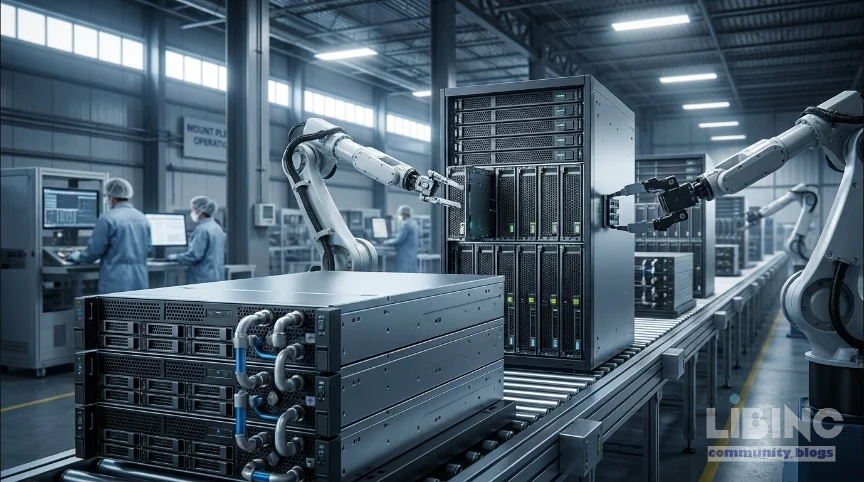
What matters at Foxconn's Mount Pleasant campus isn't the faded LCD-fab myth but a new engine: AI-server integration that anchors U.S. hyperscalers' rack-scale compute. This is the real pivot, not the public narrative about industrial policy risk. The site now runs boards, racks, and cooling loops instead of wafers, and the economics are reframing the Wisconsin project from a flagship factory to a capacity allocator with end-user demand.
The stakes are high: if this pivot holds, Wisconsin exits the decade with a durable EMS-heavy hub rather than a one-off incentive tale. The hidden conflict is that the campus now sits inside a hyperscaler cluster where a handful of customers can move volumes quickly, altering risk profiles and political optics. The direction of this analysis is to map the operational shift, assess the labor and supply-chain consequences, and gauge the policy readjustments required to sustain a durable, AI-driven footprint.
- Analytics view: AI-server integration
- Geographic and competitive contrast
- Causes and consequences
- Expert reconstruction and implications
Analytics view: AI-server integration
The Mount Pleasant site did not spring from a sudden whim; it reflects a long-running reorientation of Foxconn's U.S. footprint. In 2020, the facility began assembling components for Google's data-center servers, establishing a baseline EMS profile built on surface-mount technology, board-level assembly, and the kinds of assembly work that keep data centers humming. That work created a floor-level competence in high-mix, mid-volume production that translates cleanly into rack-scale integration and thermal-management testing once the customer base shifts toward AI infrastructure.
Two lines of evidence explain the late-2024 to 2025 pivot. First, the structure of the partnership with OpenAI announced on November 20, 2025 — co-design and co-development of AI servers, racks, networking, and cooling with no purchase commitments — reframed Foxconn as a design partner with a credible anchor for U.S. capacity. Second, Foxconn’s own 2026 investor briefing, where management guided AI-server shipments to grow more than year over year with cloud and networking products already accounting for roughly half of group revenue in Q1 2026, signals a durable shift from the old LCD narrative to an ongoing product line with visible end-customer demand. This is not a land-grab for a single line; it is a deliberate pivot to an ecosystem that ties EMS capability to hyperscaler needs, with the GB200/Blackwell-era systems as the current anchor. The consequence is a labor and supply chain profile that looks more like rack-scale integration and cooling verification than wafer fabrication.
- Historical baseline: 2017 Wisconn Valley incentives tied to a leading-edge LCD fab.
- 2020 pivot: Mount Pleasant houses surface-mount assembly for Google data-center servers, establishing EMS capabilities.
- 2025 partnership: OpenAI foxconn tie-in emphasizes design and readiness with option-to-buy, not guaranteed purchases.
- 2026 trajectory: AI server-related revenue growth, with Nvidia GB200/Blackwell systems as a driver for rack-scale assembly.
The operational reality is a shift from cleanroom semiconductor emphasis to high-mix EMS capabilities: SMT lines, board-level work, rack integration, liquid-cooling loop verification, and power and networking subassemblies. This is not a trivial rebranding; it changes the core labor profile, supplier mix, and the geographic flow of value. The Wisconsin site now functions as an integrator node within a broader hyperscaler cluster, a role that comes with different risks and different kinds of resilience than a single-plant, wafer-centric dream.
To map the current output, Foxconn’s Mount Pleasant is not the primary origin of all AI-server hardware; much volume still ships from Asia and Mexico. But the site’s contribution to downstream assembly and integration for Nvidia GB200-class racks and related systems is tangible. The current bill of work includes SMT on server boards, rack-scale integration, cooling loop testing, and subassemblies for networking and power. In practice, this means Wisconsin technicians trained in high-mix EMS disciplines become the backbone of a modern AI infrastructure supply chain rather than a semiconductor-plant workforce. The result is a labor-market realignment with implications for local training programs and regional suppliers that can supply the nuanced, fast-changing needs of AI hardware assembly.
Why this matters for the EMS ecosystem
Why does the Mount Pleasant pivot matter beyond Foxconn itself? It establishes a rare Midwest anchor for hyperscaler-backed assembly and integration, a role that previously distributed more across the Southeast or overseas. The operational profile — SMT, rack integration, thermal testing, and power interface work — aligns with the existing Midwest EMS labor pool and supplier network. This reduces the sensitivity to wafer-fab cycles and expands the practical footprint of U.S. AI infrastructure. In short, the site becomes a geostrategic node whose business viability depends on the health of the AI hardware ecosystem and the willingness of hyperscalers to co-locate design and integration activities near demand centers.
Geographic and competitive contrast
The geography of Foxconn’s pivot matters as much as the mechanics of the work. The broader EMS expansion by Tier-1 peers is moving predominantly to the Southeast, where labor costs, utilities, and incentive structures have historically favored greenfield investment. Jabil, Flex, and Celestica have announced or guided sizable data-center-related expansions, but none has yet identified a Midwest anchor on the scale of Mount Pleasant. This divergence is not incidental: the Southeast offers a more forgiving cost curve for large-scale rack manufacturing and a supply base that is closely aligned with AI-dedicated data centers. In contrast, Wisconsin’s labor force, while highly skilled in EMS, is more accustomed to mid- to high-mix assembly rather than the ultra-low-volume, high-precision cleanroom work that some AI server components still demand in certain sub-assembly stages. The result is a bifurcated EMS landscape where a single Midwest anchor coexists with a regionalized Southeast expansion, yielding a logistics and talent map that looks very different from a traditional, evenly distributed national footprint.
- Geographic bifurcation: Midwest anchor vs Southeast corridor expansion.
- Labor-market delta: high-mix EMS vs semiconductor-cleanroom scalpel precision.
- Incentive structures: Wisconsin’s revised commitments vs Southeast state offerings.
For operators and suppliers, this means logistics, labor sourcing, and the broader ecosystem will adapt around a small number of large racks and their cooling, power, and networking subassemblies. The Mount Pleasant cluster creates a rare density of compute, power capacity, and assembly in one place, a configuration that hyperscalers typically assemble across multiple states. The presence of both Microsoft’s data-center expansion and OpenAI’s design partnership intensifies this clustering effect, converting Wisconsin into a rare hub where a local EMS partner is directly adjacent to end-user cloud-scale demand rather than a passive supplier to distant fabs.
Competitive balance and the risk profile
The market signals are clear: the EMS sector is bifurcating, with the Midwest acting as a durable but not universal anchor. The lack of a symmetrical Midwest wave from peers suggests Foxconn’s Wisconsin pivot is more an anchor exception than a replicable model at scale nationwide. The risk profile rises when the campus’s economics depend on a handful of end customers. A sudden shift in hyperscaler demand or a change in OpenAI’s production strategy could reweight Mount Pleasant’s profitability and employment trajectory. Yet the strategic value of a Midwest anchor remains: reduced transit time for AI hardware assembly, a more resilient regional supply network, and a tangible counterweight to offshore or Southeast-centric supply chains.
Causes and consequences
The Mount Pleasant transformation follows a chain of causes that culminate in a new AI hardware assembly ecosystem. The OpenAI partnership, framed as co-design and readiness rather than guaranteed purchases, shifts risk away from Wisconsin’s public incentives and toward a design-led revenue model built on collaboration with hyperscalers. The 2026 revenue guidance, anchored by GB200-class systems and related rack-scale systems, translates into a measurable shift in Foxconn’s business mix toward AI infrastructure. The consequences are immediate for labor, suppliers, and policy: a need for new training pipelines, a different set of suppliers, and a recalibration of government incentives to align with a high-velocity EMS environment rather than a single flagship plant.
- OpenAI partnership creates a design-and-readiness pathway that anchors activity in the U.S. without guaranteeing volumes.
- GB200-class rack systems steer demand toward rack-scale assembly, cooling loops, and power subassemblies.
- State incentives shift from a pure capex push to a performance-driven framework tied to actual job creation and capital investments.
Labor implications are material. The required skill set centers on high-mix EMS operations, not wafer fabrication. SMT operators, rack integrators, and liquid-cooling QA technicians rise in importance, while ultra-cleanroom manufacturing remains a smaller portion of the pie. Wisconsin’s technical colleges and local suppliers must adapt to this new mix, which emphasizes cross-functional assembly, test, and integration competencies rather than pure semiconductor process expertise. The shift also transforms the regional ecosystem: board houses, sheet-metal shops, cooling-component suppliers, and cable assemblers become more central to hyperscaler-ready infrastructure, with Mount Pleasant acting as a densified center for this new economy.
The policy implications are equally consequential. The 2024 contract modification, which formalized 2,616 jobs and $1.2 billion in investment by 2029, is more conservative than the original Wisconn Valley promises. If Foxconn sustains AI-server demand, Wisconsin will likely end up with a large EMS site that is meaningful but not transformative in the same sense as the LCD-era narrative. This reframing reduces political risk from an over-ambitious manufacturing dream to a pragmatic, demand-driven infrastructure role that aligns with the realities of cloud-scale hardware supply chains.
Expert reconstruction and implications
Experts who study industrial policy and supply chains view Mount Pleasant as a case of conditional resilience rather than a universal blueprint. The key takeaway is not a triumph of American manufacturing but a reconfiguration of a regional EMS ecosystem around AI infrastructure. The Mount Pleasant anchor is durable because it aligns with a broader global shift toward localizing AI hardware assembly and integration near demand centers, yet it remains vulnerable to concentration risk if a few end customers drive most of the volume. The reconstruction below consolidates how operators and investors can think about the evolving landscape.
- Operational profile reorientation: from wafer-centric production to high-mix EMS — SMT, rack integration, immersion cooling testing, and subassembly wiring.
- Supply-chain realignment: a Midwest hub draws on a dense regional network of board shops, sheet-metal fabricators, and cooling-component suppliers necessary for credible rack-scale systems.
- Investment implications: the capital cadence shifts from large, single-plant incentives to ongoing capex tied to capacity utilization and end-customer commitments via design partnerships.
- Policy considerations: incentives calibrated to measurable outputs (jobs, capital, regional impact) rather than promises, with an emphasis on workforce retraining for EMS disciplines and data-center readiness.
From an investment perspective, Mount Pleasant is a case of durable, anchor-driven resilience rather than a flashy reshoring wave. The geography matters: the Midwest gains a rare hyperscaler-anchored site that could seed a regional ecosystem, but the concentration risk remains real. The path forward will hinge on continued OpenAI collaboration, sustained Nvidia platforms, and the willingness of Wisconsin and neighboring states to invest in a workforce aligned with AI infrastructure assembly and testing. The larger question for U.S. industry remains how to replicate or complement this model across other regions, ensuring that the network of suppliers and talent is not overly dependent on a single cluster or a handful of customers.
In sum, Foxconn's Mount Pleasant pivot represents a nuanced, technically grounded shift from an industrial-policy shorthand to a real, working AI-server integration hub. It signals a quiet but meaningful realignment of the U.S. EMS landscape, with Wisconsin emerging as a durable node in a hyperscaler ecosystem rather than the site of a failed promised investment. The outcome will unfold through 2026 and 2027 capex and hiring trends, where the true test is whether the local workforce and suppliers can scale in step with the demand signals from design partners and cloud-scale operators.
Closing the workforce and supplier gap for a durable EMS hub
Beyond headlines about partnerships, the real lever for Mount Pleasant is a steady ramp of EMS-specific skills and a tightly knit regional supplier network. A practical plan links workforce retraining to clear career ladders and end-to-end readiness for rack-scale AI infrastructure, ensuring the site can scale without losing quality or resilience.
Table stakes include formal retraining, apprenticeship pipelines, and local supplier development that matches the cadence of AI hardware assembly, cooling verification, and power/subassembly integration. The programs should span: (1) rapid upskilling in high-mix EMS operations; (2) cross-training for SMT, rack assembly, and QA; (3) supplier onboarding with clear performance metrics and lead times.
2,616 jobs by 2029 and $1.2B investment, anchored by EMS disciplines and regional suppliers.
To operationalize this, recommended actions include:
- Partner with Wisconsin technical colleges to create EMS micro-credentials (short, 50–100 hour tracks) aligned to rack-scale needs.
- Launch a 12–18 month supplier development program for board houses, sheet-metal shops, and cooling-component vendors with shared KPIs (quality, lead time, and ramp-rate).
- Implement a staged hiring plan: year 1 focuses on SMT and rack-integrators; year 2 adds QA and testing specialists; year 3 scales cross-functional teams for end-to-end integration.
These steps create a resilient ecosystem that can absorb demand shifts from hyperscalers and mitigate concentration risk by diversifying local capabilities and training paths.
What is driving Foxconn’s Mount Pleasant pivot toward AI-server integration?
Foxconn is shifting from wafer-centric narratives to an EMS-centric model focused on rack-scale AI infrastructure, supported by partnerships with hyperscalers like OpenAI and alignment with Nvidia GB200-class systems. This creates a durable, design-led US footprint anchored in local assembly, cooling, and integration rather than a single capital-intensive fab. This reorientation reduces reliance on any one market cycle and emphasizes co-design with end customers, improving long-term resilience and speed to volume.
Analysts see this as a reconfiguration of the regional EMS ecosystem, balancing risk with a real demand profile from cloud-scale operators and the need for workforce retraining in EMS disciplines.
How does the OpenAI collaboration affect risk and capacity planning?
The OpenAI deal is framed around design and readiness with an option-to-buy, not guaranteed purchases. This lowers upfront capacity risk for Wisconsin while anchoring a credible, end-customer-driven timeline. For planning, it translates into phased capacity expansion, tighter feedback loops with hyperscalers, and a reliance on flexible labor and supplier networks that can scale with demand signals rather than fixed commitments.
Which skills matter most for the new Mount Pleasant model?
Key skills center on high-mix EMS operations: SMT programming and inspection, rack-scale integration, thermal-loop testing, and power- and networking-subassembly assembly. Cross-functional training that blends board-level assembly with systems testing is essential, as is QA for cooling and immersion processes. Local colleges and on-site training should emphasize these competencies to align with AI-infrastructure needs.
What regional advantages does Wisconsin offer compared with the Southeast?
Wisconsin provides proximity to demand centers, a skilled EMS labor pool, and the potential for a dense cluster of compute, power, and cooling assets in one geography. The Southeast offers lower costs and established greenfield incentives, but Mount Pleasant represents a rare Midwest anchor for hyperscaler-backed assembly, potentially reducing transit times and strengthening regional supply chains.
What policy changes would strengthen a durable AI-server ecosystem?
Effective policy would tie incentives to measurable outputs (jobs, capital, regional impact) and support workforce retraining in EMS disciplines. Co-funding of technical education, supplier readiness programs, and incentives that reward multi-tenant, reusable design and testing facilities can help sustain a resilient, local supply chain that serves multiple hyperscaler tenants.
What are the main risks of concentration in a few customers?
The biggest risk is demand concentration: if a few end customers shift strategy, volumes could swing rapidly. Mitigation involves diversified hyperscaler commitments, flexible capacity planning, and a broad supplier base to support multiple product lines. A well-structured retraining program also reduces ramp-down impacts on the regional workforce.




Add a comment
To comment, you need to register and authorize
Comments