

Dendrochronology as a Time Machine: Reading Climate and History from the Mount Smolikas Bosnian Pines
Lead
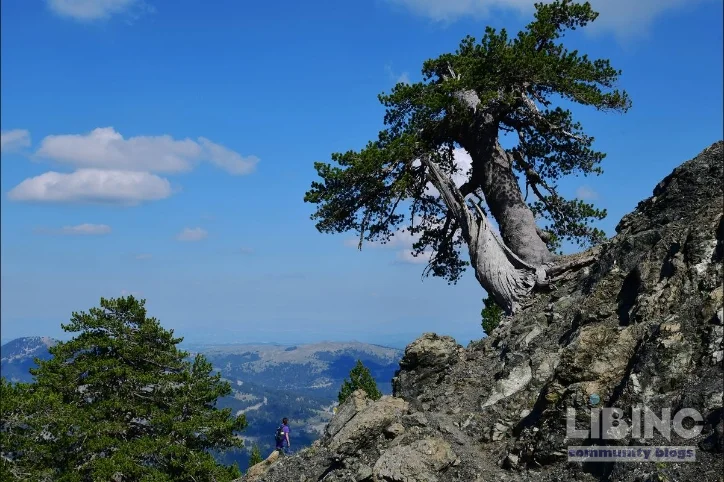
Across Europe an archive sits inside living trees and in the relic trunks of the past. A five‑strong field team—Jan, Paul, Jonas, Claudia, and I—hiked to Mount Smolikas to core Bosnian pines and the sun-bleached remnants that littered the slopes. What began as a quest to determine whether these pines could be centuries old soon unfolded into a broader inquiry: could their rings reveal not only local climate and growth rhythms but also planetary shifts, historical upheavals, and turning points in human history? This is the promise and the problem of dendrochronology: a discipline that reads time as a material record. To read that record, we needed methods, crossdating patterns, and the recognition that a single tree is only part of a wider chronicle that links mountain slopes to distant climate regimes and centuries of human events. The fieldwork was rough, rewarding, and the prologue to a much larger narrative about climate, culture, and continuity.
Through analytics
The Mount Smolikas expedition was as much about data as it was about endurance. The core aim was to transform hollow increments into a living archive that can be read year by year, ring by ring. We used standard field methods to sample living Bosnian pines and to recover cross-sections from dead logs strewn across the landscape. Each sample carries a dual legacy: growth history preserved in ring widths and a tissue-density signal that encodes seasonal conditions. The science rests on crossdating—pattern matching the sequence of wide and narrow rings across multiple trees against a reference chronology anchored by living specimens. When a ring pattern aligns across dozens of samples, the year of formation is established with high confidence. This is how we convert a forest into a calendar, and a hillside into a long-run climate archive.
Key analytic steps include:
- Sampling strategy and safe access on rugged terrain to reach the oldest tissues without harming living trees
- Coring living trunks to the cambium and cutting cross-sections from dead logs for density and growth analysis
- Measuring ring widths and density to extract drought proxies and temperature proxies
- Building and aligning local chronologies with broader regional records to extend dating beyond the living stand
Crossdating is not a single trick but a networked approach. Patterns in a single tree must be corroborated by neighboring trees that grew under the same climatic regime. When we can match a pattern from a dead log in one corner of the range with a living tree on a neighboring slope, we gain confidence in the exact year assignments and in the regional coherence of the climate signal. The result is a layered archive: the local signal recorded in a single Bosnian pine, the regional signal shared across the Pindos, and the hemispheric patterns that reveal larger climatic rhythms. In this sense, dendrochronology doubles as a climate proxy and a connective tissue for understanding past civilizations that felt the wind and weather just as acutely as we do today.
Adonis, the famously old Bosnian pine at the heart of our study, became a focal data point in this analytics framework. Its age is not merely a number; it is a data point that anchors a broader network of chronologies. The tree’s rings reveal drought periods, density changes tied to temperature fluctuations, and, when aligned with other long-lived trees, a regional history of Mediterranean climate variability. The analytical architecture is robust because it integrates multiple signals—growth, density, spatial coherence across trees, and crossdated milestones—into a single, testable narrative about climate and its influence on human activity over many centuries.
Adonis as a data point
Adonis stands not as an isolated curiosity but as a central reference within a continental-scale archive. Its long life spans eras of major cultural and technological change in Europe. The ring-width chronology from Adonis and its Bosnian-pine neighbors provides a continuous drought proxy for the Balkan region and a temperature proxy through wood density. These proxies are not abstract; they correlate with known climate patterns and assist in interpreting social and historical records that accompany the tree’s life. In short, Adonis helps calibrate the climate signal, improve cross-dating across sites, and strengthen inferences about how environmental stressors map onto human histories across the Holocene.
Through contrast
Longevity in trees comes in different flavors. The Bosnian pines on Mount Smolikas endure in a dry, exposed, rocky environment where drought and high‑elevation cooling shape growth. By contrast, the bristlecone pines of California’s White Mountains endure in a more extreme xeric setting, where cold summers and long-standing dryness slow growth and preserve wood against decay. These environmental contrasts are not merely ecological trivia; they imprint distinct signatures in ring patterns and wood density that dendrochronologists learn to interpret. The Smolikas pines speak in a dialect of drought proxy signals for the Balkans, while bristlecones translate prolonged aridity and cold into a different succession of narrow rings and resistant wood. The contrast clarifies how wood encodes climate in a regionally specific language, enabling cross-regional synthesis when we construct a broader hemispheric timeline of climate variability.
- Dry-region trees emphasize drought proxies in ring widths
- Cold-region or high-elevation trees show temperature sensitivity through density and growth suppression
- Cross-regional networks enable calibration of proxies across climates and altitudes
Beyond living trees, we work with remnant wood—snags, fallen logs, and even timber from historic structures or artifacts. The ability to crossdate remnant wood against reference chronologies extends the archive back in time and across space. A beam in a medieval church or an oak panel from a Baroque instrument becomes a time-stamped data point when its rings are placed within a broader network of dated chronologies. The result is a multi-source chronology that enhances the interpretive power of the climate-history record and reveals the human dimension of forest dynamics across centuries.
Neolithic and ancient wood in the landscape
Recent work crosslinks timber from archaeological contexts with modern reference chronologies to date early settlements and wooden structures with year-level precision. A Neolithic lake settlement at Lake Kastoria, dated between 5328 BCE and 5140 BCE, demonstrates how wood can anchor the start of organized agriculture and settlement in a region. The radiocarbon content of individual rings carries signature Miyake events—spikes in atmospheric radiocarbon tied to powerful solar flares—that provide exact year markers within the long sequence. This fusion of dendrochronology and radiocarbon dating is not merely about age; it anchors a broader narrative of technological and social evolution in the region, linking climate forcings to human development with a precision previously unattainable.
In the context of musical instruments, wood from Stradivari violins has recently been traced to high-elevation forests of Val di Fiemme using a network of chronologies. The claim illustrates a broader methodological point: the same ring-pattern logic that clocks centuries of climate and civilization can locate the geographic origin of iconic artifacts. The implications extend to art history, archaeology, and conservation science, where precise dating informs provenance, preservation, and interpretation of cultural heritage as a living part of our environmental record.
Through cause-and-effect relationships
Patterns in wood arise from real causal chains linking climate, forest dynamics, and human activity. The width of a ring captures the annual balance between carbohydrate production and the resources available for growth; density reflects cell-wall formation under seasonal heat and moisture regimes. The Mount Smolikas record demonstrates that dry summers tend to produce narrow rings in Bosnian pines, whereas milder or wetter conditions yield broader rings and denser wood. This relationship is a primary mechanism by which tree rings record climate history long before instrumental records exist. When we compare Mediterranean ring-width series with those from cooler, northern regions, we observe a seesaw in summer temperatures across Europe. The Balkans often experience cooler summers when northern regions trend warmer, and vice versa. The jet stream, a wavy belt of winds at the edge of the atmosphere, mediates this seesaw by shifting heat and moisture patterns across the continent.
Over the past seven centuries, this seesaw has left a recognizable imprint in the tree-ring record. The 1970s and the late 20th century stand out as markers in modern times, but the signal extends much further back. The evidence suggests that the jet stream’s spatial position at the time of growth alters regional temperature and precipitation, which then translates into the ring widths and wood density captured in living trees and remnant wood. By reconstructing yearly summer jet-stream positions from a network of European chronologies, we can infer how atmospheric circulation patterns have shifted through time and how those shifts correlate with historical climate extremes documented in annals and chronicles across Greece, Italy, Ireland, and beyond. In effect, the trees provide a climatological mechanism that connects subcellular signals to hemispheric-scale patterns and to human responses across centuries.
These connections also illuminate how climate extremes influence society. In summers when the jet stream buckles southward, the Balkans endure hotter, drier conditions that drive wildfire risk and harvest variability; in cooler northern summers, northern Europe can face different stressors that alter wine quality and crop timing in the Balkans. The Black Death era, traditionally interpreted through historical chronicles, gains a climate dimension when wood records show cool, wet summers that would have augmented disease transmission and stressed food systems. In this way, climate variability is not a backdrop but an active driver of historical trajectories, and dendrochronology provides the long-run evidence linking environmental stress to societal outcomes.
The broader implication is cautionary: as anthropogenic forcing intensifies, jet-stream-driven extremes may become more erratic. If the pattern observed in the Smolikas network holds regionally, future climate extremes could reflect a more volatile seesaw, complicating agricultural planning, water management, and disaster response. The trees do not forecast a single future; they illuminate potential modes of variability and their likely societal consequences. The message is not determinism but probabilistic insight—an empirical framework to anticipate risk, informed by centuries of wood that witnessed the world’s weather and its revolutions.
Through expert reconstruction
The most powerful payoff of dendrochronology lies in reconstructing historical processes that left marks on both forests and societies. When we assemble a network of chronologies, we can determine not only the year in which a tree was felled but also where the tree grew. The recent work tracing Stradivari’s spruce to high-elevation forests in northern Italy exemplifies how wood acts as a geographic fingerprint. In mountain landscapes, the convergence of climate signals and human activity creates patterns that only a broad, cross-regional network can identify with confidence. The construction of a multi-site climate history depends on the agreement of independent chronologies that, together, sharpen the resolution of the past. The Mount Smolikas dataset anchors the Mediterranean portion of this network and helps calibrate the global archive of Holocene climate change.
Across Europe, an oak-pine chronology now spans nearly 12,500 years without a skipped year. The sheer length of this record is the result of combining living-tree data with sequences from remnant wood, subfossil wood, and archaeological timbers. The method rests on crossdating, a process that confirms the placement of every ring by pattern matching rather than by estimation alone. This approach has two consequences. First, it provides exact dating of each ring even in centuries-old logs. Second, it anchors a large-scale climate history that predates industrialization, enabling us to trace periods of drought, cooling, and warming across the Holocene with remarkable fidelity. The Baum of this method is the realization that trees, in aggregate, teach us how climate has evolved and how societies responded to shifts in weather, water supply, and resource availability.
From an interpretive standpoint, the delta between a local signal and a broader pattern is where real insights emerge. The Mount Smolikas record shows the same climatic pulses that shaped the surrounding region, while aligning with distant chronologies that record analogous patterns. The result is a robust, testable narrative linking subcellular processes to atmospheric dynamics, to historical writings, and to archaeological findings. The narrative does not end with measurement; it culminates in a more nuanced understanding of cause and effect: how climate extremes influence harvests, plague dynamics, migration, and even the rhythms of art and science across centuries. The archives are not finished; they invite new interpretations as more samples are added, more sites are connected, and more historical documents are cross-referenced with tree-ring data. The trees, in this sense, are both witnesses and guides for how we think about climate and civilization.
In the end, dendrochronology offers a clear, testable, and expandable framework for reading the past. The Mount Smolikas expedition demonstrates how a carefully designed field program—rooted in crossdating, density analysis, and multi-site chronologies—can turn a forest into a timeline that stretches back to the dawn of settled life in Europe. It is a reminder that material records preserve not only the weather and the trees’ lives but the social and political dramas that unfold within climate’s arena. The trees will continue to talk; we need only to listen with rigor, skepticism, and a willingness to revise our understanding in light of new, precisely dated data. And as we listen, we must ensure that our present actions create rings worth reading in the centuries to come.
Everything is connected. Reading the past through dendrochronology sharpens our sense of responsibility for the future, because the forest’s voice is the longest record we have of the planetary system we share. Let us give the trees something good to talk about.
Applied clarity: turning climate signals into decisions
Translating the forest archive into actionable insights requires a transparent pipeline from field to policy. The steps are clear, repeatable, and testable: collect samples with care, crossdate across dozens of trees, convert ring signals into drought and temperature proxies, and align local results with regional chronologies to build a robust climate narrative.
| Step | Purpose | Example |
|---|---|---|
| Sampling | Minimize harm while capturing growth signals | Coring living pines; rescuing dead wood |
| Crossdating | Year-level placement across trees | Pattern matching across 50+ samples |
| Proxy extraction | Ring width and density proxies | Drought and warmth indicators |
| Calibration | Link to regional climate records | Comparisons with speleothems |
Crossdating across dozens of trees yields precise year placements, enabling trustworthy regional signals.
These visuals translate complex methods into practical steps for researchers, educators, and heritage managers who need reliable climate context for planning and interpretation.
- Open data sharing and metadata
- Cross-regional calibration for transferability
- Transparent uncertainty framing
- Data sources: living trees, remnant wood, artifacts
- Chronology network: regional alignment
- Validation: independent replication
Practical implications
Managers can use these signals to assess drought risk, farmers can adjust planting windows, and conservators can schedule interventions on wooden heritage objects based on plausible climate expectations.
How can dendrochronology reveal climate history?
Dendrochronology uses tree rings to infer past climate by tracking growth responses to temperature and moisture. Each ring encodes a year, with width reflecting moisture availability and density capturing seasonal warmth. By correlating patterns across many trees and anchoring them to regional climate records, scientists build proxies for drought, temperature, and precipitation that extend well before instrumental data exist.
This multi-tree, multi-site approach creates a reliable historical climate narrative that can be cross-checked with ice cores, lake sediments, and historical chronicles to understand regional variability and extreme events.
What is crossdating and why is it crucial?
Crossdating is pattern matching across multiple trees to assign exact calendar years to rings. It reduces dating errors, verifies local signals, and builds a coherent regional archive. Without crossdating, ring-width chronologies drift in time, weakening climate reconstructions and any historical correlations that depend on precise dating.
In practice, crossdating multiplies the confidence in the timeline and enables transfer of climate signals between sites and species that share similar growth responses.
What proxies arise from tree rings?
Two primary proxies are ring width and density: width tracks moisture and drought stress, density reflects growing-season temperature and moisture balance. Additional signals include latewood patterns and radial growth trends that help separate temperature-driven from precipitation-driven influences. When combined across sites, these proxies reveal regional climate modes and their impact on agriculture, water resources, and ecosystems.
Cross-site calibration strengthens interpretation and allows comparisons with other climate proxies to build a fuller Holocene picture.
How do remnant woods extend the archive?
Remnant wood from snags, fallen trunks, and archaeological timbers extends dating beyond living stands. These samples unlock earlier periods and fill spatial gaps, provided they can be crossdated against modern chronologies. This expansion enhances temporal coverage and improves regional continuity in climate reconstructions.
Remnant wood thus acts as a bridge between past and present climate contexts, enabling longer, more connected narratives of how climate influenced cultures and landscapes.
How robust are these datings for long records?
Dating reliability grows with sample size, replication across sites, and the inclusion of multiple proxies. Networks spanning centuries to millennia can achieve year-level precision when multiple trees display concordant patterns. Uncertainty is quantified and communicated, allowing users to weight results in policy or conservation planning.
Robust crossregional networks also help identify outliers or local disturbances, refining the climate interpretation rather than overstating certainty.
How can these findings inform policy and risk planning?
Translating climate signals into actionable proxies supports drought preparedness, water management, agricultural timing, and preservation strategies for cultural heritage. By presenting transparent uncertainty and linking signals to concrete decision contexts, dendrochronology informs risk assessment, adaptation planning, and public communication about climate variability.
Ultimately, these insights help align scientific understanding with practical resilience across sectors.






Add a comment
To comment, you need to register and authorize
Comments