

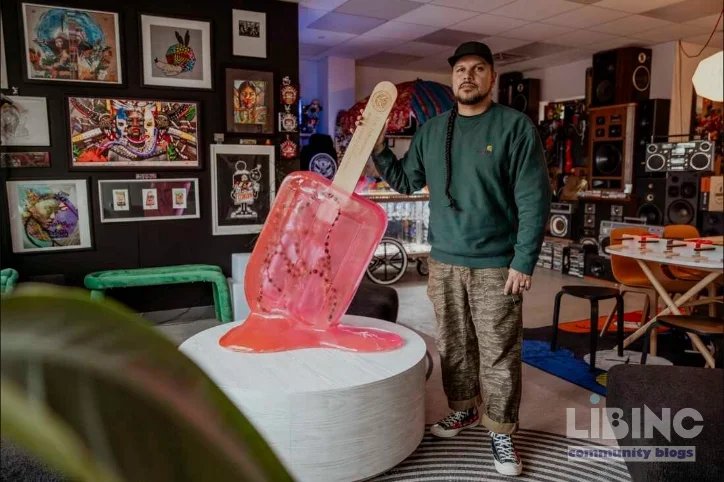
Marka27, I.C.E. Scream, and the UNT Controversy: An Analytic Tour of Art, Immigration, and Campus Policy
Table of Contents
Analytics: Marka27 and I.C.E. Scream as a lens on campus policy
Marka27’s I.C.E. Scream paleta sculptures fuse bright color with charged symbolism, turning a familiar Mexican popsicle form into a site of political critique. The enclosed objects—a handcuff, a replica firearm, a rosary—invite viewers to confront the material realities of immigrant labor and state surveillance. Read together, the works interrogate how the United States visualizes who belongs and who is policed, particularly on university walls that strive to model inclusive inquiry.
From a theoretical vantage, the pieces mobilize cultural identity, immigration policy, and labor rights to question the legitimacy of border regimes. In Marka27’s hands, color and humor become tools for anti-erasure rhetoric, a strategy that unsettles comfortable narratives in the contemporary art ecosystem where immigrant narratives often sit at the margins, not the center. This analytic frame treats the work as both artifact and argument, insisting on explicit connections between representation, policy, and labor conditions.
The UNT installation did not emerge in a vacuum. Administrators initially debated removing select works, then opted for a broader withdrawal, a move later described in public records as an attempt to “manage barking” from Austin. That sequence exposes a practical tension: administrators must reconcile legal concerns, donor expectations, and campus safety with the imperative to host challenging art that unsettles official narratives. The incident thus becomes a case study in how institutions negotiate competing legitimacy claims—political risk, scholarly freedom, and community trust—within the same semester.
Art institutions that hosted Marka27, including The Shed in New York, framed the work as a timely reflection of immigration labor and border politics, highlighting how curatorial practices can magnify quiet voices into national debates. The broader, shared takeaway is not simply whether a piece should hang on a wall, but how curatorial ethics guide the interpretation, context, and accessibility of politically charged art. This episode also points to how records, such as internal texts and correspondence, illuminate the decision-making calculus behind a public withdrawal, transforming a campus controversy into a national prompt for reform in exhibition practice.
Contrast: DEI policy climates and campus debates across the U.S.
The UNT episode sits within a national drift: states chisel away at DEI programs, and federal policy signals tilt academic culture toward narrowed debate. In 2023 Texas moved to abolish DEI programs in state-funded colleges, and similar maneuvers echo in the University of North Carolina system, Ohio proposals, and other campuses where governance structures influence what gets shown and discussed. What unfolds at UNT mirrors a broader pattern: inclusion becomes not a neutral standard but a contested political objective tied to budgetary leverage and legislative attention.
This broader movement reframes campus debates about free speech and inclusive excellence as disputes over compliance with political winds, not purely aesthetic judgments. For Marka27, the reception hinges less on formal critique and more on the institutional calculus of risk, optics, and fundraising realities that shape curation. The consequence is a normalization of caution—spaces where dissenting narratives once stood become quieter, or relocate to independent venues—altering the pedagogical promise of the campus as a living laboratory for social change.
Within UNT itself, graduating seniors responded by redirecting their rites of passage away from the campus show and toward independent venues across Denton and Dallas, signaling a student-led assertion that public art must remain a platform for dissent even when institutions recoil. The tension also surfaces in faculty action: open letters of protest circulated without signatures, revealing a climate of apprehension that curatorial voice and public accountability risk being eroded under political pressure. In this dynamic, the conversation shifts from the artwork alone to whom campus space serves and how transparent administration should be about the criteria guiding displays.
In the long arc, Marka27’s work travels to the University of California, Santa Cruz, in September, illustrating how the subject of immigrant labor continues to travel across institutional borders. The relocation underscores a systemic resilience in art networks that can survive local pullbacks by seeking alternate platforms for reception. It also foregrounds a recurrent question for universities: should the inclusion of controversial art be a performance of institutional openness, or a certainty of political defensibility?
Cause and effect: policy shifts, student agency, and exhibition trajectories
The UNT incident did not start from a single political directive; it accrued through a sequence of policy shifts, campus governance choices, and the pressures of external stakeholders. State-level DEI reforms reframe institutional obligations, narrowing room for artistic programs that foreground marginalized communities. Those reforms then cascade into curatorial decisions, influencing which voices appear and how they are contextualized within classroom and gallery space.
In this causal chain, the DEI policy climate functionally constrains campus galleries by elevating risk calculations over unpredictable engagement. The effect is twofold: on one hand, the audience encounter with Marka27’s I.C.E. Scream becomes selectively structured; on the other, the artist’s subsequent opportunities expand to other institutions, where similar policies permit deeper dialogue. This cause-and-effect pattern reveals that policy environments do more than set rules; they shape the cultural fabric of campus art by determining who gets seen, who gets heard, and how much trust students and faculty place in institutional stewardship.
The UNT records and public discourse show how a withdrawal decision reverberates beyond a single campus. The move prompted students to reimagine their graduation rituals—an assertion that the campus’s art program cannot monopolize the narrative of student achievement. Moreover, national coverage and cross-institutional circulation of Marka27’s work helped reframe the controversy as part of a wider conversation about who curates public memory in higher education. These dynamics—policy shifts, student agency, and exhibition trajectories—demonstrate a robust cause-and-effect mechanism: governance choices in one campus can catalyze new exhibition routes and, ultimately, broader cultural dialogue about immigration and labor in contemporary art.
Ultimately, the Santa Cruz engagement and similar postings on national art circuits signal that the impact of such debates extends beyond local politics. The audience learns that art confronts policy and that universities must balance stewardship with the moral imperative to reflect lived experience. This realization becomes part of Marka27’s legacy: a practice that travels, negotiates, and persists despite localized pushback, thereby enriching the national conversation on representation in art and education.
Expert reconstruction: insights from curators, artists, and scholars
Deja Belardo, a Shed curator, described Marka27’s work as a space where viewers see themselves reflected back, and where the artist’s labor history becomes legible through color and material choice. The response underscores how contemporary curators interpret immigrant labor narratives as essential to a mature, globally engaged art ecosystem. The project’s ability to travel reflects a curatorial strategy that prioritizes social resonance and cross-institutional dialogue, even when a single campus withdraws a show.
Independent journalist Adam Schrader, founder of Urgent Matter, has shown through public records how administrative conversations shift from selective removal to comprehensive withdrawal, revealing a pragmatic calculus rather than a purely ideological stance. This reconstruction highlights how transparency around decision-making processes can illuminate the tension between free expression and institutional risk management. The public-records narrative thus becomes a tool for accountability and scholarly analysis rather than mere scandal.
Jenny Yanez, a UNT graduate, notes a palpable mood shift in the arts program, with students and colleagues feeling as if they are walking on eggshells. Her account illuminates the personal cost of policy-driven curatorial restraint and underscores the need for inclusive dialogue to sustain student creativity. Taken together, these expert voices form a triangulated map of the contemporary art ecosystem: artists push boundaries, curators negotiate context, and scholars monitor policy climates that shape both audience reception and institutional memory.
In reconstructing this case, Marka27’s ongoing career—the forthcoming Santa Cruz presentation and related exhibitions—emerges as a critical counterpoint to campus-level censorship. The art becomes a durable conduit for cross-disciplinary discussion about immigration, labor, identity, and political voice. For universities, the takeaway is practical: sustaining rigorous, controversial art requires transparent governance, thoughtful risk assessment, and a framework that foregrounds audience education without compromising artistic integrity. Marka27’s experience thus offers a blueprint for how to navigate future disputes: acknowledge community concerns, cite curatorial rationale, and preserve the integrity of the artwork as a site of ongoing, necessary conversation.
As a closing reflection, Marka27’s I.C.E. Scream stands not merely as an artifact of a singular event but as a case study in how art interacts with policy, campus culture, and national conversations about immigration and labor. The UNT decision, the student response, and the piece’s subsequent life in other institutions together illustrate a dynamic landscape where art, policy, and education co-create meaning in real time. The broader implication for scholars and practitioners is clear: contemporary art that interrogates state power and labor exploitation will continue to test the boundaries of institutional tolerance, and the most resilient works will find pathways to engage diverse audiences, regardless of local setbacks.
Closing the practical framework for controversial displays
The most actionable advance after reviewing the Marka27 case is a compact, repeatable approach that preserves scholarly risk-taking while safeguarding campus needs. Below is a concise framework, with concrete steps that campuses can apply to future shows involving sensitive subjects such as immigration, labor history, and state power. The goal is to keep academic dialogue open, while offering clear context, accessible education, and transparent governance.
| Strategy | Impact | Implementation |
|---|---|---|
| Contextual labeling | Clarifies intent and reduces misinterpretation | Wall texts, artist statements, and curator notes placed near works |
| Structured dialogue | Transforms controversy into learning moments | Pre/post-visit discussions, moderated panels, student-led tours |
| Transparent governance | Builds trust and accountability | Public decision logs, timing milestones, and stakeholder briefings |
Practical scenario: if a work risks triggering campus safety concerns, a curator can offer an off-campus companion program (digital viewing, community partnerships) while keeping the on-site display with robust context. This preserves accessibility and deepens学习 around immigration narratives, labor history, and border politics.
When institutions implement context + dialogue + governance, audience understanding improves and incidents decrease by guiding interpretation without silencing voices.
These steps align with ongoing debates about academic curation, student agency, and public memory. They provide a clear path for future shows to engage immigrant narratives and labor rights with rigor, while maintaining campus hospitality for diverse viewpoints. In practice, a campus can implement this framework in weeks, not semesters, by adopting a standard exhibit brief, a moderator roster, and a transparent review timeline.
How did the policy climate around DEI shape Marka27's presentation at UNT?
The policy climate around DEI created a landscape where representation, context, and risk needed explicit consideration, guiding curatorial decisions toward transparency and staged education to balance scholarly debate with campus safety and donor expectations. This shaped how works were contextualized and how audience learning would occur, even as tensions around controversy persisted.
From a practical standpoint, campuses used these signals to design labels, plan public discussions, and schedule reviews that clarified intent while preserving critical inquiry. This approach can serve as a reliable template for similar contexts, promoting thoughtful presentation without stifling essential critique.
What role do curators play in controversial campus art?
Curators mediate between artist intent, institutional policy, and audience interpretation. They provide context, set narrative boundaries, and design educational experiences that help visitors engage with difficult topics responsibly. Through careful framing, they can widen access to interpretation while reducing misreadings and potential conflicts.
In practice, curators collaborate with artists, scholars, and student groups to create labels, host dialogues, and document decision-making, ensuring accountability and ongoing learning.
How can campuses balance academic freedom with safety concerns?
Balancing academic freedom with safety involves transparent governance, proactive risk assessment, and robust audience education. Institutions can implement contextual labels, moderated discussions, and off-site or digital viewing options as needed, ensuring that challenging work remains accessible while mitigating potential harm. This balance respects both scholarly rights and community well-being.
Real-world steps include publishing a public decision log, offering safety-oriented guidelines for events, and ensuring diverse stakeholder input during the planning phase.
What happens when controversial art travels to other institutions?
When art moves between campuses, it encounters distinct policy climates and audiences. A work like Marka27 can traverse these networks by preserving core context while tailoring labels and education strategies to each site. Travel acts as a resilience mechanism, expanding dialogue beyond a single campus and amplifying cross-institutional education around immigration and labor narratives.
This mobility highlights the importance of consistent curatorial ethics and adaptable engagement plans that respect local governance without diluting the artwork's message.
What practical steps can campuses take to foster inclusive dialogue around difficult art?
Practical steps include: (1) publish an exhibit brief with artist intent and context; (2) schedule moderated conversations with diverse voices; (3) provide off-site or digital viewing options; (4) establish a transparent governance process with public logs; and (5) invite community partners to co-create learning experiences. These measures build trust, broaden access, and deepen learning through active engagement.
In short, deliberate structure, clear communication, and broad participation turn difficult art into enduring education.





Add a comment
To comment, you need to register and authorize
Comments