

IHC-based biomarker testing in NSCLC: analytics-led biomarker profiling for reflex molecular testing
- Through analytics
- Through contrast
- Through cause-and-effect relationships
- Through expert reconstruction
IHC-based biomarker testing in NSCLC stands at the intersection of speed, accuracy, and equitable access to precision medicine. As NSCLC grows more genetically complex, upfront IHC profiling can triage patients toward reflex molecular testing and targeted therapy. This article analyzes how an immunohistochemistry (IHC) panel, aligned with international guidelines, identifies actionable drivers while streamlining diagnostic workflows. The stakes are high: delays in characterization risk missed therapeutic windows and suboptimal outcomes, especially as rare targets proliferate. Our analysis proceeds by dissecting performance signals, contrasting biomarker patterns, and translating expert insights into practice-ready recommendations.
Table of contents
Through analytics
Analytical assessment shows high concordance of IHC with molecular results for certain targets, establishing reliability as a frontline screen. When benchmarked against NGS panels, the IHC readouts for HER2, cMET, and EGFR track closely with corresponding molecular findings, supporting reflex workflows rather than wholesale replacement. Strong protein overexpression in HER2, for example, contrasts with variable or focal patterns for other targets, guiding decisions about subsequent testing steps. This analytic signal underpins a practical pathway: use IHC to triage and reserve NGS or FISH testing for confirming ambiguous or discordant cases.
- High concordance for HER2, cMET, EGFR with molecular data
- Faster triage reduces time-to-treatment in eligible patients
- Selective sequencing avoids unnecessary costs and delays
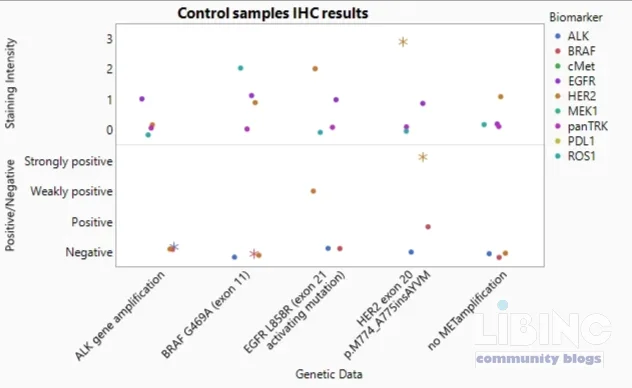
In addition, the scatter plot matrix and related visualization reveal co-occurrence patterns that imply networked signaling relationships rather than isolated events. When cross-referenced with NGS panels, the strongest correlation emerges between cMET and MEK1, with roughly one-third of samples showing concurrent expression, suggesting possible pathway crosstalk or shared regulatory control. A notable overlap between cMet and HER2 further hints at a subset of NSCLC tumors driven by convergent alterations. Across 30 control and unknown samples, the data converge with published NSCLC prevalence, reinforcing IHC as a rapid upfront stratification tool before reflex molecular testing.
This analytics layer demonstrates that IHC can provide a quantitative map of biomarker landscapes, enabling a data-informed prioritization of downstream assays. By coupling staining intensity with known prevalence, pathologists can estimate the likelihood of actionable alterations and design reflex plans accordingly. The result is a more efficient diagnostic ladder that preserves sensitivity for common drivers while still accommodating the breadth of rare targets.
Through contrast
Contrast reveals how IHC-based stratification compares to full reliance on comprehensive NGS panels alone. While NGS provides a dense, multiplex readout, it lags behind in turnaround time and access, creating a bottleneck in first-line decision-making. In practical terms, IHC offers a fast screen that flags high-probability biomarker cases and flags where reflex testing should be intensified or adjusted. However, this approach risks missing rare or atypical alterations if not paired with confirmatory assays and guideline-driven reflex testing protocols.
- NGS panels deliver breadth but with slower turnaround
- IHC accelerates initial stratification and triage
- Guided reflex testing mitigates gaps for rare alterations
Another contrast emerges in the interpretation challenges of rare targets. Pan-TRK, BRAF, ALK, and ROS1 exhibit extremely low staining, complicating interpretation and potentially inflating false negatives if interpreted in isolation. Such limitations underscore the need for structured reflex pathways: pathologists begin with IHC reads that guide targeted reflex testing via FISH/NGS panels, and the final decision aligns with international guidelines. The overall strategy remains advantageous when routine NGS is unavailable, as upfront IHC can triage patients toward appropriate downstream testing and trial enrollment.
From a practical perspective, centers with limited access to rapid sequencing can still achieve meaningful stratification, provided they implement standardized reporting and well-defined reflex thresholds. The balance point lies in maximizing actionable yield while avoiding over-interpretation of weak or focal staining patterns. In this sense, IHC serves as a decision amplifier rather than a substitute for molecular validation when clinical-grade actionability hinges on precise mutations.
Through cause-and-effect relationships
Understanding co-occurrence in IHC results provides causal clues about tumor biology. The observed association between cMet and MEK1 expression may reflect shared activation of parallel signaling routes that converge on cell survival and proliferation, implying that simultaneous targeting of MET and MEK pathways could translate into clinical synergy in a biomarker-selected subset. By extension, the cMet-HER2 co-occurrence hints at a networked alteration landscape, where single-target therapy might fail due to compensatory signaling. These patterns argue for integrated diagnostic agendas that couple IHC matrices with reflex FISH/NGS panels to confirm functional relevance and guide combination strategies.
In addition, the differential prevalence of ALK, BRAF, and PD-L1 across samples—aligning with known epidemiology—illustrates how local prevalence affects decision-making. If the goal is timely therapy, clinics can leverage IHC positivity rates to prioritize subsequent molecular testing, balancing the risk of false positives against the cost and delay of NGS panels. This cause-and-effect framework clarifies why reflex testing is not a luxury but a necessary strategy to translate biomarker signals into actionable treatment choices.
- Co-occurrence suggests potential combination strategies
- Prevalence-informed triage optimizes resource use
- Reflex testing closes the loop between protein signals and mutations
Through expert reconstruction
Expert reconstruction translates data into clinical pathways. Experienced pathologists synthesize IHC patterns with clinical constraints, guideline recommendations, and trial eligibility, producing pragmatic workflows that maximize patient access to targeted therapy and trial enrollment. The practical takeaway is that IHC should be viewed as a robust screening modality rather than a solitary diagnostic endpoint, particularly in centers where rapid NGS deployment remains uncertain. Implementing structured reflex algorithms reduces turnaround times, harmonizes reporting, and aligns pathology practice with CAP, IASLC, AMP, ASCO, NCCN, and Canadian consensus guidelines.
From an operational perspective, laboratories can design IHC-based panels that deliver high-yield results without sacrificing specificity. Tailoring antibody panels to the most prevalent actionable targets—HER2, cMET, EGFR—while maintaining an explicit plan for rare biomarkers ensures that patients receive timely therapy selection without unnecessary detours. Finally, the integration of IHC results with reflex FISH/NGS panels allows clinicians to map treatment trajectories to biomarker patterns, informing clinical trial enrollment and real-world outcomes.
- Practical integration of IHC with molecular reflex testing
- Strategic panel design targets prevalent drivers while accommodating rarity
- Workflow harmonization improves trial access and real-world results
The practical takeaway: IHC-based biomarker testing in NSCLC enables rapid upfront stratification, guiding reflex molecular testing and aligning patient care with NGS panels when available. Implemented thoughtfully, this approach balances diagnostic speed with therapeutic precision, reducing delays and improving outcomes across diverse clinical settings.
In sum, IHC-based biomarker testing in NSCLC offers a robust, scalable pathway to precision medicine. It acts as an essential screening layer that informs downstream molecular testing, optimizes resource use, and supports timely therapeutic decisions. The integration of IHC with reflex molecular assays should be standard practice in modern NSCLC care, enabling broad access to targeted therapies and clinical trials while preserving the integrity of molecular confirmation where it matters most.
The practical takeaway: IHC-based biomarker testing in NSCLC enables rapid upfront stratification, guiding reflex molecular testing and aligning patient care with NGS panels when available. Implemented thoughtfully, this approach balances diagnostic speed with therapeutic precision, reducing delays and improving outcomes across diverse clinical settings.
Practical reflex thresholds for frontline NSCLC testing
To translate IHC signals into concrete care actions, implement a clearly defined reflex pathway that prioritizes rapid, guideline-aligned molecular confirmation while preserving testing breadth for rare targets. The core panel should include HER2, cMET, EGFR, ALK, ROS1, and PD-L1, with explicit cutoffs and next-step actions to minimize delays and maximize actionable yield. For example, HER2 3+ strong membranous staining should trigger reflex confirmation by FISH or NGS within 7 days; HER2 2+ equivocal warrants confirmatory testing; ALK/ROS1 positivity on IHC should proceed to confirmatory rearrangement testing; EGFR scenarios should move to activating mutation assessment by NGS. PD-L1 informs immunotherapy decisions but does not replace mutation testing. Turnaround targets: IHC readouts in 1-2 days, reflex sequencing in 7-12 days, with expedited lanes for high-probability cases.
Illustrative workflow examples help teams implement this approach: a) rapid triage of strong HER2 signals toward targeted therapy confirmation; b) equivocal HER2 results escalated to FISH; c) suspected MET-driven disease prioritized for MET-focused sequencing; d) ALK or ROS1 rearrangements confirmed by FISH and followed by therapy eligibility checks.
| Biomarker | IHC Result | Reflex Test | Indication for Reflex | Turnaround (days) | Notes |
|---|---|---|---|---|---|
| HER2 | 3+ strong | FISH or NGS | Amplification suspected | 7-10 | High concordance with molecular data |
| HER2 | 2+ equivocal | FISH or NGS | Equivocal pattern | 10-14 | Clarify with confirmatory testing |
| EGFR | Strong or suspected pattern | NGS for activating mutations | Mutation confirmation | 7-12 | IHC alone not predictive; use as screen |
| ALK | Positive | FISH or NGS | Rearrangement confirmation | 7-14 | Proceed to targeted therapy if positive |
| ROS1 | Positive | FISH or NGS | Rearrangement confirmation | 7-14 | Guides ROS1 inhibitor therapy |
| cMET | 2+/3+ | NGS or FISH | MET alteration confirmation | 7-12 | MET exon 14 skipping or amplification focus |
Across cohorts, co-expression patterns (for example, cMET with MEK1) surfaced in about one third of samples, suggesting potential combination strategies. The overlap of cMET with HER2 indicates a convergent driver theme in a subset. These signals support directing reflex testing toward the most predictive panels and reserving full sequencing for discordant or ambiguous cases, thus preserving speed without sacrificing accuracy.
Reflex algorithm at a glance
- Core panel: HER2, cMET, EGFR, ALK, ROS1, PD-L1
- 3+ HER2 or strong cMET: reflex to FISH/NGS within 7 days
- 2+ HER2 equivocal: FISH confirmation; if negative, proceed to alternative targets
- ALK/ROS1 IHC positive: confirm with FISH/NGS and start therapy consideration
- EGFR patterns: confirm activating mutation with NGS
How does an IHC-based triage approach impact time-to-treatment in NSCLC?
An IHC-based triage approach accelerates initial decision making by rapidly screening tumor samples for protein expression patterns that correlate with actionable genetic alterations, thereby enabling clinicians to prioritize reflex molecular testing, shorten the time from biopsy to therapy, reduce sequencing backlog, conserve resources in high-volume centers, and maintain guideline-concordant pathways even when rapid NGS is not universally accessible, all while preserving diagnostic accuracy through clearly defined thresholds and quality controls that ensure the most informative results drive treatment choices. This upfront screen keeps patients moving through the care ladder faster, especially in settings where sequencing capacity is limited or results are delayed, and supports timely initiation of targeted regimens when clinical actionability is clear.
In depth, the approach aligns lab workflows with pragmatic decision points, enabling parallel testing streams that minimize bottlenecks and preserve access to trials for eligible patients.
Which biomarkers are most reliable for IHC triage in NSCLC?
Strong, well-characterized protein overexpression signals for HER2, cMET, and ALK show the strongest concordance with downstream molecular findings in many cohorts, making them reliable anchors for reflex pathways; EGFR, ROS1, and emerging targets benefit from upfront IHC to guide targeted sequencing rather than stand-alone decisions, while PD-L1 status informs immunotherapy considerations without substituting for mutation-driven therapies. The reliability of each marker depends on standardized staining, validated scoring, and pathway-specific guidelines.
How should equivocal IHC results be handled in a reflex testing strategy?
Equivocal results prompt a predefined reflex to confirmatory testing, typically FISH or NGS, within a tight turnaround window (often 7–14 days). This ensures that ambiguous protein signals do not delay the identification of actionable alterations while preserving the speed advantages of initial IHC screening. Clear criteria for escalation reduce subjectivity and improve reproducibility across centers.
What are the risks of relying on IHC alone for biomarker decisions?
Relying solely on IHC can miss rare or mutation-specific alterations that do not translate directly into protein expression patterns, leading to under-detection of actionable targets. A structured reflex pathway, combining IHC screening with confirmatory molecular tests, mitigates this risk by ensuring that all patients eventually receive comprehensive profiling when indicated by initial signals.
How can labs implement standardized reflex pathways with limited NGS access?
Labs can implement standardized panels and a tiered reflex plan that prioritizes high-probability targets for rapid molecular confirmation, followed by broader sequencing when access allows. This involves agreed thresholds, uniform reporting templates, and clear communication with clinicians to preserve treatment timelines and trial opportunities even when full NGS capacity is constrained.
How does local biomarker prevalence influence testing pathways?
Local prevalence informs prioritization decisions: in regions with higher rates of certain alterations, reflex steps can be streamlined to rapidly confirm those drivers, while in areas with diverse or rare targets, the reflex plan emphasizes early comprehensive testing or enrollment in trials. This approach balances speed, accuracy, and resource utilization in real-world practice.




Add a comment
To comment, you need to register and authorize
Comments