

El Último Sueño de Frida y Diego: A Critical Analysis of the Met Opera Dream-Driven Reframing of Kahlo and Rivera
Table of Contents
- 1. Analytics-driven Reframing
- 2. Contrast as Structural Engine
- 3. Cause and Effect: From Libretto to Stage
- 4. Expert Reconstruction: What the Opera Reveals About Contemporary Opera
El Último Sueño de Frida y Diego at the Metropolitan Opera reopens a century of fascination with Frida Kahlo and Diego Rivera, but it does so not as a biopic but as a dream-logic drama. This is a deliberate shift: the work treats biography as a canvas for symbolic inquiry, using mythic frame and choreographic language to interrogate pain, memory, and artistic legacy. The question at the center is not simply who these artists were, but how their lives translate into a living, breathing stage experience that can illuminate modern audiences without surrendering historical nuance.
To understand the Met production, we must probe how the piece negotiates its own stakes. The opera as a form carries an expectation of immediacy and emotional immediacy; here, Frank and librettist Nilo Cruz repurpose the Orpheus myth, reversing the classical arc to ask what it means when the dead insist on memory rather than return. The risk is not merely misrepresenting Kahlo and Rivera; it is risking a kind of ethical aesthetic, where the dream-logic of the stage might overshadow documented life. The analysis that follows deploys four lenses to reveal both the depth and the limitations of this approach, while keeping the central question in view: can a modern opera responsibly reframe iconic painters beyond reductive biopic tropes?
1. Analytics-driven Reframing: The Dream as Structural Engine
Conventional operatic biography often invites direct narrative translation from life to stage. El Último Sueño de Frida y Diego refuses that path. Instead, it uses dream-logic, the Day of the Dead motif, and a reverse Orpheus premise to produce a dramaturgy where memory, not chronology, drives perception. This choice is not ornamental; it reorganizes cause and effect so that emotional truth outranks linear truth, and aesthetic symbolism outruns documentary accuracy. The result is a work that demands audience interpretation rather than passive reception.
From a structural standpoint, the opera hinges on two engines: the underworld return mechanism and the desiderata of creative survival. The underworld is not a mere setting; it is the battlefield where pain, art, and desire compete for narrative priority. The marimba’s sonic imprint, the death-masked chorus, and the stylized movement language work together to convert personal trauma into an epic, almost ritualized process of remembering. This analytic frame clarifies why the production names itself as a dream rather than a documentary: the dream is a more faithful medium for capturing the intensities that shaped Kahlo and Rivera’s art and lives.
Why does this matter for art-historical discourse? Because the dream frame foregrounds affect over annotation, memory over archive. It reframes Kahlo’s iconic imagery—the floral crown, the color-saturated world, the bodily pain—as a living grammar of expression rather than static symbols. In that sense, the opera contributes to a broader trend in visual culture: modern art’s survivability depends on its capacity to be reinterpreted within new sensibilities. The work’s success, therefore, rests on translating complex intertextual references into coherent stage cues that still reward repeated listening and viewing. The analytic payoff is not a single verdict but a nuanced re-reading of what Kahlo and Rivera’s legacies can imply for contemporary performance practice.
Another analytic layer concerns linguistic choice. The opera is sung entirely in Spanish, a choice with both practical and symbolic implications. It preserves language-specific color, rhythm, and metaphor, while inviting non-Spanish-speaking audiences to experience how cadence and intonation carry cultural memory. This decision challenges a common theatrical impulse to domesticate international works for English-speaking audiences. Instead, it positions the Met as a node in a transnational network where language itself becomes an interpretive tool, shaping how the audience perceives the emotional intensity of each line. The linguistic choice also complicates the biographical impulse: in Spanish, the poetry of Kahlo’s and Rivera’s dialogue—whether private or public—retains a density that English-language adaptations might dilute through translation.
From the perspective of musicology, the orchestration choices deserve particular attention. Frank’s scoring integrates a nontraditional palette—marimba, layered percussion, and extended coloristic textures—to evoke a Mexican- and Andean-tinged sonic environment. The orchestral color becomes a protagonist, guiding mood shifts with a sophistication that mirrors Kahlo and Rivera’s own painterly approach to color. This alignment of musical color with visual symbolism reinforces the analytic argument that the dream-logic approach is not decorative but functionally integrated into the dramaturgy. The score thus acts as a second lens on the same question: how do sound and image converge to produce a credible, imaginative biography that remains loyal to memory rather than to a factual ledger?
In short, the analytics block demonstrates that the Met production deploys a disciplined dream-logic rather than accident or novelty. Its structural innovations—reverse Orpheus, underworld chorus, surrealist imagery translated into movement—are not gimmicks but essential tools for rethinking historical biographies. The risk, of course, is that such a frame might elide disputed historical facts. Yet the artistic payoff lies in revealing new cognitive angles on pain, creativity, and the meaning of being famous in the 20th century. This analytical framing will recur in later sections as we compare the work to its historical and cultural precursors.
To summarize this analytic strand: the dream narrative is the form’s most potent instrument for reconfiguring Kahlo and Rivera’s legacy, turning biographic detail into a symphony of memory where the living and the dead negotiate meaning through artistry rather than chronology.
Key terms and concepts in this section
- Dream-logic dramaturgy
- Underworld as narrative arena
- Coloristic orchestration
- Nonlinear biographical reading
- Spanish-language opera as interpretive medium
2. Contrast as Structural Engine: Pop Icon vs. Personal Turmoil
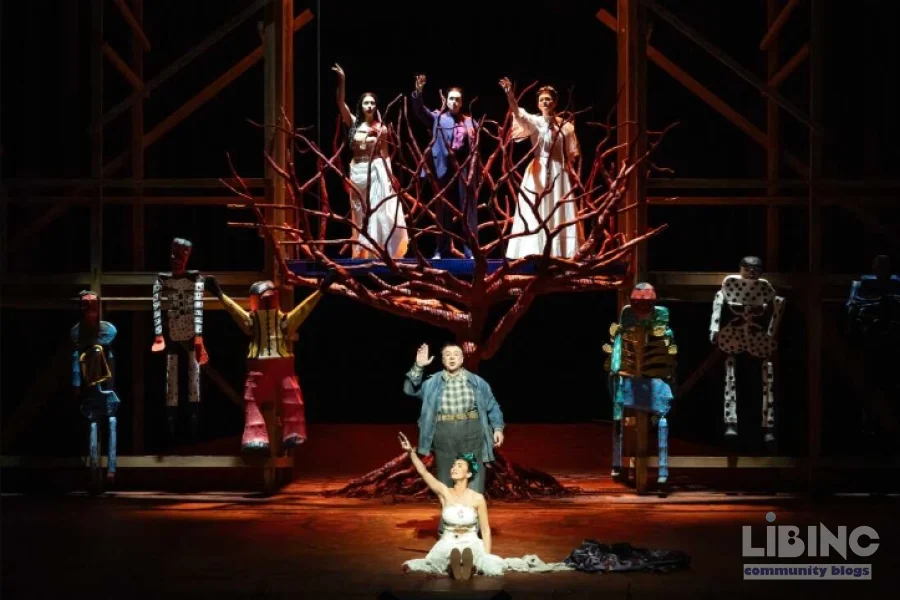
The portrayal of Kahlo and Rivera in popular culture has often pitted iconography against interior life: the flower-adorned image versus the raw, sometimes brutal, emotional terrain. In the Met production, contrast is not simply a matter of juxtaposing public image with private pain; it is a formal engine that generates tension across scenes, voices, and stage directions. The opera’s staging materials—skeletons that move with hip-hop energy, death masks as chorus attire, and the surrealist visual logic—return repeatedly to a central paradox: Kahlo’s beauty and pain, Rivera’s fame and fragility, coexisting inside a single, irreversible moment where memory fights oblivion.
From the librettist’s perspective, contrast is the tool that keeps the audience from slipping into archival reverie. Cruz’s text repeatedly probes whether Kahlo’s image should be read primarily as feminist symbol or as a human being with volatile needs and contradictions. The result is a layered reading that refuses the easy dichotomy between celestial art and bodily affliction. In this sense, contrast functions as ethical inquiry: by forcing attention to both Kahlo’s radiant self-expression and the violence she endured, the narrative invites a more capacious understanding of artistic creation as a response to suffering. This is not a rejection of Kahlo’s iconic status; it is a redefinition of iconhood as a dynamic compromise between public admiration and private struggle.
Rivera’s role as a figure of immense renown adds another axis to the contrast. He is depicted not solely as a master of frescoes and a publically celebrated painter but as a complex, sometimes contradictory partner to Kahlo. The operatic framing asks whether fame can coexist with emotional transparency, whether dominance in the art world can be reconciled with vulnerability in intimate life. The Met’s staging intensifies this tension by giving Rivera moments of radiant charisma that compete with Kahlo’s magnetic interior life. The audience is invited to assess how the two artists’ powers complement or collide, and whether the narrative ultimately privileges one over the other or treats their relationship as a mutual, combustible force. In this way, contrast becomes a diagnostic tool for evaluating both art-historical legacy and the ethics of representation in performance.
To ground this discussion in concrete imagery, consider the visual grammar that accompanies the musical contrasts. Kahlo’s identity is often expressed through color, flora, and natural elements, while Rivera’s presence is tied to monumental scale and architectural logic. The choreography translates that binary into a shared space in which bodies, costumes, and set pieces constantly negotiate scale and proximity. When Kahlo and Rivera touch, the tension peaks; the staging uses this moment to signal a breach between living memory and the inescapable memory of mortality. The effect is not merely dramatic; it is epistemic: it asks what we can know about a life by witnessing its most intimate contradictions rendered in sound and movement.
Where the contrast lands artistically is crucial. It pushes the audience toward a nuanced appreciation of Kahlo’s representational power—her capacity to encode pain into image—while acknowledging Rivera’s historical centrality without letting it overwhelm Kahlo’s interior world. The opera thus becomes a conversation about how two artists with very different public profiles navigate the same existential terrain: love, betrayal, illness, and the pressure to perform one’s own myth. In this sense, contrast serves not as mere dramaturgical flair but as a critical method for rethinking the relationship between public myth and private reality in modern art history.
Analytically, the contrast strategy raises a clear question for future productions: how far can a dream-structured narrative sustain rigorous historical nuance while remaining theatrically compelling? The Met production demonstrates that the answer lies in balancing visual daring with textual density, ensuring that iconography does not eclipse the human stakes at the center of the drama. The result is a performance that remains faithful to its subjects’ complexity even as it embraces the operatic virtues of mythic storytelling.
In sum, the contrast analysis reveals that the work’s power rests on its ability to hold Kahlo’s image and Kahlo’s vulnerability in productive tension. It is precisely this tension that allows the opera to challenge conventional biopic expectations while still offering a rich, emotionally legible portrait of two artists who reshaped 20th-century art in Mexico and beyond.
Contrast highlights
- Icon vs. interior life
- Fame vs. vulnerability
- Public myth vs. personal memory
- Monumental imagery vs. intimate suffering
3. Cause and Effect: Libretto, Music, and Audience Reception
The transformation from script to sound to spectators’ perception is a sequence of carefully orchestrated causes and effects. The librettist’s decision to stage a return-from-death narrative for Frida while presenting Diego as a living, deteriorating counterpoint creates a causal chain that starts with mortality as memory-keeping and ends with performance as remembrance. Each dramatic choice—whether to foreground Day of the Dead symbolism, or to place Frida’s memory in the underworld as a site of artistic resurrection—carries implications for how the audience interprets Kahlo and Rivera’s legacies. The causal logic is not linear; it is a web of interdependent decisions in music, text, staging, and design.
From the composition perspective, Frank’s orchestration makes certain instruments perform as narrators: the marimba, for instance, acts as a sonic emblem of folk and Central American musical lineages. This instrument is not merely coloristic; it carries cultural memory and signals a continuity between Mexico’s artistic rootedness and the Andean cosmology that inspired Frank’s broader oeuvre. The effect is to align Kahlo and Rivera with a larger, transregional artistic genealogy, signaling that their work belongs within a global avant-garde rather than a narrow, national tradition. This is a deliberate cause-and-effect decision: it reframes the painters as participants in a cosmopolitan modernism rather than isolated figures within Mexican muralism alone.
The staging, under Deborah Colker’s direction, multiplies causal pathways. Skeletons performing hip-hop-derived movement suggest that death is not an end but a perpetual, pulsing energy that animates life’s most charged moments. This choice causes audiences to reframe the living/dead boundary, making memory a kinetic force that can propel a new life for the artists’ legacies. Such a move is not purely sensational; it is a functional method for ensuring that the memory of both Kahlo and Rivera remains active in the present. The performer’s movement and the chorus’ masked presence work together to harvest an emotional response that may last beyond the curtain call, contributing to a longer afterlife for their historical influence within the arts and popular culture alike.
A further causal layer concerns the Met’s inclusion in the live cinema network with HD broadcasts. The global reach magnifies the impact of the score, librettolanguage choices, and onstage choreography by producing a shared experience across theaters worldwide. The decision to port the performance to HD venues after the initial run creates a feedback loop: viewers who encounter the work remotely may bring new questions about representation, prompting future productions to refine their handling of memory, trauma, and iconography. The audience’s reception is thus part of the experiment: it shapes subsequent interpretations of Kahlo and Rivera and influences how future operas might navigate similar biographical subjects through dream-structured dramaturgy.
Finally, the collaboration history matters. Gonzalo Cruz’s early reluctance to approach the project as a mere biopic and his eventual engagement with a dream-based premise illustrate how initial assumptions can be transformed by midcourse inspiration. The cause-and-effect logic here demonstrates that the success of this work relies on a willingness to reframe canonical figures in ways that accommodate current sensibilities about gender, trauma, and cultural memory. The opera’s reception, then, becomes a test case for whether contemporary audiences prize fidelity to documentary fact or fidelity to psychological truth and cinematic vividness. The evidence from performances suggests a growing openness to the latter, particularly when the sonic and visual vocabulary remains robust and coherent across venues.
In sum, the causal chain—from librettists’ choice to onstage design to audience memory—creates a durable influence on how modern opera negotiates biographical material. The Met’s production demonstrates that carefully calibrated causes yield durable effects: a work that respects history while inviting interpretive plurality, and a narrative that resonates with contemporary concerns about representation and power in the arts.
Causes and effects, then, are not enemies here but partners, ensuring that the dream-logic approach produces meaningful consequences for how the legacy of Kahlo and Rivera is understood in the 21st century.
Cause-and-effect checkpoints
- Dream-logic narrative as memory maintenance
- Marimba and color-centric orchestration as cultural signifier
- Death-masked chorus as existential tempo
- HD broadcast as global interpretive feedback
4. Expert Reconstruction: What the Opera Reveals About Contemporary Opera Practice
From an expert’s vantage point, El Último Sueño de Frida y Diego signals a postmodern reconfiguration of biography in opera. It foregrounds process over product, memory over fact, and aesthetics over simple narrative closure. This is not a diagnosis of Kahlo and Rivera’s lives; it is a reconstruction of how their legacies can be ductile enough to bear new meanings in a different art form. The Met’s production demonstrates that contemporary opera can negotiate dense cultural histories without resorting to didactic glosses or reductive character scheming. The result is a form of interpretive fidelity—one that respects historical nuance even as it creates a fresh artistic object that stands on its own terms.
Deborah Colker’s direction translates the librettist’s textual ambitions into kinetic theater. The stage language—hip-hop-tinged movement, expansive choreography, and a surrealist visual vocabulary—offers a template for future directors seeking to textualize complex biographical figures in ways that honor both their lived realities and their symbolic resonance. The design’s success rests on maintaining coherence across disparate idioms: dance, theater, opera, and visual art must converge into a single, legible syntax. When that happens, the audience experiences a heightened sense of presence—the kind of immediacy that contemporary audiences demand from high-stakes drama while still feeling the intellectual curiosity that opera uniquely affords.
From the perspective of musicology and dramaturgy, the work raises important questions about how to balance fidelity to original lives with the demands of a modern audience’s expectations for novelty and cultural cross-pollination. The score’s coloristic richness invites repeated listening, while the libretto’s dream-frame prompts ongoing re-interpretation in subsequent productions. This is a positive sign for the canon: it suggests that modern opera can expand its repertory not by “replacing” established works but by extending their vocabulary and raising new questions about representation, memory, and myth. The Met’s decision to stage a wholly Spanish-language work with a deliberately non-biographical axis demonstrates confidence in the audience’s willingness to engage with challenging, non-Westernized narratives on the grand stage.
In terms of performance history, the journey from the San Diego Opera premiere to the Met’s lavish staging marks a trajectory of increasing scale and international attention. Each city—San Diego, San Francisco, Chicago, and now New York—has contributed to the production’s maturation, testing different interpretive angles and reinforcing the idea that this opera’s subject matter is not ephemeral but part of a broader conversation about how we commemorate artists whose reputations outgrow their mortal lives. The expert reconstruction offered here thus points to a future in which the work serves as a blueprint for a new genre of biographical opera: one that embraces symbolic reinvention while preserving emotional truth.
For practitioners, the takeaways are concrete. The dream-logic framework provides a model for handling other biographical subjects whose lives intersect with public myth and private suffering. The integration of nontraditional instruments and a multilingual libretto demonstrates how to cultivate cross-cultural resonance without diluting specificity. The production’s emphasis on movement and imagery—without sacrificing musical complexity—offers a blueprint for artists who aim to fuse dance, design, and vocal performance into a unified, persuasive dramatic experience. The Met’s example, then, becomes a case study in how to expand the expressive range of contemporary opera without compromising artistic rigor or historical sensitivity.
Ultimately, El Último Sueño de Frida y Diego matters because it tests the boundaries of what opera can be in the 21st century. It shows that a modern stage work can be at once reverent toward historical figures and expansive in its imaginative reach. The result is not merely a fresh take on Kahlo and Rivera; it is a demonstration of how the best opera can reframe our understanding of art, memory, and identity in a global cultural landscape.
From an editorial and scholarly standpoint, the work invites ongoing dialogue about representation, memory, and myth. It is not a finalized judgment on Kahlo and Rivera; it is a provocative invitation to re-engage with their legacies through a different lens—one that values dream-like perception as a legitimate path to truth as much as documented fact. This is the enduring contribution of the Met production: it expands the vocabulary of how we narrate art history in performance, insisting that artistic truth can be found where memory and aspiration meet on the stage.
In closing, El Último Sueño de Frida y Diego demonstrates that contemporary opera can serve as a vital public square for debates about iconic figures. It asks us to consider what it means to remember artists whose work continues to shape culture long after their deaths. The answer, as the production suggests, lies in a shared willingness to dream—and in a dramatic form that makes that dream live again on the stage and in the theatre of the mind.
Readers and viewers are invited to approach the opera not as a definitive account but as a gateway to deeper questions: How do we balance biographical fidelity with symbolic truth? What do we owe to the inner life of the artist when memory becomes a shared cultural property? Does the dream-logic approach offer a more honest reckoning with pain, color, and love than traditional biographical narratives? These questions remain vital as the work continues to tour and to inspire new generations of artists, critics, and audiences.
As a final reflection, the Met’s production exemplifies how contemporary opera can negotiate long-standing cultural legacies with audacious formal innovation. It shows that art history is not a finished archive but a living conversation that can be reimagined through sound, movement, and voice. In that sense, El Último Sueño de Frida y Diego is less a biographical artifact and more a dynamic contribution to the ongoing evolution of how we tell the stories of artists who changed the world.
As the curtain falls, the question lingers: whose dream is it, after all? The answer, perhaps, is that the dream belongs to all of us who witness, remember, and reinterpret the lives of Frida Kahlo and Diego Rivera through the ever-renewing medium of opera.
Final takeaways
- The dream-logic framework reframes biography as memory-driven art.
- Staging integrates surreal imagery with contemporary movement to reflect emotional truth.
- Language and orchestration deepen cultural specificity while inviting global audiences.
- The work models a responsible, interpretive approach to iconic artists in performance.
Practical pathways for future productions
Translating the dream-logic approach into stage practice requires concrete, scalable steps that keep memory central while ensuring theatrical clarity. The following blueprint translates theory into action for opera teams considering similar biographies.
| Dramaturgy engine | Traditional biography | Dream-logic opera | Audience impact |
|---|---|---|---|
| Narrative driver | Chronology | Memory-driven sequence | Interpretive space |
| Symbols as cues | Iconography as fact | Symbolic grammar | Engagement through mystery |
| Musical role | Verbatim life events | Coloristic sonic palette | Juxtaposed realism and myth |
Practical steps include casting multilingual performers, choreographing dream sequences, and using modular design to adapt to different venues. In a Met-scale production, begin with a 6- to 9-month design loop that tests dream-scenes in studio workshops and gathers audience feedback before finalizing the staging vocabulary.
Implementation scenarios include three micro-arcs: memory-arc, icon-arc, and synthesis-arc. Each arc informs lighting, palette, and movement choices, enabling quick swaps for touring productions without sacrificing coherence.
- Tiered design blueprint
- Stage language alignment
- Movement vocabulary
- Design systems
- Costume color-coding
- Projection and set geometry
- Musical architecture
- Coloristic orchestration
- Rhythmic cadence for dreamscape
Finally, to gauge success across venues, use a lightweight reviewer rubric that maps to the proposed arcs and solicits cross-cultural feedback to refine translation and performance choices.
| Metric | Baseline | Target |
|---|---|---|
| Memory engagement | Low | High |
| Pacing adaptability | Fixed | Flexible |
| Cross-language clarity | Moderate | High |
Conclusion
These steps provide a practical, scalable path to deploy dream-logic storytelling in contemporary opera while maintaining historical sensitivity.
Frequently Asked Questions
What is the core idea behind El Último Sueño's dream-logic approach?
El Último Sueño redefines biography as memory-work, presenting Kahlo and Rivera not as a strict factual record but as a living, interpretive surface where memory, emotion, and myth guide the audience toward a deeper understanding of their impact, recognizing that art often travels more convincingly through symbol, gesture, and color than through dates alone. The approach emphasizes non-linear, memory-driven storytelling, underworld journeys, and a chorus of mortality to reframe painterly iconography as dynamic language rather than fixed image. This yields a more nuanced portrait that invites ongoing interpretation rather than final judgment.
Analytically, memory becomes the primary driver of meaning, while iconography serves as thematic shorthand. The experience shifts from documenting life to exploring how art persists through memory, tragedy, and cultural memory. The result is a portrait that can adapt across productions while remaining faithful to core emotional truths.
Why is the opera sung in Spanish and what does that choice affect?
The Spanish libretto preserves cadence, metaphor, and cultural texture, enriching the emotional contour of every line. It invites non-Spanish-speaking audiences to engage with rhythm and intonation as carriers of memory and identity, rather than translating away cultural nuance. This decision challenges audiences to listen more attentively and rewards repeated listening as subtleties emerge in phrasing, accent, and oral color. Practically, it supports authentic collaboration with Latin American artists and composers, strengthening cross-cultural resonance on stage.
How does the underworld motif function within the narrative?
The underworld motif operates as a stage for memory to negotiate with mortality. It reframes loss as a creative energy that can catalyze renewal rather than ending the story. In performance, this yields dramatic momentum—moments where pain, memory, and artistic purpose collide—while offering a ritualistic texture that reinforces the drama’s symbolic core. The effect is less about literal survival and more about ongoing cultural relevance through artistic memory.
What practical steps can future producers take from this model?
Future productions can adopt a four-part approach: (1) establish a memory-centered arc with clear symbolic cues; (2) design flexible sets and lighting to accommodate dream-logic shifts; (3) implement a modular casting plan to support multilingual performance; (4) test scenes in studio workshops with audience feedback loops. This combination preserves emotional truth while allowing adaptability for different houses and markets.
Are there ethical considerations when portraying real historical figures?
Yes. A responsible approach balances reverence with interpretive freedom, avoiding reductive caricature while honoring lived experience. This means transparent authorial intent, clear disclaimers about non-literal elements, and inclusive consultation with scholars, biographers, and communities connected to Kahlo and Rivera. The goal is to provoke thoughtful dialogue rather than sensationalize tragedy or myth, ensuring that representation supports broader conversations about memory, trauma, and artistic influence.
How does this model inform future biographical opera?
The model demonstrates that biographical opera can extend the range of how artists are remembered. By privileging memory, symbol, and musical color over strict chronology, future works can tackle complex legacies while inviting diverse audiences to engage with cultural history. The implication is a more adaptable repertoire that maintains historical sensitivity while embracing innovative storytelling forms.






Add a comment
To comment, you need to register and authorize
Comments