

Table of contents
- Lead
- Analytics: Maritime China as a system of sea governance
- Contrast: From treasure fleets to shadow sovereignty
- Cause and Effect: Sea, economy, and ritual
- Expert Reconstruction: Re-reading maritime China beyond triumphal narratives
To live with the sea as an empire means more than fielding fleets. It demands attention to a world where storms, smugglers, merchants, and fishers slip beyond the reach of authority. The ocean resists taming and unsettles nations in a single breath. The Qing govern the sea through negotiation, ritual, and commerce, not by force alone. This maritime China reveals a coastal politics where power, risk, and prestige circulate along the water.
Analytics: Maritime China as a system of sea governance
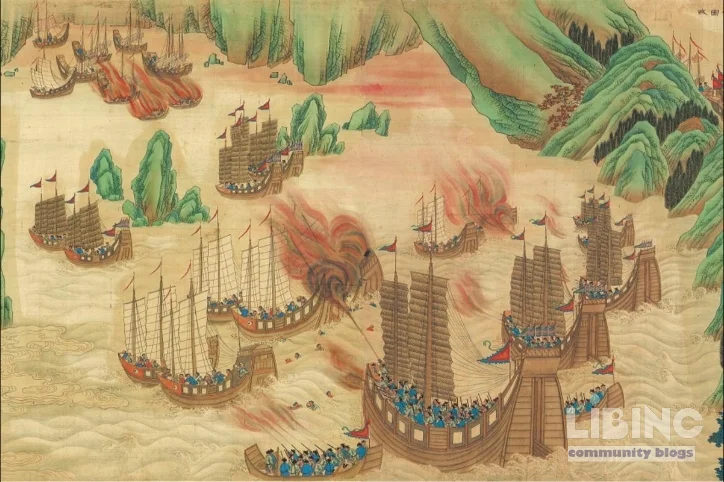
The Qing faced the sea as a social order rather than a mere border to defend. Haijin, the maritime prohibition, aimed to sever coastal livelihoods from foreign networks and to prevent piracy, but it intensified smuggling and regional autonomy. Early Manchu rulers used the ban to starve Ming loyalists and regulate contact with traders, yet enforcement proved partial and expensive. The result is a hybrid system: officials still taxed coastal traffic; smugglers, pirates, and brokers moved goods through informal channels; and the coast learned to live with risk rather than eradicate it.
- The haijin produced contingent networks that bound villages to distant markets, turning the coast into a regulated frontier with a thriving black economy.
- The Canton System formalized a controlled gateway that also served as a revenue engine and a diplomatic instrument.
- Maritime governance relied on a blend of hardware and software, combining patrols with interpreters, credits, and ritual negotiation.
The Canton System, formalized from 1757, allowed coercive oversight while granting merchants credit and routine rituals of negotiation. Merchants in Cohong guilds supplied brokers, interpreters, and credit, turning Canton into a dense node in a global trading web. But this compromise did not erase danger: pirates still haunted coastlines, and smugglers bypassed official channels, testing the limits of state power.
New fiscal rationalities accompanied these changes. Maritime revenue funded coastal defenses, local magistrates, and elite culture, tying the sea to imperial finances as a source of stability amid population growth and frontier pressure. Officials learned to leverage trade as a tool of governance rather than merely a source of disorder. The result was a governance architecture that could mobilize a coast when needed while sustaining order through everyday exchange.
Beyond regulation, maritime governance depends on the negotiation between empire and coast. Pirates, smugglers, officials, and villagers learned to adapt, creating a practical order that statutes never fully codified. This improvisation did more than keep commerce moving; it shaped how coastal communities imagined their relationship to Beijing and to distant markets. The sea thus became a classroom for governance, where policy and practice coevolved in the face of uncertainty.
Ritual and belief provided a parallel layer of control. Mazu, the Heavenly Empress, and other sea deities offered a framework for collective resilience when authorities proved distant or inconsistent. Temples, shrines, and annual festivals tied people to the water and to each other, creating social cohesion that law alone could not guarantee. In this sense, maritime governance blended formal rules with informal power, producing a hybrid order that could adapt to shifting conditions at sea.
Finally, appetite and display showed the sea’s integral role in status and culture. Shark fin, sea cucumbers, and abalone moved along networks of divers, traders, cooks, and hosts, linking coastal ecosystems to inland courts and urban elites. Consumption rituals at banquets became stages where authority met appetite, and where the empire projected refinement through ocean-derived luxuries. In short, governance at sea depended as much on taste and ritual as on patrols and tariffs.
Contrast: From treasure fleets to shadow sovereignty
The 15th-century voyages of Zheng He embodied a bold maritime vision that Qing rulers did not replicate against the Indian Ocean. Zheng He led a treasure fleet that projected imperial prestige and diplomatic ties, signaling state presence across waters. The Qing, by contrast, chose governance near the shore as their primary leverage, prioritizing local knowledge and negotiated access over distant domination. This shift did not erase maritime ambition; it redirected it toward stability, revenue, and ritual legitimacy in coastal zones.
- Zheng He’s voyages and Qing coastal governance illustrate two models of maritime power, one expansive and symbolic, the other practical and constitutional.
- South China Sea trade persisted within a framework that emphasized settlement, ritual, and revenue rather than conquest.
- The sea’s allure in Qing times resided as much in aristocratic display as in the material flow of tea and silk.
Offshore markets and ports remained hubs of exchange even as imperial attention narrowed. Foreign merchants navigated a structured yet coercive system that demanded compliance with local rituals, shipping rules, and tax regimes. The contrast shows maritime China did not retreat from the ocean; it reworked its power relations to keep pace with global currents while preserving coastal autonomy and local legitimacy.
Cause and Effect: Sea, economy, and ritual intertwined
Sea power produced feedback loops that fed state legitimacy and local livelihoods. Piracy thrived where official reach faltered; local wealth funded temples, and ritualized prayers to Mazu offered social cohesion when fleets faltered. The ritual economy of shark fin, sea cucumbers, and abalone tied coastal producers to inland elites, turning dangerous sea life into luxury consumption. When storms wrecked ships, communities responded with memorials and rituals, turning disaster into collective duty and reinforcing a sense that the ocean operates with its own logic.
- Piracy emerged as a flexible occupation at the edge of legality, enabled by local collusion and weak enforcement.
- Temple rites and Mazu worship provided legitimacy to coastal communities and offered calm in crisis.
- Demand for luxury seafood created revenue streams that crosscut official controls, binding the coast to the court and the countryside alike.
These dynamics produced a sea economy where risk became a currency. Local magistrates sometimes brokered arrangements with pirates to prevent larger disruptions, while merchants leveraged ritual capital to secure safe passage for goods. When disasters struck, coastal societies mobilized a dual memory—remembered wrecks and remembered protections—turning the sea into a moral and economic register. The coast thus remained a living laboratory for how empire and populace cohabit a volatile frontier.
Beyond profit and punishment, the sea shaped cultural life. Banquets in Canton and Suzhou displayed ocean wealth as social capital; the table became a politics of alliance, credence, and status. In this sense, appetite functioned as governance: elite taste codified who had access to the ocean’s bounty and who did not. The sea arrived in urban kitchens as a symbol of refinement and as a mechanism for social ordering, connecting distant ecosystems to metropolitan identities.
Expert Reconstruction: Re-reading maritime China beyond triumphal narratives
Historians now treat maritime China as a field where official power, local knowledge, and ritual practice braid into a single seam. The ocean embodies a form of governance that pivots on negotiation, not domination; a practice that recognizes tacit power, such as the informal authority of pirate networks and the practical literacy of Cohong brokers. The state acts through compromises rather than sheer coercion, and this is precisely how it maintains social peace on a volatile coast. Mazu’s temples, stockades at Whampoa, and banquet halls in Canton function as parallel infrastructures that extend imperial reach while maintaining everyday legitimacy on the water’s edge.
Experts now emphasize that maritime governance requires recognizing the sea’s dual character: it delivers wealth and risk in equal measure. The empire learns to harness the social capital generated by ritual and display, while still enforcing duties and tariffs. Pirate networks, shadow markets, and coastal religious practices together form a complex regulatory lattice that cities and villages navigate with a mix of fear, respect, and savvy. This is not a narrative of decline or triumph; it is a story of adaptive governance that works through ambiguity and partial control.
In this reading, the sea actively participates in statecraft. It exposes the limits of centralized power, yet it also reveals the ingenuity of communities that use ritual, commerce, and memory to stabilize life at sea. The ocean becomes a teacher about governance under pressure: formal rules must partner with informal practices, and public displays of authority must align with private economies and religious life. The result is a maritime China that remains deeply connected to the water, even as its leaders gaze toward inland frontiers and grand projects on land.
In sum, maritime China shows that empires never fully tame the ocean. They weather its chaos by weaving policy with ritual, revenue with risk, and desire with duty. The sea remains a dynamic partner in statecraft, a force that unsettles tidy narratives and invites us to see the 18th century not as a quiet interlude but as a global theatre where coast and empire co-constructed a world that was always in motion.
Integrated mechanisms: turning policy into practice along the coast
To complete the picture, a concrete lens shows how policy becomes measurable outcomes on the water. This section highlights actors, tools, and practical scenarios that coastal communities used to stabilize trade, curb disruption, and project imperial legitimacy.
| Actor | Function | Example |
|---|---|---|
| Haijin official | Restrict, tax, and align coastal traffic | Seasonal patrols plus revenue collection |
| Cohong brokers | Credit networks and negotiation | Merchant lending and ritual payments |
| Local magistrates | Enforce laws, arbitrate disputes | Coastal settlements under supervision |
| Mazu temple networks | Social legitimacy and risk sharing | Annual rituals and collective rites |
| Pirates and smugglers | Operate in informal channels | Cross-border trade via clandestine routes |
The map illustrates a living system: formal commands sit beside flexible networks. The result is a hybrid regime that mobilizes coastal resources, sustains revenue streams, and keeps channels open when state reach wavers.
Instruments at hand
- Haijin policy with local taxation
- Canton System as a controlled gateway
- Ritual networks that lend legitimacy
- Merchant incentives and divers earnings
- Coastal patrols balanced with negotiation
Practically, these tools create a rhythm of policy and hospitality: ships land, duties are paid, interpreters join the crew, and coastal communities participate in shared rituals that bind traders to local memory and to the imperial court. This balance makes risk tolerable and keeps trade flowing.
In every port, policy and practice, revenue and ritual, converge to sustain a maritime empire under the pressure of the sea.
How did the Canton System shape maritime trade and revenue?
The direct answer: the Canton System created a supervised gateway where trade occurred under state oversight and merchant credit. This framework stabilized flows and monetized coastal commerce through Cohong networks, while rituals and select privileges reinforced loyalty. In practice, revenue was steady and predictable, yet delivery times and risks remained shaped by local actors and coastal conditions. Over time, this arrangement balanced imperial control with economic vitality, allowing coastal cities to anchor broader commerce without open conquest.
Analytically, it connected distant markets to Beijing through a formal channel, while still inviting informal networks that could adapt to turning points in demand and supply. The system also embedded a structure that valued credit relations as political leverage, not merely financial transactions.
What role did ritual networks play in maritime governance?
Ritual networks offered social legitimacy and risk-sharing that law alone could not guarantee. The initial answer is: temples and festivals anchored communities to the sea and to authorities. This created trust, reduced friction among crews, and provided a buffer during storms or piracy. In practice, annual rites, processions, and offerings integrated maritime life with inland power, producing a shared culture of resilience that helped sustain traffic even when formal enforcement faltered.
From a governance perspective, these rituals were a soft power tool, aligning local interests with imperial priorities and turning sea life into a common project rather than an endless contest with the state.
How did piracy influence Qing policy and practice?
Piracy forced adaptive governance. The direct answer: officials often brokered pragmatic arrangements to minimize disruption while maintaining formal controls. Strategically, this meant balancing repression with negotiation, using magistrates to arbitrate disputes and leveraging local networks to route goods safely. In practice, piracy shaped a steady, negotiated rhythm rather than full suppression, creating a cooperative risk management system that preserved coastal livelihoods while signaling imperial reach.
Analytically, piracy acted as a stress test that revealed the strength of a coast built on hybrid authority rather than sheer force.
What is the contrast between Zheng He’s voyages and Qing coastal governance?
First, Zheng He’s expeditions represented expansive symbolic power projecting the empire outward. The direct answer: Qing governance was near-shore, pragmatic, and revenue-focused. In practice, coastal control depended on negotiation with local elites and merchants, temple networks, and ritual legitimacy to stabilize populations and revenues along the coast rather than launching distant, multilateral fleets.
Analytically, the shift reflects different strategic priorities: prestige and display in one era, stability, cash flow, and local legitimacy in another.
What lessons from maritime governance apply to modern statecraft?
The clear takeaway: successful governance blends formal authority with informal practice, and links revenue to social legitimacy. The first sentence is: integrated policy, ritual life, and market networks together create resilience on volatile borders. In practice, contemporary states can learn to map informal networks that sustain communities under stress, formalize channels that reduce risk, and invest in cultural instruments that bind diverse actors to common objectives. This balanced approach supports stability without eroding local agency.
How can modern observers quantify coastal governance in similar settings?
Direct answer: by combining revenue streams, enforcement reach, and social legitimacy indicators. Practically, analysts track duty collections, port throughput, piracy incidents, temple activity, and merchant credit flows to gauge governance performance. This multi-angled metric set helps explain why some coastal zones appear orderly despite persistent risk, and how policy flexibility underpins long-term stability.




Add a comment
To comment, you need to register and authorize
Comments
From a research standpoint, the piece offers a rich invitation to expand source material beyond official edicts and treaty-like narratives. By integrating coastal legends, temple inscriptions, and merchant correspondence, scholars could produce a more plural, performative history of maritime governance. Such work would not simply extend the chronicle of empire; it would illuminate how coastal societies maintain social peace in the face of natural and political volatility, and how they translate the ocean’s risk into a shared sense of duty and belonging to a wider political community.
Another fruitful direction is to interrogate the role of non state actors who maneuver within these systems. The Cohong brokers, interpreters, and credit networks are foregrounded as essential to maritime governance, yet less is said about everyday negotiation among fishermen, temple priests, and local elites who may have wielded influence that exceeded their official status. How did gender, kinship, and neighborhood ties shape maritime politics at the ground level? What forms of reciprocity and obligation bound these actors to Beijing, and where did autonomy become a resource in its own right? Unpacking these micro dynamics could reveal the friction between centralized policy and local adaptation, a friction that perhaps explains why the system endured despite pervasive risk.
Additionally, the ethical dimension of maritime governance deserves more attention. If ritual and display help stabilize frontiers, what are the consequences for those who are excluded from access to ocean wealth? The appetite for luxury goods binds inland elites to coastal production, yet access remains uneven. How do coastal communities articulate claims to sea wealth in a way that is just, or at least sustainable, over generations? These questions push us to consider not only how empire maintained order, but how communities experienced and contested the distribution of ocean resources over time.
The article’s emphasis on ritual and belief as parallel channels of control is especially provocative. Mazu worship, coastal temples, and annual festivals anchor communities in shared practices that sustain social cohesion when bureaucratic reach is imperfect or distant. Ritual becomes political technology, a medium through which legitimacy circulates and loyalty is reinforced without the visible trappings of coercion. This probabilistic governance—where formal rules coexist with informal authority—helps explain how coastal communities absorb risk, adapt to pirates and smugglers, and still project loyalty to Beijing. The result is a nuanced portrait of how empire persists not by erasing local autonomy but by weaving it into a broader ceremonial economy that ties appetite, display, and prestige to the state’s financial and ritual apparatus.
The discussion of appetite and display—sea delicacies as symbols at elite tables—adds a powerful dimension to our understanding of governance. Foodways, banqueting cultures, and the circulation of luxury goods become a form of statecraft, translating ocean wealth into social capital and political legitimacy. In this sense, governance at sea is not simply about regulation or revenue; it is also about shaping taste, status, and belonging. Coastal economies thus function as a bridge between inland courts and distant networks, making the sea a mediator of culture as well as a conduit for goods and taxes. The implication is that imperial legitimacy rests on a subtle choreography of enforcement, ritual celebration, and everyday exchange, a choreography that sea power makes legible even when the waves remain unruly.
This analysis also challenges triumphalist narratives that treat oceanic power as a story of conquest and distant projection. The shift from Zheng He’s treasure fleets to Qing coastal governance does not signal retreat from the ocean but a transformation in purpose and scale. The sea remains central, but its governance is recast around local knowledge, negotiated access, and revenue strategies that sustain frontiers as much as they defend borders. The maritime empire thus emerges as a constellated system in which offshore markets, coastal temples, magistrates, and Cohong brokers form a lattice of authority that is robust precisely because it blends coercion with compromise, ceremony with commerce. The image of the coast as frontier becomes more intricate when we see it as a networked political economy in which risk and prestige circulate in equal measure.
A provocative avenue for further work is to probe the lives of non élite actors within this hybrid system. Pirates, smugglers, and village mediators did not simply react to imperial pressure; they actively shaped the terms of governance through alliances, tacit understandings, and local configurations of power. How did women, fishers, and market women participate in ritual economies or in the credit networks that underpinned the Canton System? What role did clerics, temple patrons, and lineages play in stabilizing frontiers when patrolling fleets could not be everywhere at once? Exploring micro histories of particular villages, coves, or guilds could illuminate how the broader architecture of maritime governance was lived and contested on the ground. Such studies would help reveal the extent to which informal authority could anticipate or respond to formal mandates, and how memory of wrecks, protections, and divine intercession fed ongoing social peace on the water’s edge.
Finally, the piece invites methodological reflection. If the sea is a teacher of governance, then our sources must be read not only as reflections of state power but as records of negotiation, improvisation, and ritual improvisation. Maps, temple rolls, ship registers, and court archives can be read together to trace how policy and practice coevolve under pressure. In that light, the sea itself becomes a archive, and the coast a corridor where imperial legitimacy is continually renegotiated through display, credit, ritual spectacle, and shared risk. The invitation to read maritime China beyond triumphal narratives opens promising pathways for comparative work—how different empires negotiated coastal governance where formal power met the unpredictable life of the sea. We might gain fresh insights by pairing maritime China with other coastlines where similar hybrids emerged, not to claim universality but to sharpen our sense of how sea power can operate through complexity, not only coercion.