

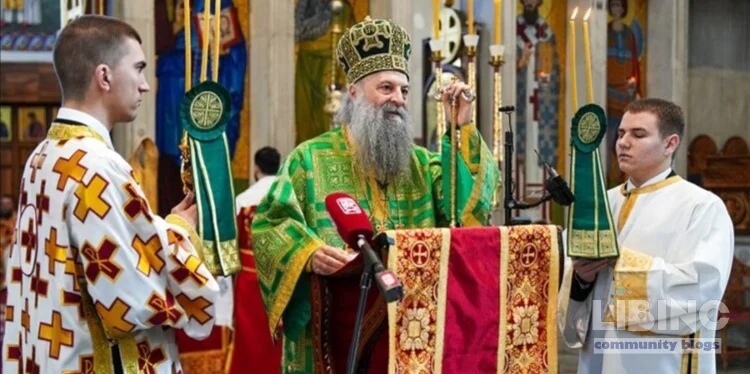
Peace as a Framework for Dialogue and Reconciliation: An Analytical Reading of Patriarch Porfirije’s Belgrade Greeting
Table of Contents
- Lead
- Analytics: Peace as a Structural Principle
- Contrast: Spiritual Diplomacy vs. Secular Realism
- Cause and Effect Relationships: From Values to Outcomes
- Expert Reconstruction: Practical Pathways for Coexistence
- Closing Reflections
Lead
Global forums confront the tension between rapid change and enduring meaning. Patriarch Porfirije's Belgrade greeting, read at the Partners in a Changing World conference, reframes peace as a discipline grounded in truth, trust, and mutual recognition. The stakes are existential: without a robust moral vocabulary, advances in technology and economics risk widening divisions rather than binding them. The hidden conflict lies in translating spiritual values into practical policy that preserves sovereignty while advancing human dignity. The direction of this analysis is to test how the patriarchs message, anchored in Saint Sava ethic of universal neighborliness, offers a blueprint for dialogue and reconciliation that can operate across Central and Eastern Europe, the Americas, Israel, and the broader Middle East. If we heed that call, change can become a source of shared life, not a pretext for confrontation.
Analytics: Peace as a Structural Principle
In the message, peace appears as a structural principle rather than a marginal outcome. The patriarch frames change under the gaze of Meaning and the Divine Logos, arguing that transformation must serve the needs of every human being: truth, peace, trust, and life in love and communion. This is not mere rhetoric; it is a policy claim. When decision makers anchor choices in these needs, social systems resist coercion and fear. The analysis below traces how this framing reshapes public discourse around security, development, and culture in the region.
To begin, the text insists that change will be blessed by God provided that they seek to satisfy fundamental and timeless needs. This reframes modernization as a moral project with verifiable criteria. Rather than equating progress with throughput or GDP growth alone, the message places human flourishing at the center of evaluative standards. In practical terms, this means secondary constraints on technology and markets: not every innovation, not every economic reform, qualifies as progress unless it strengthens truth seeking, peaceful coexistence, and neighborliness. The claim is not anti modern; it redefines modernization as a value driven enterprise with clear moral guardrails.
Moreover, the emphasis on the neighbor expands the geography of peace beyond narrow borders. The text defines the neighbor as every human being, including those who are different or difficult to understand. This universalization has analytic consequences: it creates a normative baseline for conflict resolution that transcends identity boundaries and invites inclusive security frameworks. The result is not sentimental but strategic: peace accrues where identities are acknowledged and managed through dialogue, not suppressed or weaponized for advantage.
Another thread concerns memory and historical memory. The message cautions that a people that forgets the truth about its past can hardly build its future responsibly, yet insists that truth must never become a cause for new divisions. This tension maps onto memory politics: how communities remember past harms becomes a bridge or barrier to cooperation. Institutions that privilege memory without accountability risk cycles of retaliation; those that couple memory with justice and reconciliation open durable avenues for cooperation. This suggests design principles for curricula, museums, commemorations, and transitional justice initiatives that unify rather than polarize communities. The core mechanism is trust: memory becomes a tool for peace, not a lever for revenge.
Finally, the ethical fiber of the message ties the public sphere to spiritual foundations. By invoking Saint Sava ethic of neighborliness, the text implies a governance ethos where inclusion and encounter become legitimate governance tools. In security policy, this translates into diplomacy that foregrounds personal encounter—interfaith dialogues, people to people programs, and joint humanitarian projects—as parallel tracks to treaties and sanctions. The claim is bold: moral arguments, grounded in shared humanity, can produce tangible reductions in fear and increases in credible trust between communities and states.
Contrast: Spiritual Diplomacy vs. Secular Realism
Porfirije s approach sits at the intersection of faith inspired ethics and statecraft. It contrasts with secular realism that emphasizes power balances and material interests. The analysis compares how the moral vocabulary of the Belgrade message complements or challenges the standard tools of diplomacy, development, and security policy. The central question is whether spiritual diplomacy can be operationalized as a policy instrument without slipping into sectarian rhetoric or political naivete.
Strengths and opportunities in this frame include the potential to generate moral legitimacy for peace programs, broaden the support base for interfaith diplomacy, and deepen the resilience of civil society through shared narratives. These possibilities, however, rest on careful design to avoid political instrumentalization and to ensure that religious language stays inclusive and universal rather than exclusive or coercive.
- Moral legitimacy and peace program credibility through shared values
- Interfaith diplomacy channels for people to people contact
- Memory based reconciliation strategies that respect victims and clarify responsibility
- Inclusive narratives that strengthen civil society and cross border cooperation
On the risk side, the alignment of faith based rhetoric with state policy can create friction with bureaucratic norms that demand measurable outcomes and formal authority. There is also the hazard of theological framing eclipsing practical considerations such as sovereignty, governance capacity, and balance of power. The challenge is to maintain the moral edge while ensuring that policy instruments remain transparent, accountable, and rights based. The result depends on institutions that can translate ethical commitments into verifiable actions.
In addition, the secular realism critique raises a question: can the neighbor principle survive political contestation and identity politics. The answer hinges on building durable mechanisms for dialogue that operate across religious and secular divides. The Belgrade message offers a blueprint for creating secure and stable environments in which dialogue can thrive even amid disagreement. The path forward requires sustained investment in cross faith networks, and a willingness to treat the other as a legitimate interlocutor rather than a potential adversary.
Time also matters. Spiritual diplomacy gains strength from long term commitments that survive electoral cycles. The tradeoff is the need for rapid crisis response channels that translate moral commitments into quick, tangible relief when violence or displacement erupt. Effective policy design thus blends patient, value driven diplomacy with agile platforms for humanitarian action and crisis communication.
Cause and Effect Relationships: From Values to Outcomes
The causal logic of the message connects inner virtues to outer behavior. When communities internalize truth, peace, and neighborliness, they design institutions and practices that reduce harm and expand opportunity. This section traces the chain from values to concrete outcomes in policy, diplomacy, and civil society.
- Value alignment yields new norms for diplomacy and security cooperation
- Constructive memory work builds trust across communities
- Interfaith and intercultural dialogue create channels for crisis prevention and conflict management
- Truth and justice mechanisms reduce re-traumatization and fuel reconciliation
These causal steps do not guarantee outcomes, but they increase the probability of durable peace. When communities hold to a common moral vocabulary, negotiators acquire additional leverage to resolve disputes without coercion. The effect is not merely symbolic; it translates into more predictable governance, fewer escalations, and more inclusive policies that acknowledge the rights and dignity of minorities. The analysis therefore identifies concrete policy levers that policymakers can deploy to operationalize the values articulated in the Belgrade message.
A critical chain link concerns memory and education. If schools, museums, and public commemorations emphasize truth telling together with accountability, the social climate shifts from reactivity to deliberation. The result is less stigma and more curiosity about the other. This is essential in a region with historical wounds that still color present choices. The memory framework therefore acts as both a brake and a ladder: it stops cycles of revenge while offering a structure to climb toward reconciliation through shared narratives.
The neighbor principle also expands diplomatic options. When policy makers and religious leaders treat every person as a neighbor, they create pathways for regional cooperation that include minority groups, diaspora communities, and cross border exchanges. The outcome is not a single treaty but a spectrum of confidence building measures that strengthen civil society, commerce, and cultural exchange. The implication is clear: peace requires constant cultivation, not occasional gestures or grand declarations.
In addition to policy alignment, educational ecosystems play a pivotal role. Curricula that integrate multiple histories with explicit attention to victims, accountability, and mutual responsibility cultivate a generation capable of nuanced dialogue. When youth are exposed to shared narratives that acknowledge trauma while affirming dignity, the chances of future conflict decline and the prospects for constructive collaboration rise. These effects accumulate over time, creating a civil culture resilient enough to weather disagreements without dissolving into hostility.
Expert Reconstruction: Practical Pathways for Coexistence
Operationalizing the Belgrade message calls for expert designed pathways that connect moral discourse with measurable action. The following recommendations translate the ethical core into concrete programs and governance changes.
- Establish interfaith and intercultural councils across Central and Eastern Europe, including diaspora representatives and local faith leaders
- Fund joint cultural heritage projects and co authored history education materials that emphasize shared humanity
- Integrate Saint Sava ethic into civic education, public diplomacy, and policy dialogues to normalize encounter and respect for difference
- Design truth telling and reconciliation programs that connect communities while protecting victims and avoiding re trauma
- Develop clear metrics for peace building outcomes, including trust indicators, reductions in violent incidents, and inclusive governance indices
- Promote media literacy and responsible reporting to counter fear and stereotypes that hinder dialogue
Beyond programs, governance alignment matters. Formal channels should link religious leadership with state actors, with explicit accountability, transparent funding, and long term commitments that extend beyond electoral cycles. The approach requires professional diplomacy trained in ethics, history, and conflict analysis, backed by civil society organizations that monitor progress and voice grievances. The aim is not to convert policy into ritual, but to embed moral reasoning into the mechanisms of decision making so that peace remains on the agenda even when tensions rise.
Implementation requires local adaptions. What works in Belgrade or Sarajevo must be framed through local cultures, languages, and political realities. Pilot projects with rigorous monitoring can demonstrate the viability of neighbor oriented diplomacy, while fail fast learning loops prevent wasteful investments. A sustainable plan couples big picture ethics with granular, on the ground action that communities can own and sustain across generations.
Closing Reflections
Patriarch Porfirije s message presents a cross cultural call for a new diplomacy grounded in meaning and neighborliness. It treats peace as a shared obligation and a measurable outcome rather than a remote ideal. The Belgrade sentiment invites regional and global actors to pursue dialogue with humility, memory with accountability, and cooperation grounded in universal human dignity. The implications extend beyond the Balkans to Central and Eastern Europe, the Americas, and the broader Middle East, where the same tensions between speed and ethics, openness and identity, fear and trust play out in daily life. The challenge is not only to interpret the message but to translate it into sustained practice that keeps faith and policy from drifting apart. The opportunity is bright for governance that embraces conflict as a terrain to be navigated together, and for communities that recognize their mutual destiny as neighbors in a shared world.
Closing the Practical Gap: Actionable Measures
Addressing the Belgrade message requires concrete steps that connect values to everyday life, especially for youths, educators, and community leaders. This section closes the gap by outlining scalable mechanisms that communities can adopt to translate dialogue into daily practice, with clear roles for civil society, faith communities, and local governments.
Interfaith Council Framework
| Role | Participants | Activities | Outcome | Timeline | Metrics |
|---|---|---|---|---|---|
| Regional Interfaith Council | 60 leaders, civil society | Quarterly dialogues, briefs | Sustained trust, joint statements | 12-18 months | Attendance, joint actions |
| Youth Dialogue Lab | 30 youth teams from 3 countries | Co-designed projects, camps | Youth leadership in reconciliation | 9-12 months | Projects launched, youth mobilization |
| Cultural Heritage Partners | Museums, schools, historians | Shared exhibits, curricula | Inclusive memory culture | 18-24 months | Exhibitions, curricula adopted |
| Truth and Reconciliation Education | Schools, NGOs | Truth sessions, accountability frames | Reduced retraumatization | 24 months | Surveys, incidents |
Beyond formal boards, this approach relies on dashboards that track progress and storytelling that anchors memory to accountability. Next, a compact dashboard highlights key indicators for trustworthy, people-centered progress.
Impact Dashboard
The last piece offers a practical blueprint for timelines that communities can own. A phased progression invites broad participation without tokenism.
Program Timeline
- Phase 1: Setup councils and youth teams
- Phase 2: Co-design curricula and exhibitions
- Memory and accountability projects
- Interfaith lectures
- Phase 3: Pilot exchanges and monitoring
- Phase 4: Scale and institutionalize
When implemented with local adaptation, these elements turn dialogue into daily life, building durable social fabric through neighborly action.
FAQ
Q1. What is the central idea of Patriarch Porfirije's Belgrade greeting?
Patriarch Porfirije's Belgrade greeting presents a vision of peace built not on abstract ideals alone but through concrete daily practices that invite everyone to see the other as a neighbor, to pursue honest truth telling, to grow trust through repeated encounter, and to translate spiritual values into public policies that respect dignity, sovereignty, and shared humanity, while resisting reduction to sectarian language or partisan advantage. This approach also emphasizes inclusion in decision making, people-to-people exchanges, and memory grounded in accountability.
In practice, it invites interfaith dialogue, civil society collaboration, and memory work that strengthens social cohesion rather than inflames tension. It reframes modernization as a value-driven project, with progress judged by the degree to which it enhances neighborliness and human dignity.
Q2. How does the neighbor principle influence regional diplomacy?
The neighbor principle expands the circle of legitimate partners beyond states to include individuals and communities from diverse faiths and cultures. It encourages channels for dialogue that sit alongside formal treaties, creating redundancy against crisis by fostering trust, familiarity, and shared responsibility. This approach can broaden support for peace programs, deepen civil society resilience, and provide durable social capital that survives political shifts.
Practically, it supports people-to-people programs, cross-border exchanges, and joint humanitarian projects that build credibility for formal diplomacy and reduce fear-based narratives.
Q3. What role does memory politics play in reconciliation?
Memory politics shapes how societies acknowledge harms, assign accountability, and teach younger generations. When memory is paired with justice and reconciliation, it becomes a bridge rather than a barrier. Schools, museums, and commemorations can present multiple perspectives with accountability, helping to prevent cycles of retaliation while offering pathways to shared memory and mutual responsibility.
In policy terms, this means curricula that include victims’ voices, accessible archives, and transparent processes for truth telling that avoid erasing suffering or exporting blame.
Q4. What practical steps can policymakers take to implement these ideas?
Policymakers can establish interfaith councils at regional and local levels, fund joint cultural heritage projects, and integrate ethics-inspired frameworks into public diplomacy. Key actions include co-authored history materials, victim-centered reconciliation programs, and clear metrics such as trust indicators and reductions in violence. Building long-term funding and accountability mechanisms helps keep peace-building commitments beyond electoral cycles.
These steps should be tailored to local language, custom, and governance capacity to avoid generic tokenism.
Q5. How can success be measured in this approach?
Success is measured not only by treaties but by everyday indicators: rising trust scores, more interfaith events, fewer violent incidents, and increased participation in civil society. Regular, transparent reporting and independent monitoring are essential. Surveys that capture perceived safety, dignity, and civic belonging provide a practical gauge of progress across communities.
Longitudinal studies help isolate the impact of youth engagement and education reforms on conflict dynamics.
Q6. What can youth contribute to dialogue and coexistence?
Youth bring energy, new voices, and digital connectivity that can widen the reach of dialogue. Youth-led projects—cultural exchanges, memory-sharing initiatives, and joint community service—build practical bridges and model inclusive behavior for older generations. Providing funding, mentorship, and structured platforms ensures that youth contributions become durable components of regional peace-building rather than one-off events.
Involvement of youth in policy dialogues also helps ensure that future governance remains attentive to dignity, nonviolence, and mutual respect across diverse communities.







Add a comment
To comment, you need to register and authorize
Comments
One of the central tensions is memory: communities remember harms differently, and memory without accountability can perpetuate cycles of retaliation. Yet the text also insists that memory must be harnessed for justice rather than revenge, turning museums, curricula, and commemorations into engines of reconciliation rather than battlegrounds of grievance. This requires institutions that can translate symbolic acts into accountable practices, and it invites civil society to monitor narratives as they travel from memory to policy. The neighbor principle expands peace beyond geographic boundaries and asks states to treat every person as a legitimate interlocutor, a move that aligns with inclusive security frameworks but demands political restraint to avoid instrumentalizing faith or identity for short term gain.
If we heed this call, modernization grows from moral inquiry rather than technical fixation. The challenge is to develop mechanisms that translate spiritual vocabulary into inclusive governance, where diplomacy is not just negotiation among elites but sustained encounter among communities. The Belgrade message therefore invites a discussion about the kinds of institutions, incentives, and publics needed to make peace a social practice that endures during electoral cycles, military tensions, and economic shocks. How can we design programs that preserve sovereignty while expanding the circle of neighborliness, how might interfaith and intercultural contact become routine rather than exceptional, and what kinds of accountability are necessary to prevent the sacred from becoming a cover for political convenience?