

SceneSmith and the AI-Driven Transformation of Robotic Training in Realistic Simulations
Robotics labs increasingly see robots roaming streets, yet the bottleneck remains data. Training a robot to handle hundreds of actions across diverse environments demands extensive hands-on teaching, which is slow, expensive, and error-prone when performed in the real world.
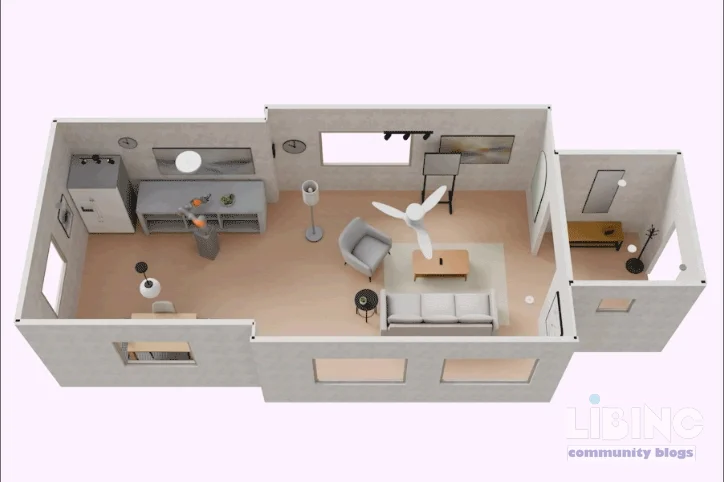
SceneSmith rises to this bottleneck by fabricating richly detailed virtual environments that mimic indoor spaces—from restaurants to bedrooms—where physics-based interactions and dense object layouts train robust policies. The result is scalable synthetic data that closes the gap between simulation and reality, enabling rapid iteration without endangering hardware or human teammates.
Analytics-driven view of SceneSmith's architecture
SceneSmith relies on a triad of vision-language model agents that coordinate to compose a scene. The designer agent sketches a layout and initial object set; the critic assesses practicality and visual plausibility; the orchestrator harmonizes feedback and decides when the design is sufficiently complete before physics assembly. This modularity mirrors human design cycles, yet scales across thousands of permutations in minutes rather than hours.
Each agent uses a multimodal prompt strategy grounded in a state-of-the-art vision-language model, GPT-5.2, allowing the system to draw on broad text-image priors. This grounding yields spatial knowledge that yields consistent object placement and feasible room configurations, bridged by a design that imitates human decision cycles. SceneSmith therefore translates abstract prompts into concrete, action-relevant layouts with surprising reliability.
As a result, SceneSmith constructs indoor settings with far greater density of objects and with manipulable assets that respond to physics constraints. For example, cabinets can be opened, bottles relocated, and tools placed on a workbench, creating a universal sandbox for robot manipulation tasks. This density matters: higher object counts increase the combinatorial challenges a robot must solve, sharpening its ability to plan, stack, retrieve, and reconfigure in diverse contexts.
Once the trio completes a scene, the geometry, materials, and physical properties feed into a physics engine to reproduce gravity, friction, inertia, and collision dynamics, producing realistic interactions that robots must learn to handle. In other words, the virtual world becomes a credible training ground, not a decorative backdrop.
In practice, researchers generated over 1,300 distinct scenes using a leading VLM with internet-scale priors, with improvisations the prompts had not anticipated. The ambient diversity surprised even the authors, expanding the repertoire of tasks robots can attempt in simulation. This breadth reduces the risk of overfitting to a narrow sandbox and improves generalization to unseen rooms and layouts.
More than 200 users evaluated SceneSmith, and nearly all judged the visuals realistic in the majority of cases—factors like lighting, clutter, and object interaction resonating with real rooms. The system also tended to follow user prompts more faithfully than competing tools, indicating robust interpretability of the AI-driven generation loop. Such responsiveness is crucial when engineers repeatedly test novel manipulation strategies in a safe, repeatable environment.
Contrasting SceneSmith with prior baselines
Compared with prior scene-generation baselines such as HSM and Holodeck, SceneSmith produces environments with more items, including settings like a private office, a pottery store, and even a Minecraft-inspired gaming room, all while preserving physical feasibility. The higher object density yields more realistic frictional and collision scenarios, which in turn sharpen a robot’s planning and control primitives.
In contrast, earlier systems often sacrificed either scalability or physical fidelity. They delivered visually plausible spaces but failed to enforce robust physics across diverse asset types, leading to policies that collapsed under real-world variability. SceneSmith’s triadic, VLM-driven workflow addresses this by tying high-level aesthetics to verifiable physics properties, so that a scene looks right and behaves correctly under dynamic interaction.
The difference shows in task-oriented tests: the scenes hold up under sustained physical interaction, not merely static inspection. Users teleoperate robots through these environments to open cabinets, store items, and navigate between rooms, validating that the scenes support real manipulation tasks rather than cosmetic simulations. The combination of density and fidelity makes SceneSmith a more reliable predictor of real-world performance than its predecessors.
These improvements extend to the practicalities of use: SceneSmith scenes tend to follow prompts more closely and can be generated with a broader variety of room typologies, including specialized retail and service spaces. The added realism also accelerates policy learning, because researchers encounter task-relevant configurations earlier in the training process, reducing the total training cycles needed to reach deployment readiness.
Cause-and-effect in robotics training pipelines
The causal chain begins with scene realism. When a virtual world faithfully mirrors real physical constraints, the policies learned in simulation become inherently more transferable to the real robot. The immediate effect is a reduction in the number of real-world trials required to validate a new manipulation strategy, lowering costs and risk for early-stage hardware deployments.
Moreover, the dense, diverse scenes produced by SceneSmith increase the coverage of edge cases during policy search. By exposing robots to uncommon configurations—unusual furniture arrangements, stacked items, or crowded workspaces—developers reduce brittleness in the face of unexpected perturbations. This broader exposure yields policies that generalize better to kitchens, workshops, and stores the robot will encounter post-deployment.
The correlation between synthetic diversity and transfer performance is not incidental. The use of ground-truth physics in the simulator creates a monotone relationship: richer virtual environments yield richer data, which translates into more robust decision-making. In effect, SceneSmith narrows the sim-to-real gap through a disciplined alignment of visual realism with physics fidelity, so that the same policy behavior emerges when a robot touches a real object or slides a cup across a table.
One observed trade-off centers on generation speed. SceneSmith’s multi-agent loop and physics-aided validation require substantial compute, so a single scene may take hours to finalize. The payoff, though, lies in fewer real-world experiments and more reliable policy evaluation, which makes the upfront cost defensible for large-scale robotics programs aiming to deploy hundreds of devices across facilities.
Expert reconstruction: implications for research and industry
Industry and academia alike see three broad implications. First, SceneSmith offers a scalable platform for synthetic data generation and policy testing that complements real-world data rather than replacing it. The ability to synthesize diverse indoor environments at scale reduces dependence on costly field campaigns while preserving a path to rigorous validation in physics-based simulators.
Second, the agentic, text-to-3D generation framework expands the repertoire of assets beyond fixed libraries. This dynamism enables researchers to prototype novel tools and interactables—such as rotating carts or deformable sponges—without awaiting vendor-specific assets or lengthy asset pipelines. The result is a more extensible toolkit for robotics research and product development.
Third, the collaboration among MIT CSAIL, Toyota Research Institute, and industry partners signals a practical route to adoption. The team’s work, supported by Amazon, the U.S. Office of Naval Research, the Toyota Research Institute, and the NSF, demonstrates a credible industrial case for deploying AI-assisted simulation environments as a core component of robotic training pipelines. As policy learning shifts toward simulation-first strategies, SceneSmith-like systems become central to reducing time-to-value for new robotic products.
Experts anticipate future improvements that expand SceneSmith’s reach. Deformable objects, more granular material models, and richer interaction primitives stand to broaden task coverage further. In parallel, researchers will seek to reduce generation latency with more efficient prompts, model distillation, and hardware acceleration, pushing toward real-time synthetic world construction. The horizon includes deeper integration with field-testing workflows, so insights from real deployments feed back into virtual environments, closing the loop between simulation and reality.
In sum, SceneSmith marks a meaningful shift in how robotic systems acquire competence. By weaving multi-agent generation, advanced VLMs, and physics-based validation into a single, scalable pipeline, the method delivers not only richer scenes but also clearer signals about which policies truly generalize. For practitioners, the takeaway is simple: invest in high-fidelity, diverse virtual environments as your primary testing ground, and let real-world testing become a targeted, high-value step rather than the default learning path.
As the field evolves, SceneSmith will likely pave the way for broader industry adoption of AI-augmented simulation, enabling faster iteration, safer experimentation, and more reliable transfer of learned skills to real robots. The result could be a future where robots learn, test, and adapt primarily inside lifelike virtual worlds before stepping into human-centered environments.
Conclusion: SceneSmith demonstrates that the bottleneck of data for robotics no longer forces the real world to be the sole classroom. By generating rich, physics-consistent virtual environments at scale, it reshapes how researchers train, validate, and deploy robotic systems, moving the field closer to reliable, everyday autonomy.
Operational blueprint for productionized robotic training
In practice, teams balance fidelity, speed, and cost. A concrete playbook helps translate SceneSmith into deployment-ready policies.
This blueprint outlines steps, measurable goals, and pragmatic scenarios that move from sandbox tests to real-world effectiveness, with examples from current robotics programs.
| Dimension | Measure | Target | How to improve |
|---|---|---|---|
| Scenes generated | Layout/asset variation | >1,000 | Expand prompts and assets |
| Fidelity | Physics accuracy | High | Refine material models |
| Transfer rate | Real-world success | 70-90% | Increase density & edge cases |
| Real-world trials | Tests count | 50 | Targeted experiments |
With a staged workflow, teams start by defining task families, generate diverse scenes, validate physics, train policies in simulation, and finally run targeted real-world checks. This cadence reduces hardware wear and speeds iterations in kitchens, stores, and workshops.
Readiness indicators
1,300 scenes tested across diverse rooms
200+ evaluators
Consistent visuals and reliable interactions across prompts
The investment pays off when policies generalize beyond familiar layouts, enabling faster transfers to real robots with fewer hardware trials. As scenes grow richer—deformable objects, granular materials, dynamic interactions—the robot's decisions prove more resilient in cluttered retail or service settings.
Process loop
| Step | Action | Time | Output |
|---|---|---|---|
| 1 | Prompt design | minutes | Layout sketches |
| 2 | Physics assembly | hours | Interactive scene |
| 3 | Policy training | days | Policy ready for trial |
Productionized synthetic environments pair visuals with physics to shorten the route to robust autonomy in real settings.
How does SceneSmith improve sim-to-real transfer for robotics?
Directly, SceneSmith improves sim-to-real transfer by tightly aligning the visual realism with physics-based interactions in dense indoor scenes, so learned policies behave similarly on real hardware. This alignment reduces real-world trial counts and accelerates iteration, enabling safer, repeatable validation of tasks like cabinet opening and object retrieval.
Beyond initial transfer, richer environments expose edge cases that sharpen generalization and resilience under cluttered conditions.
What metrics should teams track when using SceneSmith?
Direct metrics include real-world transfer success rate, policy robustness across layouts, scene diversity, and the number of hardware trials. Tracking these alongside synthetic generation pace reveals how well virtual data maps to real constraints and where to focus data augmentation.
Pair metrics with qualitative reviews of interaction plausibility to ensure both fidelity and usefulness for manipulation tasks.
How many synthetic scenes are typically generated to train a policy?
Directly, deployments often target thousands of varied scenes to cover layouts and object interactions, with a practical range of 1,000–10,000 depending on task complexity. A larger, curated set helps reduce brittleness and accelerates learning.
Start with a baseline of 1,000–2,000 scenes for core tasks, then expand to cover unusual configurations.
What are practical scenarios for SceneSmith use?
Direct examples include pantry stocking, tool retrieval in a workshop, door manipulation in offices, and store shelf reorganization. Virtual prototypes let teams validate grasp strategies, motion plans, and safety gates before hardware testing.
These scenarios support rapid iteration and help identify failure modes early in development.
How does the triad of AI agents ensure scene quality?
Direct: A designer proposes layouts, a critic checks practicality and plausibility, and an orchestrator harmonizes feedback to produce scenes that are both visually compelling and physically consistent. This loop yields prompts that generalize across rooms and tasks.
The approach reduces misalignment between appearance and behavior, boosting reliability during policy training.
What are common bottlenecks in SceneSmith workflows and how to mitigate?
Directly, compute time for multi-agent generation and physics validation can be a bottleneck. Mitigations include prompt optimization, model distillation, hardware acceleration, and targeted real-world checks to prune the search space.
Establish caching and sanity checks to avoid repeating costly configurations and accelerate iteration cycles.






Add a comment
To comment, you need to register and authorize
Comments