

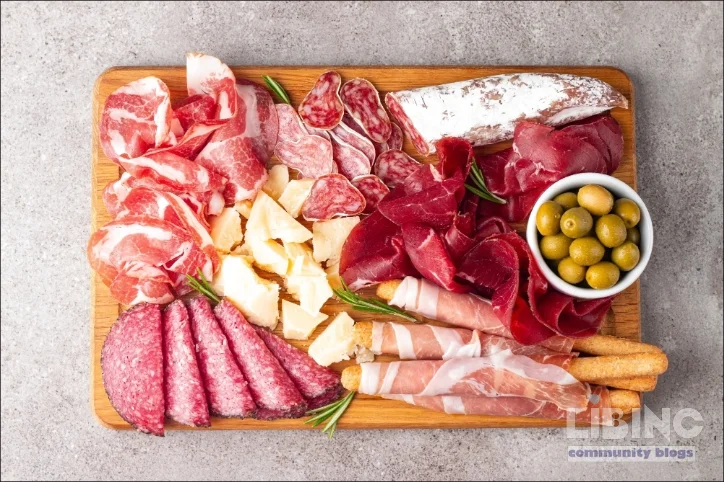
Processed Meat Cancer Risk: Mechanisms, Evidence, and Public Health Implications
Table of contents
The processed-meat cancer risk sits at the center of a complex web where chemistry, biology, and dietary patterns intersect. Nitrite and nitrate chemistry from curing can generate nitrosating agents and N-nitroso compounds (NOCs) in the gut, especially under the acidic conditions of the stomach and in the presence of secondary amines or amides. Heme iron from meat promotes endogenous NOC formation and lipid peroxidation, producing reactive aldehydes that interact with DNA. High-temperature cooking further adds genotoxic agents such as HAAs and PAHs. In short, the risk emerges from a confluence of preservation methods, cooking practices, and the surrounding food matrix, not from a single chemical identity. This article dissects those interactions, contrasts them with plant-derived nitrates, and translates the evidence into public-health implications.
Analytical synthesis of the evidence
The strongest, most consistent signal links regular processed-meat intake with colorectal cancer risk. The International Agency for Research on Cancer (IARC) classified processed meat as carcinogenic to humans (Group 1) in 2015, with volume 114 published in 2018, signaling hazard presence rather than a uniform risk across all exposures. This distinction matters: not all Group 1 agents yield the same lifetime risk; the magnitude depends on dose, food matrix, and exposure context. For colorectal cancer, the data are most robust; for extra-intestinal sites, the evidence is heterogeneous and often inconclusive. A key challenge is separating preformed nitrosamines and nitrosation potential from other meat-related factors such as heme iron, smoking, and cooking methods.
- Each additional 50-gram portion of processed meat consumed daily has been associated with roughly an 18% higher colorectal cancer risk, according to IARC estimates that synthesize prospective data.
- Meta-analyses across 60 prospective studies show elevated risks for colon, rectal, and total colorectal cancer with higher processed-meat intake, though heterogeneity remains substantial across populations and study designs.
- Gene–environment and dose–response considerations indicate that risk amplification is not uniform; it depends on nitrate/nitrite source, cooking practices, and the presence of protective dietary components.
From a mechanistic standpoint, N-nitroso compounds (NOCs) form when nitrite-derived nitrosating agents encounter amines or amides in the stomach and gut. Heme iron catalyzes both NOC formation and lipid peroxidation, the latter generating reactive aldehydes such as malondialdehyde that can form DNA adducts. Some nitrosamines require metabolic activation (for example, by cytochrome P450 2E1) to produce alkylating lesions like O6-methylguanine and related adducts, which may contribute to carcinogenesis if unrepaired. In parallel, high-temperature cooking yields HAAs and PAHs that directly damage DNA and produce mutagenic spectra independent of nitrosation chemistry. The combined effects of these pathways create a multifactorial risk landscape rather than a single causal thread.
Contrast and context: nitrates, plant matrices, and regulation
Dietary nitrates originate from both processed-meat ingredients and plant foods. In the enterosalivary circulation, salivary glands actively concentrate nitrates; oral bacteria reduce a portion to nitrite, and the subsequent acidic gastric environment forms nitrosating agents capable of generating NOCs. Importantly, nitrate and nitrite ions are chemically identical regardless of their source; differences in biological impact primarily reflect dose and the surrounding food matrix. Plant-derived nitrates, however, sit within antioxidant-rich matrices rich in polyphenols and vitamins C and E that inhibit nitrosation and can favor nitric oxide pathways instead of NOC formation. This matrix effect helps explain why systematic reviews often fail to show a positive association between plant-derived nitrate/nitrite intake and digestive-system cancers, and in some analyses hint at inverse associations for gastric cancer.
- In plant-based curing contexts, nitrite can still form during processing, even when products are marketed as natural or having no directly added synthetic nitrite; labeling does not guarantee absence of nitrosation potential.
- Global regulators set acceptable daily intakes (ADIs) for nitrate (about 3.7 mg/kg body weight per day) and nitrite (about 0.07 mg/kg bw/day); these lifetime exposure benchmarks do not translate to a per-meal risk assessment, but they frame regulatory risk management.
- Observational studies show dose–response relationships with processed-meat intake and colorectal cancer, while associations with other cancers vary by site and often show substantial between-study heterogeneity.
From a public-health angle, the practical message emphasizes reducing processed-meat frequency and quantity rather than assuming nitrate- or nitrite-free products are risk-free. Replacing cured meats with fresh, unprocessed proteins (poultry, fish, legumes) reduces exposure to preformed nitrosamines and minimizes heme-catalyzed colonic nitrosation. The plant-nitrate narrative reinforces that dietary context matters; the vegetable matrix can modulate nitrosation dynamics and, in some cases, mitigate DNA-damaging processes. Dietary fiber, in particular, is associated with protective effects on colorectal mucosa through fermentation into short-chain fatty acids like butyrate, which supports mucosal homeostasis and may promote tumor cell apoptosis when dysplasia arises.
Causal pathways linking curing processes to carcinogenesis
Unpacking causality requires tracing the sequence from processing to molecular outcomes and, ultimately, to cancer risk. The processing chain begins with curing additives such as sodium nitrite introduced to inhibit pathogens, stabilize color, and suppress oxidation. In cured meats, nitrate salts can be reduced to nitrite during prolonged curing, yielding a nitrosation-capable milieu in the digestive tract. The subsequent formation of nitrosating agents enables nitrosation of secondary amines and amides, giving rise to NOCs such as N-nitrosodimethylamine (NDMA). Endogenous pathways can further amplify NOC formation, particularly in the colon where heme iron from meat catalyzes nitrosation reactions and lipid peroxidation generates reactive aldehydes that form DNA adducts like M1-dG.
- Nitrosamines and related NOCs can be activated metabolically to form alkylating lesions such as O6-MedG and O6-CMdG, which are mutagenic if not repaired.
- Heme iron supports both nitrosation and lipid peroxidation, connecting dietary iron intake to DNA damage and mutagenesis in colonic tissue.
- High-temperature methods—pan-frying and grilling—induce HAAs and PAHs that contribute additional genotoxic stress independent of nitrosation chemistry.
The overall carcinogenic potential depends on interaction effects among additives, meat type, cooking method, and co-ingested nutrients. Quantitative attribution remains challenging due to measurement error, heterogeneity across populations, and divergent study designs. Nevertheless, converging lines of evidence support a causal framework in which nitrosation chemistry, heme-catalyzed reactions, and heat-induced mutagens cooperate to elevate colorectal cancer risk under certain exposure conditions.
Expert reconstruction: implications for public health
From a policy and public-health perspective, the aim is pragmatic risk reduction rather than absolute elimination. The most actionable guidance centers on reducing processed-meat consumption frequency and portion size, while prioritizing fresh proteins and plant-based alternatives. Limiting direct flame contact and charring during cooking lowers the formation of HAAs and PAHs, which complements efforts to mitigate nitrosation potential in the gut. A diet rich in dietary fiber supports colonic health by fostering beneficial microbiota and generating butyrate, which can help preserve mucosal integrity and promote tumor-suppressive pathways in the colorectal epithelium.
- Substitution with non-processed protein sources reduces exposure to preformed nitrosamines and minimizes heme-related nitrosation in the colon.
- Public guidance should emphasize overall dietary patterns—not just single ingredients—because risk emerges from interactions among additives, cooking practices, and nutrient milieu.
- Regulatory frameworks should clarify that ADIs describe lifetime exposure boundaries and do not equate to per-meal cancer risk; labeling should reflect residual nitrosation potential from curing methods and plant-derived ingredients alike.
Despite the coherence of mechanistic narratives, quantitative certainty remains imperfect. Future research should prioritize harmonized exposure assessment, longitudinal tracking of specific nitroso compounds in human matrices, and integration of dietary patterns with genetic and microbiome factors that modulate nitrosation, oxidation, and DNA repair processes. In the interim, a balanced message for the public is clear: moderation in processed-meat consumption, mindful cooking to reduce mutagen formation, and a fiber-rich, plant-diverse diet collectively reduce colorectal cancer risk while maintaining dietary quality and cultural acceptability.
This synthesis aligns with contemporary reviews identifying the strongest cancer signal for processed meat with colorectal cancer and highlights the multifactorial nature of carcinogenesis in the context of diet, cooking, and biological individuality.
Practical daily risk framing and meal strategies
The mechanistic picture is clear, but everyday risk hinges on how often and how much processed meat is eaten, the cooking context, and the surrounding diet. To translate this into concrete choices, consider three levers: portion size, cooking method, and the dietary matrix. Limiting cured-meat portions to roughly 25–50 g per meal and pairing them with high-fiber vegetables, legumes, and whole grains lowers nitrosation exposure and supports mucosal defenses. For example, swap a 70 g sausage for a 25 g slice with beans and steamed greens; over a week this reduces aggregate exposure even if protein intake remains adequate.
| Scenario | Processed-meat portion (g) | Nitrosation potential | Mitigating factors |
|---|---|---|---|
| Low exposure | 25–50 | Low | High-fiber side |
| Moderate | 75–100 | Moderate | Plant-rich matrix |
| High | 125–150 | High | Limited fiber |
Concrete meal patterns to apply this week:
- Scenario A: 40 g cured meat with a large bean and vegetable plate, plus a whole grain side.
- Scenario B: 0–25 g cured meat on days with fish, legumes, and leafy greens.
- Scenario C: Plant-forward days that replace cured meats with tofu, tempeh, or lentils.
- Plan portions
- Set a target of 25–50 g per meal
- Reserve cured meats for occasional indulgences
- Choose cooking methods
- Avoid direct flame on meat
- Prefer simmering, baking, or steaming
- Balance with fiber
- Include vegetables, beans, and whole grains
In summary, the best public-health approach combines smaller cured-meat portions, gentler cooking, and fiber-rich plant foods to reduce cancer-risk signals while supporting overall dietary quality.
What is the strongest evidence that processed meat increases colorectal cancer risk?
Across hundreds of prospective studies, the strongest and most consistent signal is that regular consumption of processed meats is associated with a higher risk of colorectal cancer, particularly for cancers of the colon and rectum, with a typical estimate around an 18 percent increase for each additional 50 grams per day of processed meat, even after adjusting for age, BMI, smoking, and total energy intake. This estimate is supported by mechanistic plausibility via N-nitroso compound formation, heme iron catalysis, and mutagenic compounds created during high-temperature cooking. The evidence is strongest for colorectal cancer and more variable for other sites, reflecting heterogeneity in exposure and biology.
How do nitrates and nitrites in cured meats contribute to nitrosation and cancer risk?
Across diverse cohorts, nitrite derived from curing salts can form nitrosating agents in the stomach and intestine, enabling nitrosation of amines and amides to yield N-nitroso compounds that have mutagenic potential. The first sentence of the answer summarizes the core pathway and the breadth of observational signal; the following sentences emphasize metabolic activation and dietary context. The magnitude of risk depends on dose, the food matrix, and coexisting nutrients that may inhibit or promote nitrosation, making risk assessment inherently nuanced rather than universal across all cured products.
Do nitrates from vegetables pose the same risk as those in processed meats?
Vegetable-derived nitrates enter a matrix rich in antioxidants, polyphenols, and vitamin C that can inhibit nitrosation and promote nitric oxide pathways, which may offset potential risks. The per-meal risk is therefore not identical to cured meat exposure, and many reviews note neutral or even inverse associations for gastric cancer with plant-based nitrate intake. The overall takeaway is context: the same chemical could have different biological outcomes depending on food matrix, timing, and overall diet quality.
What practical steps can I take to reduce risk in daily meals?
The first sentence presents a broad strategy for reducing risk in everyday eating, followed by concrete steps that can be implemented now. Practical actions include limiting cured-meat portions to 25–50 g per meal, pairing meals with high-fiber vegetables and legumes, using gentler cooking methods, and choosing plant-forward or fish-based meals on most days. In addition, regular fiber intake supports mucosal health and may help mitigate mutagenic effects. These steps translate abstract mechanisms into workable daily choices that fit many dietary patterns.
Does cooking method affect formation of HAAs and PAHs?
The first sentence notes that high-temperature cooking elevates genotoxic compounds such as HAAs and PAHs, with subsequent sentences offering practical mitigation: avoid direct flame contact, flip meat frequently, trim drippings, and prefer baking, steaming, or sous-vide finishes before a quick, light sear. The overall message is that cooking style can materially influence mutagen exposure in a real meal context, and small changes can meaningfully reduce risk without sacrificing flavor or enjoyment.
What should consumers know about regulatory limits and product labeling?
Regulators set ADIs for nitrate and nitrite based on lifetime exposure, which does not translate to per-meal cancer risk. The first sentence clarifies this distinction; the following text emphasizes that labeling does not guarantee the absence of nitrosation potential in cured products and that consumer guidance should consider the whole diet, not just a single ingredient. Practical takeaways include choosing products with minimal processing where possible and prioritizing whole-food protein sources most days.





Add a comment
To comment, you need to register and authorize
Comments