

Poetry in Education: A Multidisciplinary Field Trip Blending Theatre, Art, and Nature
Analytics of Poetry in Education: Why a Multidisciplinary Field Trip Works
At year’s end, a trio of colleagues and I mapped a field trip that could do more than check boxes on our schedule. We planned to visit a downtown theater, stroll a park along Deschutes River, and pause to notice water with poetry as a guiding light. The aim was to blend theatre, nature, and language into a single, sustained experience for our third-graders.
In practice the plan demanded patience with curriculum constraints and a belief that poetry in education can unlock deeper learning. We used sensory observation, spoken figurative language, and visual art as sources of ideas, then threaded those ideas into concrete poetry for Art Night. The result would be a collaborative, multidimensional experience that kept students engaged, curious, and ready to share.
Analysis begins with a simple idea: students learn by doing and by moving between places. The field trip fused three modes of learning—theater observation, park literacy, and water observation—to build language, attention to detail, and willingness to take risks with words. This approach also reveals the challenge of aligning field experiences with our literacy unit and the constraints of time, safety, and assessment.
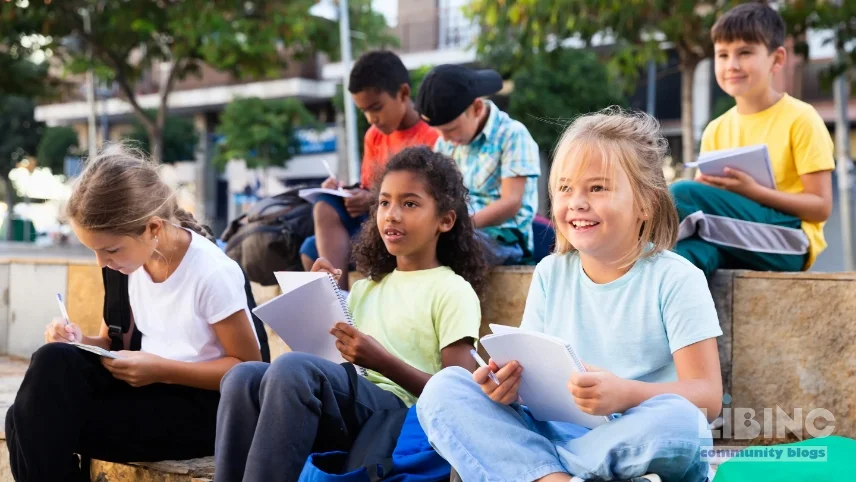
On site, Karen's art activity invited us to draw the river's edge, then fold and rub to make a mirror image. The activity fused visual arts with tactile exploration and visual analysis, an explicit example of art integration. I guided students to record what they saw and how those sights felt, encouraging sensory observation as the engine of poetry in education. The sharing session built confidence in spoken figurative language as students described how "the river slows into a glassy path" or "the trees hold up a green umbrella."
Back in class, the focus shifted to strengthening figurative language. We modeled turning observations into similes, then encouraged students to stretch those ideas into metaphors that could live on a poster or a line of verse. We discussed how a tree "is an old man's hand" becoming "the woody hand of an ancient leaf-warrior," and we invited students to test variations, preserve punctuation, and build a rhythm that supports meaning.
To honor the trip's experience while meeting time limits, we introduced concrete poetry: turning a single sentence into a shape that mirrors its subject. Students learned to choose line breaks, punctuation, and spacing to suggest movement—shape as meaning. We looked at examples from earlier teacher models and then encouraged each student to craft a line that could be stretched into the silhouette of a BMX bike or a leaf, before sharing at Art Night.
Contrast with Traditional Literacy: Seeing How Different Approaches Drive Learning
This experience stood in contrast to more traditional literacy lessons focused on nonfiction reports and grammar drills. In the past, students drafted paragraphs from a prompt and hurried to publish; here they paused to listen, observe, and speak first. The field trip demanded a different kind of patience from students and teachers alike.
Yet the gains go beyond vocabulary growth. The approach embodies multidisciplinary learning and art integration, linking literacy with drama and visual arts. By inviting sensory observation and auditory narration, students developed a richer lexicon and a more confident voice. The practice also supports social-emotional learning as students listen to peers, negotiate meaning, and celebrate each other’s ideas.
Challenges emerged, too. The field trip required chaperones, permissions, and a clear safety plan, all while we kept pace with a closing literacy unit. An absent student on the day of the trip forced us to adapt the plan and still produce an outcome, like the BMX bike poem later, that showed effort can be captured in diverse forms.
Despite the obstacles, the team leveraged the trip's momentum to strengthen the link between field experiences and classroom outcomes. We used a focus on concrete poetry to translate on-site impressions into visual forms for Art Night, a natural extension of the learning cycle. The result was a portfolio of poems that spoke through shape, rhythm, and metaphor, reinforcing the value of poetry in education.
Cause and Effect of Field-Based Learning: How Experiences Shape Language and Imagination
From planning to execution, the chain of actions created clear causal links between experience and language growth. The field trip provided authentic contexts that demanded precise observation, careful verbal description, and deliberate revision. When students returned to the classroom, the notes from the park, stage, and river supplied material for expanded sentences and more adventurous word choices.
Observational notes show students used sensory-based writing more freely after the park visit. They described textures, sounds, and movements with vocabulary that distinguished their statements from previous writing. When prompted to use personification or metaphor, hesitant writers produced longer, more connected sentences, validating the idea that authentic experiences drive language development.
Teacher modeling played a central role in building confidence. I narrated my own thinking aloud, then invited students to offer their interpretations. The shared practice created a norm for respectful critique and built a culture where ideas could be tested and revised.
Over the long term, the pattern of field experiences supporting poetry in education creates durable habits of mind across subjects. Students continue to draw on metaphor, simile, and concrete poetry in science notes, social studies, and reflective journals, widening the scope of literacy to include visual and performative elements.
Expert Reconstruction and Replication: How to Reproduce in Other Classes
How would you reproduce this in another classroom? Start with a shared purpose, secure a safe outdoor space, and plan a minimal equipment kit that invites observation and improvisation.
Create a compact, repeatable protocol: assign roles, set a sensory observation notebook, and prepare an open-ended prompt that can yield similes or metaphors. Tie the trip to your literacy unit through a planning sheet that records "What do we see?" and "What do we hear?" Then model the thinking aloud so students adopt a similar voice, supporting the development of poetry in education.
Include a pre-visit meeting with families, a simple safety plan, and a post-visit debrief that surfaces students' preferred modes of expression—whether oral, written, or visual. The flexibility keeps the project aligned with diverse needs and keeps the focus on meaning, not form.
Finish with a public showcase that blends performance and display, such as an Art Night where poets read and visuals accompany the lines. The staging reinforces the idea that poetry in education thrives when ideas travel from field to paper to audience, and that concrete poetry provides a visible, shareable outcome.
Conclusion: This field trip demonstrates that well-planned, multidisciplinary experiences can make poetry a living, learning force in the classroom. When teachers design with purpose, students transform experiences into language, and language into insight that lasts beyond the school year.
Standards Alignment and Impact Measurement
To scale this approach, teachers should tie field-based poetry experiences to clear literacy targets and provide evidence of growth. An experiential learning framework helps meet core language arts goals while prioritizing equity, accessibility, and cross-curricular relevance. This section adds a practical, standards-focused plan that complements the on-site work and offers concrete rubrics and examples.
Key pathways include aligning with universal language standards, using rubrics that capture voice, imagery, and social collaboration, and documenting progress through portfolios and reflexive writing. For practical impact, map activities to a simple 1-week cycle: pre-visit inquiry, on-site observation, post-visit synthesis, and public sharing. Each phase yields artifacts that demonstrate growth in reading, writing, speaking, and listening, plus cross-cutting skills like collaboration and critical thinking.
- Alignment with standards: link on-site tasks to literacy targets (vocabulary, figurative language, evidence-based description) and speaking/listening benchmarks. Use a short mapping sheet to show how each activity touches a standard.
- Assessment rubrics: employ a 4-point rubric for voice and imagery, structure and rhythm, creativity, and collaboration. Rubric anchors should be visible to students before each activity.
- Equity and accessibility: provide varied modalities (audio, visual, text), offer prompts in multiple languages, and allow alternative outputs (oral retell, video, illustrated poem) to capture diverse strengths.
Practical examples: Pre-visit prompts ask students to collect three sensory words from a park scene; on-site tasks require a paired description using at least two similes; post-visit products include a portfolio page with a concrete poem and a short reflection. A sample 1-week plan helps teachers coordinate field experiences with a literacy unit while maintaining flexibility for diverse classrooms.
- Reading: Identify descriptive language and infer meaning from poetry.
- Writing: Produce concise and vivid lines using simile and metaphor.
- Speaking & Listening: Present observations clearly with peer feedback.
| Phase | Activity | Skills Targeted | Evidence | Time | Safety/Accessibility |
|---|---|---|---|---|---|
| Pre-Visit | Alignment planning and prompts | Literacy, Speaking | Plan document, rubrics | 1–2 days | Permission and accessibility review |
| On-Site | Sensory observation walk | Observation, Vocabulary | Field notes | 90–120 min | Safety briefing, buddy system |
| Post-Visit | Concrete poetry drafting | Figurative language, structure | Drafts; quick feedback | 60–90 min | Accessible formatting options |
| Exhibition | Art Night presentation | Public speaking, collaboration | Performance and posters | 2–3 hours | Quiet space; captioned displays |
| Reflection | Portfolio and reflection entry | Meta-cognition, vocabulary growth | Journals, portfolios | 45–60 min | Multiple output formats |
By embedding these practices, teachers can trace how field experiences propagate into classroom language and across subjects, providing a durable, scalable model for poetry in education.
Impact Metrics and Differentiation
To demonstrate value, collect short, repeatable measures that reflect both skill gains and student agency. Use exit tickets focusing on one metaphor or one sensory detail, track progress across a few cycles, and compare initial and final artifacts. Differentiation should be explicit in prompts and expected outputs, allowing bilingual, visually oriented, and orally driven demonstrations of understanding.
Reproducible Protocol (for replication in other classes)
Preparing a compact, repeatable protocol enables other teachers to adapt quickly. The following checklist supports consistency without sacrificing creativity.
| Step | What to Do | Artifacts | Notes |
|---|---|---|---|
| 1 | Define purpose and standards alignment | Planning sheet | Keep prompts short and target one standard per activity |
| 2 | Assign roles and prepare sensory prompts | Notebook, prompts | Roles rotate to build leadership skills |
| 3 | Capture on-site observations | Field notes, photos | Respect safety and privacy |
| 4 | Translate to tangible outputs | Concrete poetry and posters | Offer multiple output formats |
This pragmatic protocol preserves the learning arc while enabling adaptation across classrooms and contexts.
What are the benefits of a multidisciplinary poetry field trip?
Experiential learning blends theatre, nature, and language to boost observation, vocabulary, and expressive confidence. Students practice listening, describing, and interpreting, while building collaboration skills through shared creation. This integrated approach often leads to deeper engagement and transferable language abilities across subjects.
In practical terms, students move from sensory noticing to poetic construction, then to public sharing, which reinforces self-efficacy and social-emotional growth.
How can teachers align this approach with standards and assess progress?
Use a simple standards map that links each activity to literacy targets (reading, writing, speaking and listening). Employ a 4-point rubric for voice, imagery, structure, and collaboration, and collect portfolios and reflective notes as evidence. Regular, short checks (exit tickets or quick prompts) show growth over time.
Assessment should emphasize process as well as product, with peer feedback guiding revision and iteration.
What safety and accessibility considerations should be planned?
Develop a clear safety plan, obtain necessary permissions, and designate chaperones. Ensure accessible formats for prompts and outputs (audio, large print, bilingual prompts). Provide flexible timelines and alternative spaces for students who need them to participate meaningfully.
Inclusive planning helps every student contribute to the learning community.
How does this approach support students with different learning needs?
Multimodal outputs (oral, written, visual) allow students to demonstrate understanding in the mode that fits them best. Differentiation through prompts, partner work, and scaffolded writing supports learners at varied levels while maintaining high expectations for all.
Equity-focused design ensures every student can access meaningful poetry experiences.
How can field-based poetry be scaled to different grade levels?
Adjust prompt complexity, grouping, and outputs to suit age and curriculum. For younger grades, emphasize sensory description and concrete poetry; for older students, incorporate advanced metaphor, research-based evidence, and multi-genre presentations.
Cross-curricular prompts (science observations, social studies context) expand relevance and depth.
What metrics show impact over time?
Track short-term gains via exit tickets, quick journals, and performance rubrics; monitor longer-term impact through portfolios, science notes, and reflective journals. A steady pattern of revision and public sharing indicates durable growth in language and interpretive skills.
Regular review of artifacts helps teachers demonstrate learning trajectories to families and administrators.
What are low-cost ways to start?
Use nearby parks, local theatres, or school grounds as learning spaces; leverage volunteers and student leaders; reuse simple materials and prompts. A starter kit with notebooks, pencils, and flexible prompts keeps costs down while preserving instructional quality.




Add a comment
To comment, you need to register and authorize
Comments